Get the free daily rdnewsNOW newsletter by subscribing here!
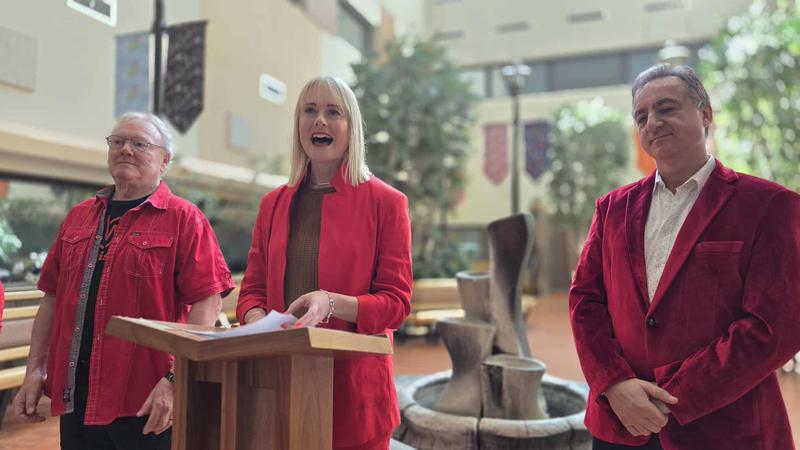
L-R: 'Time is Life' co-founders, Harley Hay, Vanessa Higgins-Nogareda, and Dr. Gustavo Nogareda, who on May 22 announced a $30,000 contribution to the Red Deer Regional Health Foundation for the interim catheterization lab coming to Red Deer Regional Hospital Centre by early 2027. (rdnewsNOW/Josh Hall)
$30,000

‘Time is Life’ group makes substantial contribution to Red Deer’s interim cath lab efforts

May 22, 2025 | 7:43 PM

Advocacy group ‘Time is Life’ presented a cheque for $30,000 on Thursday to the overall fundraising effort for an under construction interim cardiac catheterization lab at Red Deer Regional Hospital Centre (RDRHC).

The lab is slated to open in spring 2027, about five or six years ahead of when the overall $1.8 billion hospital redevelopment is scheduled to be finished.

When that happens, the interim cath lab will be replaced by two permanent ones.

But at $18 million in capital costs, the interim lab will take any contributions it can get, and that includes from some of the people who’ve pushed the hardest to make it a reality at ‘Time is Life.’

It was noted during the presentation that the Red Deer Regional Health Foundation (RDRHF), which is the entity collecting the money for capital costs, currently sits at a bit over half of what they need, with more big fundraisers to come. In March, it was announced the local philanthropic Donald family was contributing $10 million towards the project.

Operational costs are being put up by the provincial government.

“This is a significant project, and at the end of the day, every donation from our community is going to count,” said Manon Therriault, CEO, RDRHF. “It’s a collective effort. It’s a project championed by our community, and it will be funded by our community.”

Meantime, one of the folks who co-founded ‘Time is Life,’ that being Dr. Gustavo Nogareda, reminded that this lab, and the permanent ones to come, mean to level the playing field between Red Deer and the big cities.

The per capita number of cardiologists in Calgary and Edmonton is roughly five times that of Red Deer, and, he added, 150,000 people is typically when a region becomes qualified to have a cardiac catheterization lab.

Red Deer Regional, serving around half a million people in central Alberta, surpassed that mark long ago.

“Whatever piece of data you use to look at this, we’re dealing with sicker people, we’re dealing with receiving very little investment in health infrastructure historically, and we have [therefore] been unable to attract the people with the proper expertise because they wouldn’t have the tools to do the job properly,” said Dr. Nogareda, who’s been at RDRHC for 18 years.

“A graduate who finished yesterday, they can say ‘I can live in Edmonton or Calgary which is where I trained, my family is here, and I can do 10 surgeries a week; why go to Red Deer where I can only do one, and I have to move my family?’

“So if we have the infrastructure, we can attract those people because they can practice with the full spectrum of their skills.”

Red Deer-North MLA Adriana LaGrange, who was shuffled this week from the former ministry of health to the new Ministry of Primary and Preventative Health Services, shared remarks Thursday.

“This is more than just an achievement, it’s a beacon of hope, a testament to perseverance, and a victory for every individual who believed in the necessity of life-saving intervention right here in our community,” she said.

Dr. Nogareda also described the project as common sense given the travel cut out each year from Red Deer to Edmonton or Calgary — once the lab is finished — will save roughly $4 million. The cath lab itself costs about $5 million annually to operate.

Red Deer Mayor Ken Johnston, who spoke Thursday, and also when the interim lab was announced last October, added that the lab and redeveloped hospital, once complete, will — “capital W-I-L-L,” he stated — make for a centre of medical excellence in western Canada.