
Subscribe to the 100% free rdnewsNOW daily newsletter!
Sponsored

Market Watch: May 16

May 20, 2025 | 1:35 PM

This week’s highlights

  • Equity markets continue their advance amid tariff reduction
  • Bond yields move higher despite lower-than-expected inflation prints
  • U.S. tariffs begin to squeeze Canada’s labour market, jobless rate rises to 6.9%
  • U.S. monthly inflation picked up in April in midst of tariff swings
  • Eurozone growth weaker than expected at start of 2025

Week in review

Equity markets continue their advance amid tariff reduction

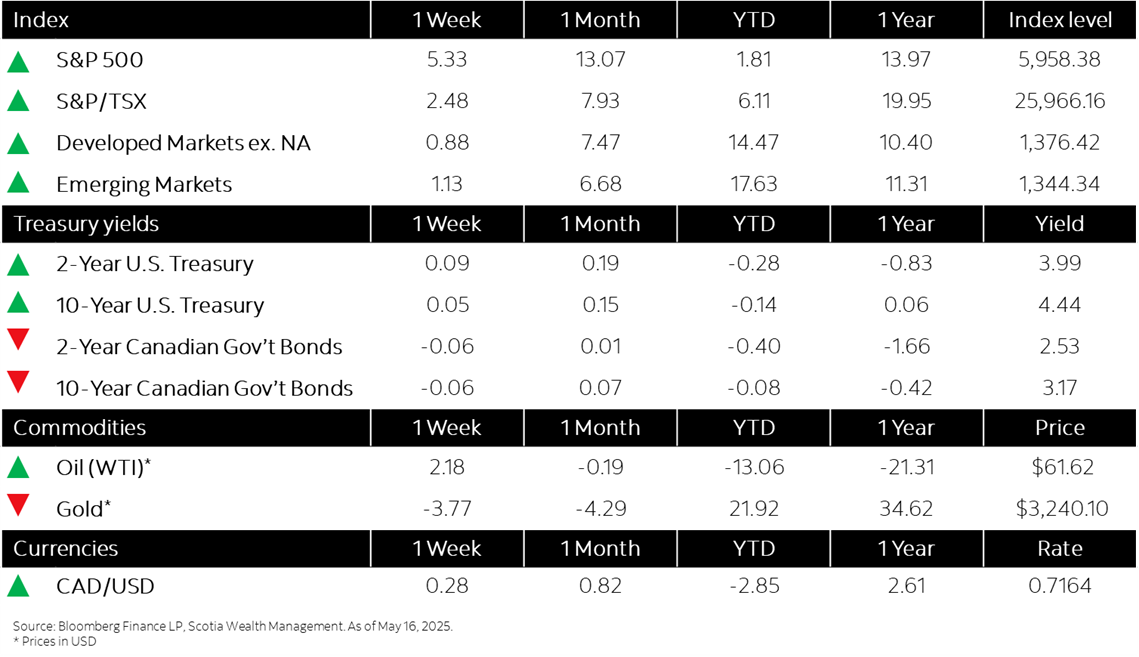
Equity markets began the week on a strong note globally, buoyed by the U.S.-China 90-day tariff truce, which lifted sentiment and drove gains in U.S. mega-cap tech stocks, though momentum faded midweek. In the U.S., softer-than-expected Consumer Price Index (CPI) and Producer Price Index (PPI) prints initially supported rate cut hopes, but mixed retail sales and corporate earnings, including UnitedHealth’s guidance suspension and Walmart’s tariff-related price warnings, tempered enthusiasm. Canadian equities tracked U.S. moves, with investors responding positively to the tariff related news, while markets prepared for next week’s CPI release. In Europe, equities rose early on easing trade tensions and stable inflation data, but gains moderated as U.K. labour and GDP data pointed to fragile growth. In China and emerging markets more broadly, optimism from the tariff reprieve was tempered by weak credit data, highlighting subdued private sector demand despite expectations for improved market sentiment over the coming months on the heels of monetary easing.

Highlights:

  • U.S. markets returned 5.33%1 for the week, rallying early in the week on easing trade tensions with China and soft inflation data, but gains faded as weak retail sales and cautious corporate guidance raised concerns about consumer resilience and future growth.
  • Canadian markets returned 2.48%2 for the week, hitting a new all-time high, lifted by global trade optimism and stable inflation expectations as investors positioned ahead of the upcoming CPI release.
  • European markets returned 0.88%3 for the week, advancing on improved global risk sentiment and inflation data, though momentum slowed as U.K. labour market weakness and GDP details pointed to fragile domestic demand.
  • Emerging markets closed 1.13%4 higher following the tariff pause, but enthusiasm waned mid-week as China’s April credit data revealed weak private sector borrowing, highlighting persistent domestic fragility.

Bond yields move higher despite lower-than-expected inflation prints

U.S. fixed income markets were initially pressured by the U.S.-China tariff truce and strong risk sentiment, but yields retreated midweek as softer-than-expected CPI and PPI data revived expectations for late-year Federal Reserve (Fed) rate cuts. Canadian yields followed a similar path, rising early on global trade optimism before moving lower ahead of next week’s CPI release and the Victoria Day holiday. In Europe, bond markets rallied modestly as inflation data came in largely as expected, while weak U.K. labour and GDP figures reinforced the case for continued policy easing. In China and emerging markets, weak April credit data signaled subdued private sector borrowing, reinforcing expectations for further monetary easing, though sovereign yields remained relatively stable amid cautious sentiment.

Highlights:

  • The 2- and 10-year U.S. Treasury yields rose by 9 basis points (bps) and 5 bps, respectively. In Canada, the 2- and 10-year yields were both down 6 bps. Bond yields and prices move inversely to one another.
  • Despite softer CPI and PPI prints and retail sales, investors have pared back expectations for monetary policy easing from the Fed. An improving growth backdrop has lifted the lid on energy prices which is expected to contribute – among other things – to a somewhat higher inflation outlook.
  • Credit spreads remained firm, currently trading close to the middle of the 3-month range. New bond supply ran ahead of projections for both investment and speculative grade new issuance. The primary market was quiet late-week following a flurry of activity as companies rushed to lock in relatively attractive borrowing costs.

Weekly dashboard

U.S. tariffs begin to squeeze Canada’s labour market, jobless rate rises to 6.9%

Canada lost more than 30,000 manufacturing jobs last month, and Windsor, Ontario, saw a jump in its unemployment rate as U.S. tariffs targeted the automotive sector and fed economic uncertainty. Statistics Canada’s Labour Force Survey reported that employment increased by 7,400 nationally, though an increase in election-related hiring padded that figure. The overall unemployment rate rose to 6.9%, up from 6.7% in March.

Highlights:

  • The latest jobs figures illustrate how tariffs are beginning to squeeze the Canadian economy, affecting regions and industries most exposed to trade with the United States.
  • Ontario saw the largest decline in employment, falling by 35,000, with most of those job losses in the manufacturing sector. In Windsor, a major hub for the automotive industry, the unemployment rate jumped 1.4%, reaching 10.7%.
  • Economists expect global trade tensions, in addition to the U.S. tariffs imposed on Canada specifically, to further weigh on the economy in the coming months and drive up the unemployment rate to more than 7%.

U.S. monthly inflation picked up in April in midst of tariff swings

U.S. monthly inflation picked up slightly in April, a month when businesses were pulled back and forth as they tried to adjust to President Trump’s unpredictable trade policies. According to the U.S. Labor Department, the consumer price index rose a seasonally adjusted 0.2% in April, slightly below the forecasts of economists. April was a particularly back-and-forth month for Trump’s tariff policies. At the start of the month, he announced 10% tariffs on all imports and more severe tariffs on many countries. He soon paused many duties, though he raised tariffs on goods from China to 145%. However, this week, the U.S. and China temporarily agreed to slash tariffs on each other’s products.

Highlights:

  • Year-over-year inflation cooled to a 2.3% increase in April, below the 2.4% that economists had expected and below March’s annual rate. A big decline in gasoline prices helped pull that rate lower.
  • Prices excluding food and energy categories, the core measure economists watch to better capture inflation’s underlying trend, rose 2.8%. That matched economists’ forecasts.
  • The 2.3% annual inflation rate was the lowest rate since February 2021, right before supply-chain snarls and pent-up consumer demand sent inflation soaring.

Eurozone growth weaker than expected at start of 2025
The eurozone economy grew less rapidly than first estimated at the start of the year, despite a boost to factory output as American firms raced to stock up on imports ahead of the imposition of trade tariffs. Gross domestic product (GDP) was 0.3% higher across the 20 members of the eurozone in the quarter through March, according to figures released by EU statistics agency Eurostat. In a previous estimate, GDP was calculated to have grown 0.4%. Part of that lower estimate is down to a contraction in the economy of Slovenia, for which Eurostat previously didn’t have an estimate.

Highlights:

  • Growth was boosted by a continued increase in industrial production through the quarter. In March, output rose 2.6%, much sharper than the 1.1% rise expected by economists, marking a third-straight month of increased output.
  • March’s higher output was driven by a more than 3% increase in production out of Germany, Europe’s industrial powerhouse, and Ireland, a hub for pharmaceutical production, where output was some 15% higher than a month earlier.
  • The step-up in production could prove short-lived as U.S. warehouses grow full, and tariffs are likely to dampen American demand for European goods, despite the pause on sweeping 20% tariffs on all EU imports. A 10% baseline tariff remains, as do 25% duties on cars and some metals.

Investment Bonanza or Shimmering Mirage

This week’s risk dashboard:

  • Will Trump’s investment haul be an economic bonanza?
  • Canadian CPI may see core prices crowding in the carbon tax cut
  • RBA could cut, but data could drive another surprise
  • Bank Indonesia has the rupiah on its side, but also loves a good surprise
  • BoC’s last chance to influence June expectations

Read the full report here

  • Global PMIs to offer further soft data evidence on tariff effects
  • UK CPI to spike on higher energy price cap
  • NZ Budget to add blended stimulus
  • China prime rates to be lowered
  • Canadian markets shut on Monday
  • Other global macro