Subscribe to the 100% free rdnewsNOW daily newsletter!
(rdnewsNOW/Sheldon Spackman)
62 Per Cent In the Bin

Local harvest well ahead of five-year average

Sep 16, 2022 | 2:00 PM

Low temperatures and light frost have been reported in some parts of the central Alberta region as harvest continues throughout the prairies.

According to the latest Crop Report from Agriculture Financial Services Corporation (AFSC) and Alberta Agriculture, Forestry and Rural Economic Development, a few scattered showers slowed down harvest, yet producers combined an additional 23 per cent of their major crops in the Central Region of the province.

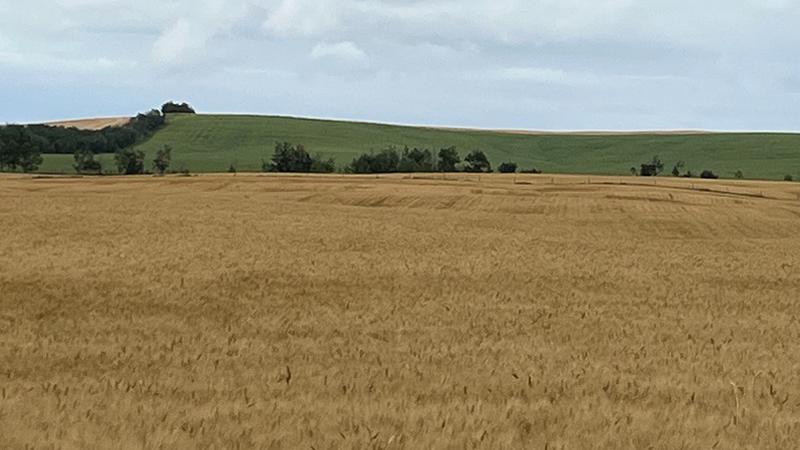
The local harvest is well underway, with 62 per cent of major crops in the bin, well ahead of the 5-year average of 39 per cent. About 16 per cent have been swathed and 22 per cent are still standing.

About 96 per cent of dry peas, 78 per cent of spring wheat, 83 per cent of barley and 58 per cent of oats are now in the bin. Almost 25 per cent of canola has been harvested and another 38 per cent is said to be in swath.

Provincially, officials say the weather remained warm and dry, and harvest advanced substantially (by 25 per cent from a week ago). Overall, about 59 per cent of major crops have now been combined, ahead of the 5-year and 10-year averages of 36 per cent. About 17 per cent of major crops are in swath and 24 per cent remain standing.

Over the past week among regions, producers in the Peace Region are said to have made the most significant progress (harvesting an additional 39 per cent), followed by producers in the North East Region (advancing progress by 31 per cent) and Central Region (harvesting a further 23 per cent). Harvest in the South and North West Regions advanced by 17 per cent. Compared to the 5-year averages (2017-2021), harvest progress is ahead for all regions. Harvest progress in the South is said to be similar to last year, while in the Peace, it is ahead.

Compared to the long-term normal, growing season precipitation accumulation has been near normal for most parts of the province, except for the North West Region, northern and western parts of the North East Region and the southern half of the Peace Region, where precipitation has been moderately low. However, over the past 60 days, conditions turned dry in much of the province. For most parts of the province, the past 60-days precipitation accumulation relative to normal has been either low, very low, or in some spots, extremely low. The only exception was for the South Region, where it was near normal.

Dry conditions from mid-July have led to the depletion of soil moisture reserves, but June rainfall contributed to the 2022 growing season. Also, there is still ample time between now and the 2023 growing season to build soil moisture reserves and surface water supplies to an acceptable level. A relatively wet and warm fall would help alleviate moisture stress for pastures and hay land, officials further point out.

Currently, pasture and hay growth is generally slow, and in the case of pasture, it is being grazed with no recovery. In some areas, livestock are moving onto harvested fields. Provincial pasture growing conditions are now rated as 29 per cent poor, 51 per cent fair, and 20 per cent good, with similar ratings for tame hay.