Subscribe to the 100% free rdnewsNOW daily newsletter!
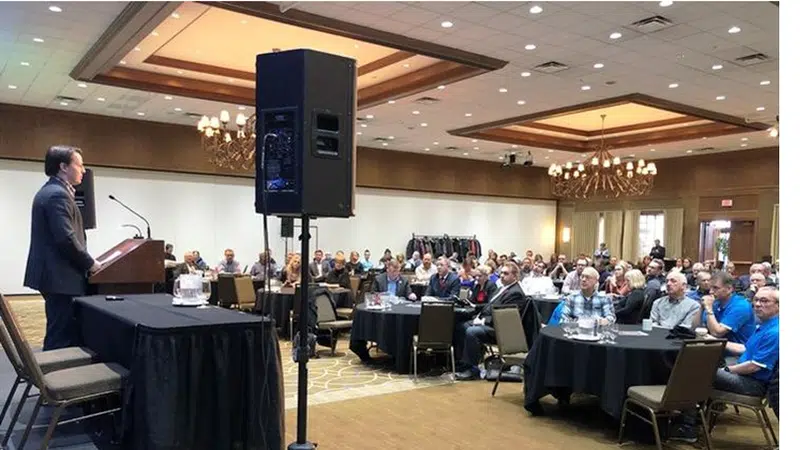
Alberta Agriculture and Forestry Minister Devin Dreeshen speaks to 200 canola, wheat, barley and pulse growers during the Team Alberta Breakfast event held at the Cambridge Red Deer Hotel and Conference Centre on Thursday.
Market Uncertainty Remains

All eyes on canola after China lifts ban on Canadian pork, beef

Nov 7, 2019 | 12:06 PM

Fresh off this week’s announcement that Canadian beef and pork exports to China will soon be resuming, Alberta’s Agriculture and Forestry Minister is cautiously optimistic that the same will soon happen for canola.

Speaking to about 200 Alberta crop producers at the Cambridge Red Deer Hotel and Conference Centre on Thursday, Devin Dreeshen says Tuesday’s news is a good first step.

“It’s still unfortunate that the canola market hasn’t opened to China,” admits Dreeshen. “It’s something that we as a province will continue to advocate to the federal government. Also, I’ve met with the Chinese Consulate-General and again pushed at that level as well. And it is nice to see other provincial governments, as well, promoting and pushing to try to reach that important market for our farmers.”

If Marie-Claude Bibeau continues to be Canada’s Agriculture Minister, Dreeshen hopes work towards reopening the canola market to China can be continued.


“We actually had a pretty good relationship,” says Dreeshen of his federal Liberal counterpart. “We met at the Calgary Stampede over the summer and have had numerous phone calls with her on canola and other issues. So as provinces, we have to work with the federal government regardless of the political stripe. But I am hoping with this minority federal government, that there will be a more receptiveness to listen to some of the bigger issues like Carbon Tax and getting pipelines approved.”

However, John Guelly, chair of Alberta Canola remains skeptical of China reopening their market to Canadian canola anytime soon.

“The conversation hasn’t really changed,” he says. “China still isn’t really speaking to the issues and they did show for the WTO (World Trade Organization) challenge or the preliminary events to it, but really, there was not a lot of interaction with the Chinese, so not that hopeful that things are going to change anytime soon.”

With depressed prices, movement issues, and declining seeded-acres for canola this year, Guelly says the ball is in China’s court to improve the situation.

“We’re still waiting for them,” he laments. “They’re the ones that put the claims that there were issues with our shipments, and they have still not been able to back up those allegations, so we’re still waiting for information from them. We’re willing to speak at any time, and hopefully that comes sooner than later.”

Speaking to fellow canola, wheat, barley and pulse growers at Agri-Trade’s sold-out Team Alberta Breakfast event, Guelly described the 2019 season as “disastrous” with a “harvest from hell.”

“A lot of areas have had four years of bad harvest, and this year seems to be culminating as one of the worst,” he explained. “There’s still a lot of crop out, especially in the Grande Prairie area. But there’s other pockets around the province where the snow came and harvest has pretty much come to an end now. Hopefully we get an opening in the winter, but it’s probably sitting there until spring.”

Despite a nine per cent reduction in the Agriculture and Forestry budget this year, Dreeshen says the province will continue to make important investments in the sector.

“Important investments such as irrigation districts ($48 million), ag societies ($11.5 million), research, those commitments are being funded, and we just wanted to make sure that farmers across Alberta know that this government has their back.”

Dreeshen also noted a $5.4 million investment into rural utilities by the third and fourth years of the budget, and continued promotion of Business Risk Management Programs for farmers.

“We’re also trying to find ways with AFSC (Agriculture Financial Services Corporation) of how we can actually find better ways to help farmers,” he exclaims. “Actually, I was in Lacombe last week and we’re hoping to at least better lay-out options, so farmers understand the types of support that they’ll have from the government. But at the end of the day, it’s a very difficult harvest, and when you see the crop reports of unharvested, especially out in northern Alberta, it is devastating.”

Dreeshen stressed that support payments for Alberta farmers will be maintained.

“So the support payments that they would have in crop insurance or in agri-stability, those programs are the same,” he explains. “I would like farmers to know that the government is still supporting them at the same level as they always have been.”