
LOCAL NEWS THAT MATTERS, SENT TO YOU DIRECTLY. SUBSCRIBE FOR FREE!
sponsored

Market Watch — Oct. 10, 2026

Oct 13, 2026 | 10:32 AM

Market highlights

  • AI optimism gives way to rising yield concerns
  • Bond markets whipsawed by inflation and policy signals

Economic highlights

  • Canadian labour market softens further in September
  • U.S. trade deficit widens sharply as services sector continues to expand
  • Eurozone retail sales edge higher as services sector growth gains momentum

Index


Friday, October 9, 2026

Source: Scotia Wealth Management Bloomberg

* Price in USD

Week in review

AI optimism gives way to rising yield concerns

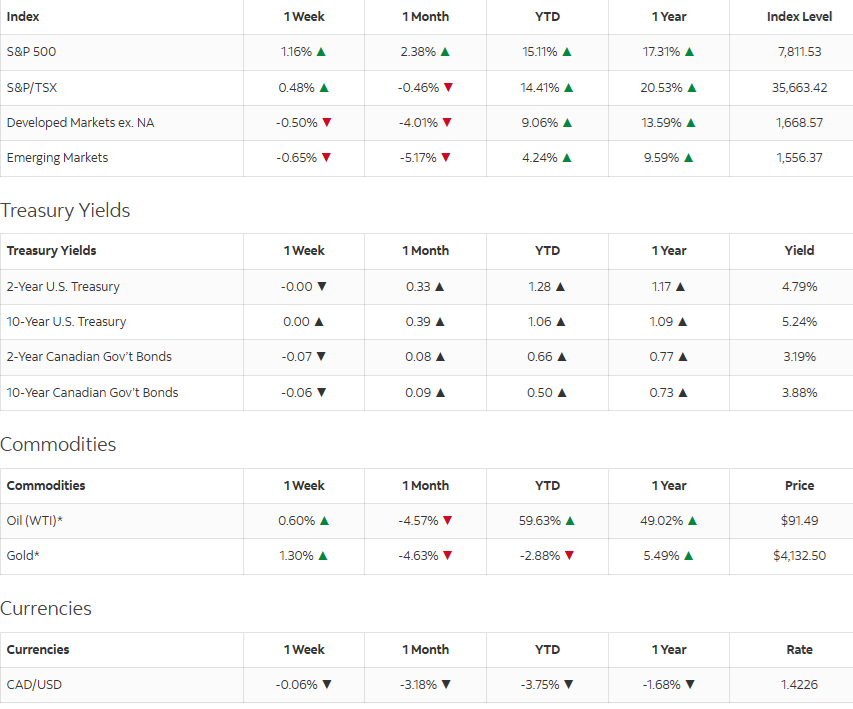
U.S. equities began the week on solid footing as softer U.S. payrolls data reinforced expectations that the U.S. Federal Reserve (Fed) could remain patient, while continued enthusiasm around artificial intelligence and semiconductor-related spending pushed major benchmarks to fresh highs. Midweek, however, sentiment deteriorated as a renewed surge in Treasury yields, hawkish interpretations of Fed communications, rising oil prices and escalating tensions in the Strait of Hormuz weighed on risk appetite and raised concerns about inflation remaining higher for longer. Canada initially benefited from improving trade data and AI-driven market leadership, but rising bond yields and pressure on commodity-sensitive sectors created headwinds before weaker September employment data late in the week increased expectations for a more accommodative Bank of Canada path. Europe was pressured by rising sovereign yields, fiscal concerns in France and broader geopolitical uncertainty before stabilizing as easing Middle East tensions, lower oil prices and more dovish European Central Bank (ECB) commentary improved sentiment. China and emerging markets were supported early by a return of Chinese investors following the Golden Week holiday and improving risk appetite, but rising global yields and concerns around technology spending weighed on the region before easing geopolitical risks and renewed Chinese demand for commodities helped support a stronger finish.

  • U.S. equities advanced 1.16%¹ on easing rate-hike concerns and sustained AI enthusiasm, but a late-week rise in Treasury yields and oil prices, alongside hawkish Fed signals and lingering doubts about AI spending, led investors to adopt a more defensive stance.
  • Canadian equities returned 0.48%² as strong trade data and growth-sector gains supported sentiment, though rising yields, commodity volatility and weaker labour data increased expectations of a more dovish Bank of Canada.
  • European equities ended -0.50%³ lower as rising yields, French fiscal concerns and elevated energy prices weighed on markets, though sentiment recovered late in the week as geopolitical tensions and oil prices eased and policymakers struck a less hawkish tone.
  • Emerging market equities declined -0.65%⁴ as rising global yields and technology-sector uncertainty weighed on sentiment. Chinese markets, however, were supported by post-holiday inflows, firmer commodity demand and easing geopolitical tensions later in the week.

Bond markets whipsawed by inflation and policy signals

U.S. Treasury markets started the week rallying after softer payroll data encouraged expectations that the Fed could remain on hold, pushing yields lower across much of the curve. That move reversed as investors confronted hawkish FOMC minutes, higher oil prices and renewed inflation concerns, finishing the week largely unchanged. Canadian bonds broadly tracked Treasuries before rallying late in the week as a significantly weaker-than-expected employment report reduced expectations for near-term Bank of Canada tightening. European sovereign debt experienced some of the week’s largest moves, with French, Italian and Spanish bonds facing pressure from fiscal concerns and political uncertainty before recovering as risk sentiment improved. Across Asia and emerging markets, Japan stood out as relatively resilient amid a gradual Bank of Japan normalization narrative, while broader global rate volatility remained the dominant influence on fixed income performance.

  • The 2- and 10-Year U.S. Treasury yields were flat. In Canada, the 2- and 10-year sovereign yields were 7 bps and 6 bps lower, respectively. Bond yields and prices move inversely to one another.
  • Sovereign bond markets swung from an early-week rally driven by softer U.S. labour data to a pronounced selloff as higher oil prices, fiscal concerns, Treasury supply and hawkish central-bank signals pushed yields sharply higher.
  • Investment-grade and high-yield credit navigated widening rate volatility as higher government yields and inflation concerns challenged sentiment, although improving risk appetite and easing geopolitical tensions helped stabilize spreads by Friday.

Canadian labour market softens further in September

Canada’s labour market weakened noticeably in September, marking a second consecutive monthly decline in employment and pointing to some cooling in labour market conditions after stronger gains earlier in the summer. While job losses were concentrated in the public sector, the softness was relatively broad-based across industries and age groups, contributing to a modest rise in the unemployment rate. The report prompted markets to scale back expectations for near-term Bank of Canada tightening, with bond yields and the Canadian dollar moving lower following the release. Despite the weaker headline result, wage growth remained positive. On the trade front, Canada’s earlier August trade data highlighted strong exports to the U.S., although much of the strength appeared linked to shipments being accelerated ahead of tariff implementation rather than an underlying improvement in trade competitiveness.

Highlights:

  • Canadian employment fell 68,000 jobs in September, well below the +10,000 consensus forecast, following a 42,000 decline in August. The unemployment rate edged up to 6.5% from 6.4%, marking a further softening in labour market conditions.
  • The decline was driven by a 70,000 drop in public sector employment, partially offset by 25,000 private-sector job gains. Sector losses were led by education (-35,000) and health care and social assistance (-23,000).
  • Weakness was spread across demographics, with employment among core-aged workers (25-54) down 28,000 and youth employment down 48,000, the largest decline since May 2023. Hourly wages rose 2.3% year over year, up from 2.0% in August.

U.S. trade deficit widens sharply as services sector continues to expand

The U.S. trade deficit widened sharply in August as imports surged to a record high, while separate data showed the vast U.S. services sector continued to grow in September, albeit at a slightly slower pace. According to figures released by the U.S. Census Bureau and the Bureau of Economic Analysis, the U.S. goods and services trade deficit increased to US$105.6 billion in August from a revised US$92.8 billion in July, a rise of 13.7%. Exports increased 1.4% to US$315.2 billion, but imports climbed a stronger 4.3% to a record US$420.8 billion.

Highlights:

  • The widening gap reflected a larger goods deficit, which rose US$12.8 billion to US$136.6 billion. Imports were boosted by strong demand for capital goods and consumer products, with August imports of goods and services reaching the highest level on record.
  • The Institute for Supply Management said its non-manufacturing Purchasing Managers’ Index (PMI) eased to 54.9 in September from 55.4 in August and its New Orders Index registered 59.8, indicating continued growth in business demand, while the Employment Index returned to expansion territory at 50.1 after two months of contraction.
  • The survey’s Prices Index climbed to 74.0, its highest level since July 2022, as businesses reported rising fuel and transportation costs and ongoing supply-chain strains. Supplier delivery times also lengthened, suggesting strong demand continues to stretch capacity.

Eurozone retail sales edge higher as services sector growth gains momentum
Retail sales in the eurozone returned to growth in August while business activity across the region accelerated to its strongest pace in more than three years at the end of the third quarter, highlighting continued economic resilience despite mounting inflation pressures. Data released by Eurostat showed retail trade volumes in the euro area rose 0.1% in August from July, reversing a 0.6% decline the previous month. Annual retail sales growth improved to 0.8%, supported by gains in food and non-food purchases, though fuel sales remained weak. S&P Global’s final September Services Purchasing Managers’ Index rose to 53.0 from 51.6 in August, a 10-month high and a sign of continued expansion in the sector. The broader Composite PMI climbed to 53.1 from 52.0, reaching its highest level in 41 months.

Highlights:

  • Eurostat said sales of non-food products increased 0.5% during the month, while food, drinks and tobacco sales edged up 0.1%. Those gains were partially offset by a 1.9% decline in automotive fuel sales. Compared with a year earlier, retail volumes rose 1.6% for food products and 1.7% for non-food goods.
  • S&P Global reported that demand for goods and services strengthened across the eurozone, with new orders rising at the fastest pace in 41 months. Business activity expanded in all five major economies tracked by the survey, led by Spain, while Germany’s recovery continued to gather momentum.
  • The PMI survey also pointed to renewed price pressures. Input costs and prices charged by businesses increased at their fastest rates since May, suggesting inflationary risks remain elevated even as growth improves.

1 S&P 500 Index CAD

2 S&P/TSX Composite Index CAD

3 Bloomberg Developed Markets ex N. America Large & Mid Cap Price Return Index CAD

4 Bloomberg EM Large & Mid Cap Price Return Index CAD