Weather warnings may be in place around central Alberta!
Sponsored

Market Watch — July 17, 2026

Jul 17, 2026 | 4:40 PM

This week’s highlights

  • Softer inflation offsets geopolitical tensions before late-week tech pullback
  • Backward-looking data, forward-looking inflation risks
  • BoC holds interest rate steady amid oil volatility, improving economic outlook
  • U.S. inflation cools to 3.5% in June as energy prices retreat
  • Energy-led slowdown pulls eurozone inflation lower in June

Week in review

Softer inflation offsets geopolitical tensions before late-week tech pullback

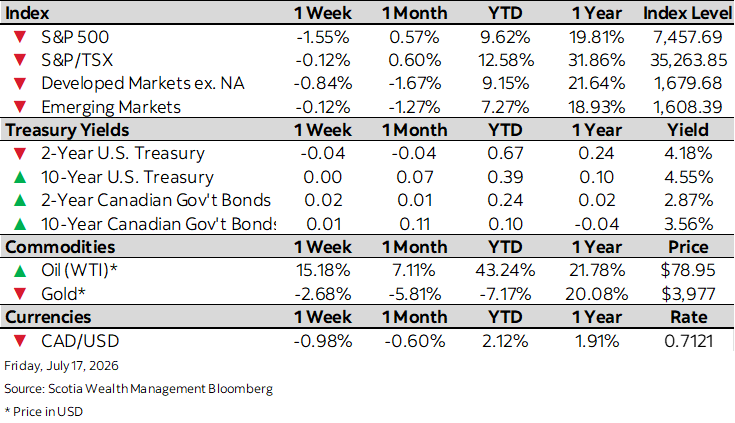
U.S. equities were relatively stable through much of the week despite renewed U.S.-Iran hostilities and disruptions in the Strait of Hormuz initially pressuring sentiment and lifting oil prices. Softer-than-expected U.S. Consumer Price Index (CPI) and Producer Price Index (PPI) readings, combined with Chair Warsh refraining from signaling further tightening, helped buoy markets. However, persistent concerns around AI led to a semiconductor and broader technology selloff later in the week which ultimately pushed markets into negative territory. Canadian equities trades sideways throughout the week with some relatively sizable intra-day swings, supported by firmer crude prices and a steady Bank of Canada decision. Policymakers left rates unchanged while signalling improving economic conditions, and softer North American inflation data helped reinforce a constructive environment for risk assets.

European equities experienced similar swings to other major markets during the week, as Middle East tensions and rising energy prices kept inflation concerns in focus. While recent data supported expectations for an unchanged ECB decision in the near term, investors remained cautious given that the data did not fully reflect the latest energy-driven price pressures, leaving the door open to further policy tightening later this year. Political uncertainty in the U.K. also acted as a modest headwind, though investors largely looked through it.

Chinese markets navigated a mixed backdrop as strong export activity and ongoing enthusiasm surrounding AI-related investment provided support early in the week. Attention later shifted to softer Chinese growth data, which reinforced concerns around domestic demand and the property sector despite resilient industrial production. Regional sentiment was further pressured by a sharp selloff in South Korean markets after AI-related concerns sparked a steep decline in memory-chip stocks, while broader weakness in technology and semiconductor shares tempered risk appetite across the region.

Highlights:

  • U.S. equities returned -1.55%1 as softer inflation data and easing rate concerns helped offset geopolitical tensions and higher oil prices, though a late-week selloff in semiconductor and AI-related shares ultimately weighed on market sentiment.
  • Canadian equities returned -0.12%2 trading largely sideways, supported by firmer oil prices, an unchanged BoC decision, and softer inflation data that helped reinforce a relatively constructive backdrop for risk assets.
  • European stocks returned -0.84%3, held back by rising energy prices and inflation concerns, while investors continued weighing the prospect of future ECB tightening despite softer trailing inflation data and limited U.K. political uncertainty.
  • Chinese and emerging markets declined -0.12%, contending with weaker Chinese growth data and renewed pressure on technology shares, including a sharp selloff in South Korean memory stocks tied to AI-related concerns.

Backward looking data, forward looking inflation risks

U.S. sovereign bonds ultimately rallied after a volatile week, beginning under pressure as renewed U.S.-Iran hostilities and rising oil prices reignited inflation concerns. Sentiment improved following softer-than-expected CPI and PPI releases, while Chair Warsh refrained from signalling additional policy tightening, leading markets to dial back expectations for future rate hikes. Still, investors questioned whether the backward-looking inflation data fully captured the implications of rising energy prices, Strait of Hormuz disruptions, and broader inflation pressures highlighted by some Fed officials. Canadian bonds largely followed the U.S. higher, while the BoC left rates unchanged and maintained a balanced assessment of growth and inflation risks. European bond markets were more mixed, as softer inflation readings competed with concerns that higher energy costs could eventually require further ECB tightening.

Highlights:

  • The 2- and 10-year U.S. Treasury yields were 4 basis point (bps) lower and flat, respectively. In Canada, the 2- and 10-year yields rose 2 bps and 1 bps, respectively. Bond yields and prices move inversely to one another.
  • U.S. Government bond yields declined as softer U.S. CPI and PPI data led investors to scale back expectations for future Fed tightening, reversing much of the inflation-driven selloff seen earlier in the week.
  • Investment-grade and high-yield credit were supported by falling underlying yields, though elevated oil prices, Middle East tensions, and growing uncertainty around AI-related technology valuations kept spread compression in check.

Weekly dashboard


BoC holds interest rate steady amid oil volatility, improving economic outlook

The Bank of Canada (BoC) left its benchmark interest rate unchanged at 2.25%, marking the sixth consecutive policy meeting at which it has opted to keep borrowing costs steady as policymakers assess a mix of improving economic conditions and persistent global risks. Economists widely expected the rate hold, predicting policymakers would remain on the sidelines while monitoring the balance between labour market conditions and inflation that remains above target. Canada’s unemployment rate stood at 6.5% in June, highlighting ongoing slack, even as broader economic activity gains momentum.

Highlights:

  • In its decision, the central bank said Canada’s economy is showing signs of improvement after stalling over the past year. The BoC estimates annualized gross domestic product (GDP) growth of about 2.5% in the quarter, supported by resilient consumer spending, recovering exports and a modest pickup in business investment.
  • Governor Tiff Macklem said the economy is gradually working through recent shocks, although uncertainty remains elevated. Ongoing trade negotiations with the U.S. and renewed conflict in the Middle East continue to pose risks to both growth and inflation.
  • The Bank expects inflation to ease gradually in the coming months as energy-related price pressures fade. It forecasts growth of 0.7% in 2026 before strengthening to 1.8% in both 2027 and 2028 as economic slack is absorbed and demand improves.

U.S. inflation cools to 3.5% in June as energy prices retreat

U.S. consumer inflation slowed more than expected in June, offering a welcome sign for households and policymakers after several months of elevated price pressures and reinforcing the broader disinflation trend in the world’s largest economy. According to data released this week by the U.S. Bureau of Labor Statistics (BLS), the Consumer Price Index (CPI) rose 3.5% from a year earlier in June, down from 4.2% in May.

Highlights:

  • On a monthly basis, consumer prices fell 0.4% after increasing 0.5% in May, marking the largest one-month decline since April 2020. The drop was driven largely by lower energy costs, which more than offset continued increases in food and shelter prices.
  • Energy prices fell 5.7% during the month, with gasoline prices dropping 9.7%. Despite the monthly decline, energy costs remained 15.7% higher than a year ago. Food prices increased 0.2% in June and were up 3.0% over the previous 12 months.
  • Core CPI, which excludes volatile food and energy prices, was unchanged on the month and rose 2.6% from a year earlier, down from 2.9% in May. Several categories, including motor vehicle insurance, apparel, medical care, communications services, and used vehicles, posted monthly declines.

Energy-led slowdown pulls eurozone inflation lower in June
Eurozone inflation cooled in June, offering some relief to policymakers and consumers after several months of rising price pressures, according to final data released by Eurostat. The annual inflation rate across the 20-member currency bloc fell to 2.8% in June from 3.2% in May, although it remained above the European Central Bank’s 2% target. The June reading marked the first decline in headline inflation since February. A year earlier, annual inflation in the euro area stood at 2.0%.

Highlights:

  • The slowdown was driven largely by easing energy costs. Energy inflation decelerated to 8.5% from 10.8% in May, while services inflation slowed to 3.2% from 3.5%. Price growth for food, alcohol and tobacco moderated to 1.5% from 1.9%, and non-energy industrial goods inflation eased to 0.7% from 0.9%.
  • Inflation slowed in 22 EU member states, remained unchanged in three and increased in two. The lowest annual inflation rates were recorded in Sweden, Czechia and Denmark, while Romania, Lithuania and Bulgaria posted the highest readings.
  • Among the euro area’s largest economies, inflation eased in Germany, France, Italy and the Netherlands, while Spain’s annual rate held steady at 3.6%. Core inflation, which excludes volatile food and energy prices, slowed to 2.4% from 2.6% in May.