Subscribe to the 100% free rdnewsNOW daily newsletter!
SPONSORED

Market Watch – April 2, 2026

Apr 6, 2026 | 9:17 AM

This week’s highlights

  • Energy outlook and renewed risk-off tone keep equities on the back foot
  • Dovish Fed tone steadies bonds, but late-week de-risking lifts yields
  • Canada reports modest GDP gain in January
  • U.S. ISM manufacturing survey shows rising price pressures
  • Eurozone inflation surges past ECB target on oil shock

Week in review

Energy outlook and renewed risk-off tone keep equities on the back foot

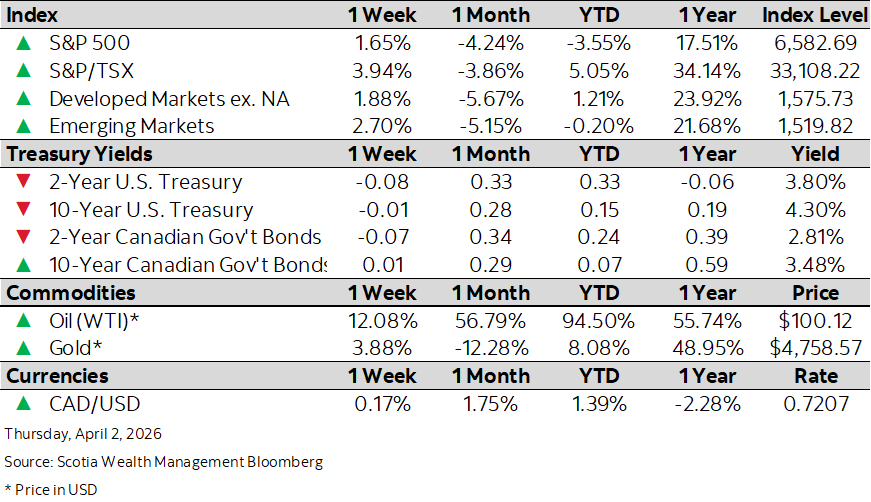
U.S. equities rose early as investors leaned into headlines that the U.S.-Iran conflict could end within weeks, with Powell noting inflation expectations were grounded and data showing firmer retail sales and ADP hiring; Trump’s later address vowing to hit Iran “extremely hard” reignited the risk-off sentiment, boosting oil and the USD and knocking futures lower into the week’s end. Canada followed the same swing, with a modest StatCan growth estimate and a Bank of Canada (BoC) hawkish-hold message keeping rates sensitivity high while oil moves dictated CAD movements. Europe participated in the midweek rebound but faced an energy-led inflation shock after German prices jumped, nudging European Central Bank (ECB) hike expectations, before Thursday’s escalation-driven selloff. China/EM traded unevenly, with major indices down early, up on de-escalation hopes, then lower again as crude spiked.

Highlights:

  • U.S. equities returned 1.65%1 as stocks caught a bid on talk of a quicker Iran endgame and a dovish-leaning Powell, with solid retail sales and ADP hiring reinforcing growth, before Trump’s tougher tone triggered a sharp risk-off reset.
  • Canadian equities returned 3.94%2 tracking global risk sentiment, firming as de-escalation talk led to an ease in yields, then sliding after Trump signaled a tougher path, with a modest StatCan growth estimate and the BoC’s hawkish hold keeping rates and crude central.
  • European stocks returned 1.88%3 rallying midweek alongside lower global yields, yet the region’s energy exposure kept inflation anxiety front and centre after Germany’s HICP jump shifted ECB hike probabilities, before the late-week escalation shock pulled equities back across major bourses.
  • Emerging markets decreased 2.70%4, slipping early before rebounding on hopes the Iran conflict could end soon, then fading as escalation lifted oil and revived USD haven demand, tightening conditions for risk assets.

Dovish Fed tone steadies bonds, but late-week de-risking lifts yields

U.S. fixed income markets began the week with yields moving lower as geopolitical escalation in the Middle East drove a flight to safety and prompted investors to pare back expectations for further Federal Reserve tightening, with comments from Chair Powell reinforcing the view that policymakers would look through near-term energy-driven inflation pressures. Midweek, optimism that the conflict could de‑escalate supported risk assets and kept rates well contained, though better‑than‑expected retail sales and resilient labour data limited the rally as rate‑cut expectations were scaled back. In Canada, bonds largely tracked U.S. developments, with yields easing early on growth concerns and then stabilizing as markets weighed softer domestic data against lingering energy‑related inflation risks. European sovereigns outperformed through midweek, supported by safe‑haven demand and a broad rally in core bonds, before selling off sharply late in the week as geopolitical tensions flared again and inflation concerns re‑emerged, particularly at the long end.

Highlights:

  • The 2-year U.S. Treasury yield was down 8 basis points (bps) while the 10-year was down 1 bps. In Canada, the 2-year yield was down 7 bps while the 10-year was up 1 bps. Bond yields and prices move inversely to one another.
  • Sovereign curves rallied early as Middle East tensions and dovish Fed messaging drove safe‑haven flows, but late‑week escalation and firmer U.S. data reversed gains, pushing yields higher in the U.S. and Europe.
  • Credit markets remained orderly despite volatility, with geopolitical relief midweek supporting spreads, while rising oil prices and renewed risk aversion later pressured high yield more than investment grade.

Weekly dashboard


Canada reports modest GDP gain in January

Canada’s economy eked out a modest gain in January, with monthly gross domestic product (GDP) rising slightly as strength in most goods-producing industries offset lingering manufacturing weakness. According to Statistics Canada (StatCan), GDP in January rose by 0.1% on a monthly basis, following a 0.2% gain in December, pointing to a fragile start to the year. Analysts had forecast no growth in January and expect growth to take a bigger hit in the coming months as the impact of high crude oil prices due to the Iran war curtails consumer spending and spikes inflation. Overall, nine of the 20 industrial sectors recorded growth in January.

Highlights:

  • Mining, quarrying and oil and gas extraction and construction were the biggest drivers of growth which helped offset a 1.4% drop in manufacturing, while the construction sector expanded for the third month in a row in January.
  • Goods-producing industries, which accounts for one-fourth of the GDP, grew by 0.2% in January, following a similar increase in the previous month.
  • Wholesale trade, transportation and real estate sectors shrank in January, offsetting growth seen in some major economic contributors such as retail trade, finance and insurance, and educational services.

U.S. ISM manufacturing survey shows rising price pressures

Factory activity expanded in the U.S. in March, but the latest monthly reading from the Institute for Supply Management signalled a strong warning that inflation is resurgent amid the war in Iran. The ISM Manufacturing PMI for March rose to 52.7, up modestly from February’s 52.4 and marked the third consecutive month in expansionary territory. Readings above 50 indicate a sectoral expansion. Analysts were expecting a reading of 52.1.

Highlights:

  • Production strengthened, with the index climbing to 55.1 from 53.5, while new orders remained in growth at 53.5, slowing from February’s 55.8, while the employment sub‑index stayed in contraction at 48.7, indicating that manufacturers continue to prioritize productivity and cost control over headcount.
  • Price pressures intensified as the prices paid index surged to 78.3, up sharply from 70.5 in February and the highest reading since mid‑2022, while supplier deliveries slowed for a fourth consecutive month.
  • Survey respondents cited the Middle East conflict, higher energy costs and lingering tariff uncertainty as key sources of pressure.

Eurozone inflation surges past ECB target on oil shock
Eurozone inflation soared past the European Central Bank’s (ECB) 2% target this month as surging oil and gas costs drove up headline prices, but the jump was smaller than expected and core inflation declined, muddying the picture for policymakers. Overall inflation in the 21 countries sharing the euro currency jumped to 2.5% in March from 1.9% a month earlier, below economists’ expectations for 2.6% increase, as energy costs rose 4.9%.

Highlights:

  • Core inflation, which strips out energy and food prices, fell to 2.3%, from 2.4% in February, as services inflation eased.
  • Policymakers at the ECB have begun weighing whether and when to respond to the pickup in inflation as the longer the shock lasts, the higher the risk of second-round effects causing broader elevated inflation.
  • Markets are currently pricing in nearly three rate hikes this year from the current level of 2.0%, with most expecting the first at the next meeting on April 30.