Subscribe to the 100% free rdnewsNOW daily newsletter!
sponsored

Market Watch – March 27, 2026

Mar 30, 2026 | 3:13 PM

This week’s highlights

  • Geopolitics and energy volatility drive a choppy week for global equities
  • Bond markets signal renewed concern over inflation risks
  • Canadian retail sales up 1.1% to $70.7 billion in January
  • U.S. labour market holds steady as energy driven inflation risks build
  • Eurozone PMI falls to 10-month low as services contract

Week in review

Geopolitics and energy volatility drive a choppy week for global equities

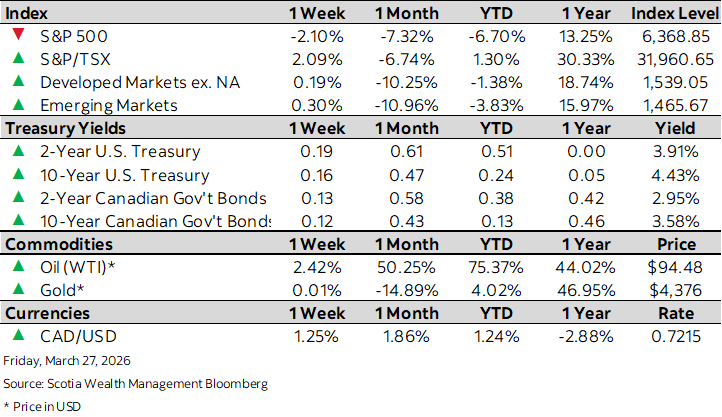
U.S. equities began the week firmer as hopes for de‑escalation in the Middle East briefly supported risk appetite, but sentiment faded as ceasefire efforts stalled and rising oil prices revived inflation concerns. Thursday’s jobless claims data, which showed initial claims rising slightly to 210,000 while remaining within a stable range, reinforced the view of a labour market that is cooling only gradually, giving the Federal Reserve (Fed) room to hold rates steady as it monitors inflation pressures tied to the conflict. Canadian equities were pulled lower by rising crude prices and heightened inflation concerns, and sentiment was further dampened by modestly improved domestic momentum and shifting expectations for additional Bank of Canada rate cuts later this year. European equities weakened as imported energy costs rose and global PMIs across major regions signaled fading momentum. Asian and emerging markets remained mixed, supported by midweek rebounds before renewed geopolitical tension and Chinese trade investigations softened risk appetite.

Highlights:

  • U.S. equities returned -2.10%1 as stalled ceasefire efforts lifted oil prices and Thursday’s jobless claims report showed steady but slowing labour conditions, reinforcing expectations for a more hawkish policy backdrop.
  • Canadian equities returned 2.09%2 following U.S. trading patterns, initially improving on temporary geopolitical relief before weakening as crude prices continued their ascent and investors assessed stable but cooling economic conditions.
  • European stocks returned 0.19%3 as higher energy costs pressured valuations and broadly soft global PMIs signaled fading economic momentum, increasing concerns about inflation and the likelihood of tighter regional monetary policy.
  • Emerging markets decreased 0.30%4 as global PMIs weakened, early week volatility eased temporarily on the prospect of renewed energy flows, and Chinese investigations into U.S. trade practices added fresh uncertainty to an already fraught trading relationship.

Bond markets signal renewed concern over inflation risks

U.S. rates spent the week reacting to shifting geopolitical headlines, rallying when ceasefire prospects briefly improved before giving back gains as rising oil prices revived inflation concerns and reinforced expectations that the Fed may stay cautious in the absence of new data. Canadian yields moved similarly, with early‑week front‑end strength fading as inflation risks linked to higher energy prices re‑entered the outlook. European sovereign markets experienced outsized swings, initially benefiting from relief around diplomacy, then selling off sharply as the region’s heavy dependence on imported energy and worsening PMI signals heightened fears of renewed inflation pressures and further policy tightening. In Asia and emerging markets, Japanese yields led the global underperformance late in the week as energy‑driven inflation concerns increased expectations for additional Bank of Japan action.

Highlights:

  • The 2- and 10-year U.S. Treasury yields were up 19 basis points (bps) and 16 bps, respectively. In Canada, the 2- and 10-year yields were up 13 bps and 12 bps, respectively. Bond yields and prices move inversely to one another.
  • Sovereign bond markets swung sharply as shifting Middle East headlines drove early‑week rallies in U.S., Canadian, and European yields before renewed inflation concerns and rising energy prices pushed global rates higher late in the week.
  • Corporate credit sentiment softened as concerns around private‑market liquidity intensified, highlighted by Apollo restricting withdrawals from its flagship fund, which reinforced broader risk aversion already heightened by geopolitical tensions and rising input‑cost pressures.

Weekly dashboard


Canadian retail sales up 1.1% to $70.7 billion in January

Statistics Canada (StatCan) reported that Canadian retail sales were up 1.1% at $70.7 billion in January, led by sales at motor vehicle and parts dealers. According to StatCan, sales were up in six of the nine subsectors it tracks, as the motor vehicle and parts dealers subsector posted the largest increase in retail sales in January, up 2%. The agency says its early estimate for February pointed to a gain of 0.9%, though it cautioned the figure would be revised.

Highlights:

  • Core retail sales, which exclude gasoline stations and fuel vendors and motor vehicle and parts dealers, rose 0.9% in January, led by higher sales at general merchandise retailers, with sales up 3% and marking a fourth straight monthly gain.
  • Sales at sporting goods, hobby, musical instrument, book and miscellaneous retailers increased 2.6%, recording its second consecutive monthly increase.
  • Food and beverage retailers posted the largest decline in core retail sales, down 0.6%, while sales at supermarkets and other grocers, except convenience stores, fell 0.7%.

    U.S. labour market holds steady as energy driven inflation risks build

    The latest jobless‑claims report showed a slight increase in weekly filings, reinforcing a picture of a labour market that remains stable but is gradually losing momentum as tariffs, weaker hiring demand, and higher energy‑driven inflation pressures weigh on conditions. Claims stayed within their recent narrow range, indicating low layoffs, while softer private payroll growth and reduced labour supply point to cooling beneath the surface. Rising oil and input prices have raised the risk that the Fed remains on hold or moves to hike.

    Highlights:

    • Initial claims ticked up to 210,000, remaining within the 201,000 to 230,000 range that signals subdued layoffs.
    • Hiring demand has softened, with private payrolls averaging 18,000 over the past three months amid tariff uncertainty and tighter immigration.
    • Continuing claims declined to 1.819 million, partly reflecting benefit exhaustion and highlighting slower job creation.

      Eurozone PMI falls to 10-month low as services contract
      Eurozone business activity slowed to its lowest level in almost a year this month, new data showed, as fears grow that the Iran war will curb growth and entrench high inflation in the European economy. S&P Global’s Eurozone PMI Composite Output Index found that overall activity in manufacturing and services across the single currency area fell to 50.5 in March from 51.9 in February, pushing the index closer to the 50-point mark that separates growth from contraction.

      Highlights:

      • The slowdown was driven primarily by a sharp cooling in services, while manufacturing output continued to rise modestly despite a significant deterioration in supply chain performance.
      • Supplier delivery times lengthened to the greatest extent in more than three years as firms faced renewed logistical constraints linked to the conflict in the Middle East. New orders declined for the first time in eight months and export orders continued their multiyear pattern of weakness.
      • Input cost inflation accelerated to its fastest pace since early 2023, particularly in Germany and France, prompting companies to raise selling prices even though the rise in charges remained well below the increase in costs.

1  S&P 500 Index USD

2 S&P/TSX Composite Index USD

3 Bloomberg Developed Markets ex N. America Large & Mid Cap Price Return Index USD

4 Bloomberg EM Large & Mid Cap Price Return Index USD

DISCLAIMER — This publication has been prepared by The Bank of Nova Scotia for Scotia Wealth Management clients. It is for general information purposes only and should not be considered or relied upon as personal and/or specific financial, tax, pension, insurance, legal or investment advice. We are not tax or legal advisors, and we recommend that individuals consult with their qualified advisors, including tax and legal advisors, before taking any action based upon the information contained in this publication. The opinions and projections contained in this publication are our own as of the date hereof and are subject to change without notice. Scotia Wealth Management is under no obligation to update this publication, and readers should assume the information contained herein will not be updated. While care and attention has been taken to ensure the accuracy and reliability of the material in this publication, neither The Bank of Nova Scotia nor any of its affiliates or any of their respective directors, officers or employees make any representations or warranties, express or implied, as to the accuracy or completeness of such material and disclaim any liability resulting from any direct or consequential loss arising from any use of this publication or the information contained herein. This publication may contain forward-looking statements based on current expectations and projections about future general economic factors. Forward-looking statements are subject to inherent risks and uncertainties which may be unforeseeable and such expectations and projections may be incorrect in the future. Forward-looking statements are not guarantees of future performance and you should avoid placing undue reliance upon them. This publication and all the information, opinions and conclusions contained herein are protected by copyright. This publication may not be reproduced in whole or in part without the prior express consent of The Bank of Nova Scotia. To the extent this document contains information or data obtained from third party sources, it is believed to be accurate and reliable as of the date of publication, but Scotia Wealth Management does not guarantee its accuracy or reliability.

® Registered trademark of The Bank of Nova Scotia, used under licence (where applicable). ™ Trademark of The Bank of Nova Scotia, used under licence (where applicable). Scotia Wealth Management® consists of a range of financial services provided by The Bank of Nova Scotia (Scotiabank®); The Bank of Nova Scotia Trust Company (Scotiatrust®); Scotia Jarislowsky Fraser, a service of 1832 Asset Management L.P.; 1832 Asset Management U.S. Inc.; Scotia Wealth Insurance Services Inc.; and ScotiaMcLeod®, a division of Scotia Capital Inc. Private banking services are provided by The Bank of Nova Scotia. Estate and trust services are provided by The Bank of Nova Scotia Trust Company. Portfolio management is provided by 1832 Asset Management L.P. and 1832 Asset Management U.S. Inc. Insurance services are provided by Scotia Wealth Insurance Services Inc. Wealth advisory and brokerage services are provided by ScotiaMcLeod, a division of Scotia Capital Inc. International investment advisory services are provided by Scotia Capital Inc. Financial planning services are provided by The Bank of Nova Scotia and ScotiaMcLeod. Scotia Capital Inc. is a member of the Canadian Investor Protection Fund and is regulated by the Canadian Investment Regulatory Organization. Scotia Wealth Insurance Services Inc. is the insurance subsidiary of Scotia Capital Inc., a member of the Scotiabank group of companies. When discussing life insurance products, ScotiaMcLeod advisors are acting as Life Insurance Agents (Financial Security Advisors in Quebec) representing Scotia Wealth Insurance Services Inc.

Scotia Wealth Management® in The Bahamas consists of a range of financial services provided by Scotiabank (Bahamas) Limited and The Bank of Nova Scotia Trust Company (Bahamas) Limited, which are entities licensed to operate within The Bahamas. International private banking and international investment advisory services are provided by Scotiabank (Bahamas) Limited. International wealth structuring solutions are provided by The Bank of Nova Scotia Trust Company (Bahamas) Limited. ® Registered trademark of The Bank of Nova Scotia, used under licence.

Scotia Wealth Management® in the Cayman Islands consists of a range of financial services provided by Scotiabank & Trust (Cayman) Ltd. International private banking services, international investment advisory services, and international wealth structuring solutions are provided by Scotiabank & Trust (Cayman) Ltd., an entity licensed by the Cayman Islands Monetary Authority. ® Registered trademark of The Bank of Nova Scotia, used under license.

Scotia Wealth Management® in Jamaica consists of a range of Private Banking services provided by the Scotiabank Group of companies (Scotiabank®). ®Registered trademark of The Bank of Nova Scotia, used under licence.