Subscribe to the 100% free rdnewsNOW daily newsletter!
Sponsored

Market Watch — March 20, 2026

Mar 20, 2026 | 4:37 PM

This week’s highlights

  • Equities continue to struggle as energy shock causes a reassessment of policy path
  • Hotter inflation expectations push front-end yields sharply higher
  • Bank of Canada keeps key interest rate at 2.25% amid oil-driven inflation risks
  • U.S. Federal Reserve holds rates steady, projects single rate cut for 2026
  • China’s economy off to steady start in 2026 amid lowered expectations

Week in review

Equities continue to struggle as energy shock causes a reassessment of policy path

U.S. equities began the week firmer as easing oil prices briefly supported sentiment, but accelerating geopolitical tensions and a hotter Producer Price Index (PPI) print pushed yields higher and led markets to abandon earlier expectations for rate cuts, with some pricing now tilting toward a potential hike as energy‑driven inflation pressures intensify. In Canada, initially softer Consumer Price Index (CPI) and weak labour data gave way to similar repricing as the Bank of Canada (BoC) signaled concern that higher oil could feed broader inflation. European equities also reversed course as surging natural gas and oil prices forced investors to reassess the European Central Bank (ECB) and Bank of England (BoE) outlook, with both regions now facing rising hike expectations. Chinese and EM markets remained uneven, pressured by global inflation concerns and conflict‑driven supply risks.

Highlights:

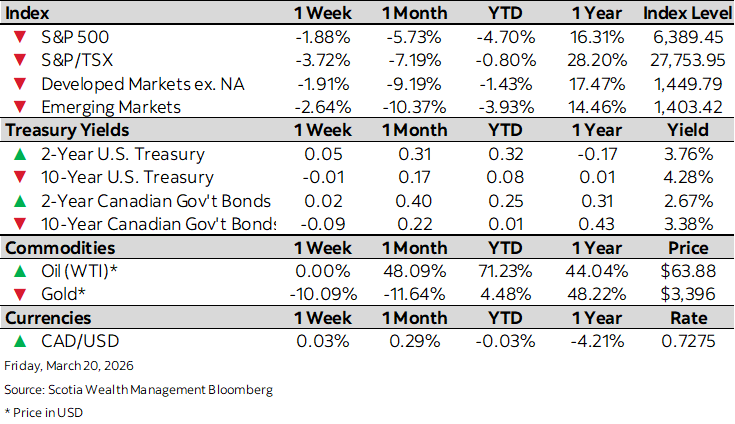
  • U.S. equities returned -1.88%1 as a hotter PPI reading and renewed oil-driven inflation risks pushed markets to unwind earlier rate-cut expectations, with markets now pricing in the possibility of a hike.
  • Canadian equities returned -3.72%2 as markets shifted from anticipating eventual BoC cuts to potential hikes, reflecting policymakers’ concern regarding inflation amidst a backdrop of a weakening labour market.
  • European stocks returned -1.91%3 as the surge in regional energy prices forced investors to price in a more hawkish path for both the ECB and BoE.
  • Emerging markets decreased -2.64%4 as investors continue to re-assess global monetary policy paths, with the fading prospect of cuts weighing on investors’ risk appetite.

Hotter inflation expectations push front-end yields sharply higher

U.S. fixed income markets opened the week firmer as softer oil prices and pre‑FOMC caution supported a bid for duration, but conditions reversed sharply after a hotter‑than‑expected PPI print and renewed Middle East escalation pushed front‑end yields higher and drove a late‑week bear‑flattening as markets priced the possibility of rate hikes. Canada followed a similar trajectory: early declines in yields after cooler CPI and soft labour data gave way to higher front‑end pressure as the BoC highlighted upside inflation risks from elevated energy prices. European bonds saw an even sharper front‑loaded selloff after attacks on key LNG and oil infrastructure ignited concerns around imported energy inflation. In Japan and broader EM, yields drifted higher as the BoJ’s hawkish hold and rising global rate expectations tightened financial conditions.

Highlights:

  • The 2-year U.S. Treasury yield was up 5 basis points (bps) while the 10-year was down 1 bps. In Canada, the 2-year yield was up 2 bps while the 10-year was down 9 bps. Bond yields and prices move inversely to one another.
  • Sovereign curves sold off in a late‑week bear‑flattening as hotter U.S. PPI, surging energy prices, and hawkish central‑bank messaging pushed markets to fully unwind rate‑cut expectations and begin pricing potential hikes.
  • Corporate credit absorbed widening rate volatility as rising front‑end yields, elevated inflation risk, and geopolitical uncertainty tightened financial conditions, pressuring HY more noticeably while IG remained resilient but sensitive to shifting policy expectations.

Weekly dashboard


Bank of Canada keeps key interest rate at 2.25% amid oil-driven inflation risks

The Bank of Canada (BoC) held its benchmark interest rate steady but said it’s prepared to adjust monetary policy if needed amid a global oil price shock that risks reigniting inflation. As widely expected, the central bank’s governing council kept the policy rate at 2.25% for the third consecutive time. The rate decision was made against the backdrop of a sharp rise in energy prices caused by the war between the United States, Israel and Iran, which has largely closed the Strait of Hormuz through which around a fifth of global oil supplies typically travel.

Highlights:

  • “Governing council will look through the war’s immediate impact on inflation but if energy prices stay high, we will not let their effects broaden and become persistent inflation,” Governor Tiff Macklem said in a press conference.
  • Before the outbreak of the war, the BoC was widely expected to remain on hold through 2026. Financial markets are now pricing in the possibility of a rate hike in the back half of the year.
  • Headline inflation is sure to rise in the coming months, as the higher oil prices go, and the longer they remain elevated, the more likely companies will pass increased transportation and production costs along to customers, pushing up the price of other goods and services.

U.S. Federal Reserve holds rates steady, projects single rate cut for 2026

U.S. Federal Reserve (Fed) officials expect the Iran war will worsen inflation this year while having little impact on economic growth, but they still expect to cut their key rate once in 2026. For now, Fed policymakers left short-term interest rates unchanged for the second straight meeting at 3.5% and 3.75%. In a statement, the central bank said that the “implications of developments in the Middle East for the U.S. economy are uncertain.”

Highlights:

  • By keeping their forecast for a rate cut this year and next, policymakers appear to expect the gas price spike from the Iran war to have a largely temporary effect on inflation and the economy. That will largely depend on the length of the conflict.
  • Fed Chief Jerome Powell said that in the short-term, higher oil and gas prices will elevate inflation, but it is too soon to know the potential impacts on the economy. “The U.S. economy is doing pretty well, it’s just we don’t know what the effects of this will be, and really no one does.”
  • In their economic projections, Fed officials now forecast that inflation will be 2.7% at the end of this year, up from their December forecast but slightly below the 2.8% it reached in January. They expect core inflation, which excludes the volatile food and energy categories, to also finish the year at 2.7%, up from a previous forecast of 2.5%.

China’s economy off to steady start in 2026 amid lowered expectations
China said its economy started the year on a steady footing, giving leaders more breathing room to try to shift the country’s growth engine toward consumption after recently lowering its official growth target for the year. Readings on retail sales, fixed-asset investment and industrial output all came in roughly in line with expectations in January and February, though data on the property sector continued to show signs of weakness. China’s National Bureau of Statistics (NBS) combines January and February data to smooth out distortions stemming from the shifting timing of the annual Lunar New Year holiday.

Highlights:

  • According to NBS, retail sales increased 2.8% on the year in the January-February period, handily topping the 0.9% growth rate recorded in December.
  • Fixed-asset investment rose 1.8% on year in the first two months of the year, better than expected and a big improvement from the 3.8% decline recorded in 2025. Meanwhile, industrial output rose 6.3% during the same period when compared with the year-earlier period, better than expectations.
  • China’s real-estate sector suffered significant declines in the first two months of the year. Property investment fell 11% in year-over-year terms, while the total value of home sales dropped 22% during the same period.

1  S&P 500 Index USD

2 S&P/TSX Composite Index USD

3 Bloomberg Developed Markets ex N. America Large & Mid Cap Price Return Index USD

4 Bloomberg EM Large & Mid Cap Price Return Index USD

Disclaimer: This publication has been prepared by The Bank of Nova Scotia for Scotia Wealth Management clients. It is for general information purposes only and should not be considered or relied upon as personal and/or specific financial, tax, pension, insurance, legal or investment advice. We are not tax or legal advisors, and we recommend that individuals consult with their qualified advisors, including tax and legal advisors, before taking any action based upon the information contained in this publication. The opinions and projections contained in this publication are our own as of the date hereof and are subject to change without notice. Scotia Wealth Management is under no obligation to update this publication, and readers should assume the information contained herein will not be updated. While care and attention has been taken to ensure the accuracy and reliability of the material in this publication, neither The Bank of Nova Scotia nor any of its affiliates or any of their respective directors, officers or employees make any representations or warranties, express or implied, as to the accuracy or completeness of such material and disclaim any liability resulting from any direct or consequential loss arising from any use of this publication or the information contained herein. This publication may contain forward-looking statements based on current expectations and projections about future general economic factors. Forward-looking statements are subject to inherent risks and uncertainties which may be unforeseeable and such expectations and projections may be incorrect in the future. Forward-looking statements are not guarantees of future performance and you should avoid placing undue reliance upon them. This publication and all the information, opinions and conclusions contained herein are protected by copyright. This publication may not be reproduced in whole or in part without the prior express consent of The Bank of Nova Scotia. To the extent this document contains information or data obtained from third party sources, it is believed to be accurate and reliable as of the date of publication, but Scotia Wealth Management does not guarantee its accuracy or reliability.

® Registered trademark of The Bank of Nova Scotia, used under licence (where applicable). ™ Trademark of The Bank of Nova Scotia, used under licence (where applicable). Scotia Wealth Management® consists of a range of financial services provided by The Bank of Nova Scotia (Scotiabank®); The Bank of Nova Scotia Trust Company (Scotiatrust®); Scotia Jarislowsky Fraser, a service of 1832 Asset Management L.P.; 1832 Asset Management U.S. Inc.; Scotia Wealth Insurance Services Inc.; and ScotiaMcLeod®, a division of Scotia Capital Inc. Private banking services are provided by The Bank of Nova Scotia. Estate and trust services are provided by The Bank of Nova Scotia Trust Company. Portfolio management is provided by 1832 Asset Management L.P. and 1832 Asset Management U.S. Inc. Insurance services are provided by Scotia Wealth Insurance Services Inc. Wealth advisory and brokerage services are provided by ScotiaMcLeod, a division of Scotia Capital Inc. International investment advisory services are provided by Scotia Capital Inc. Financial planning services are provided by The Bank of Nova Scotia and ScotiaMcLeod. Scotia Capital Inc. is a member of the Canadian Investor Protection Fund and is regulated by the Canadian Investment Regulatory Organization. Scotia Wealth Insurance Services Inc. is the insurance subsidiary of Scotia Capital Inc., a member of the Scotiabank group of companies. When discussing life insurance products, ScotiaMcLeod advisors are acting as Life Insurance Agents (Financial Security Advisors in Quebec) representing Scotia Wealth Insurance Services Inc.

Scotia Wealth Management® in The Bahamas consists of a range of financial services provided by Scotiabank (Bahamas) Limited and The Bank of Nova Scotia Trust Company (Bahamas) Limited, which are entities licensed to operate within The Bahamas. International private banking and international investment advisory services are provided by Scotiabank (Bahamas) Limited. International wealth structuring solutions are provided by The Bank of Nova Scotia Trust Company (Bahamas) Limited. ® Registered trademark of The Bank of Nova Scotia, used under licence.

Scotia Wealth Management® in the Cayman Islands consists of a range of financial services provided by Scotiabank & Trust (Cayman) Ltd. International private banking services, international investment advisory services, and international wealth structuring solutions are provided by Scotiabank & Trust (Cayman) Ltd., an entity licensed by the Cayman Islands Monetary Authority. ® Registered trademark of The Bank of Nova Scotia, used under license.

Scotia Wealth Management® in Jamaica consists of a range of Private Banking services provided by the Scotiabank Group of companies (Scotiabank®). ®Registered trademark of The Bank of Nova Scotia, used under licence.