Subscribe to the 100% free rdnewsNOW daily newsletter!
sponsored

Market Watch – March 6, 2026

Mar 6, 2026 | 5:52 PM

This week’s highlights

  • Geopolitics, energy, and trade drove global equities lower
  • Global rates adjust to inflation signals and anticipated policy shifts
  • Canadian manufacturing PMI rises to 13-month high in February
  • U.S. sheds 92,000 jobs in February; unemployment rate rises to 4.4%
  • Eurozone inflation rises unexpectedly, with further risks on the horizon

Week in review

Geopolitics, energy, and trade drove global equities lower

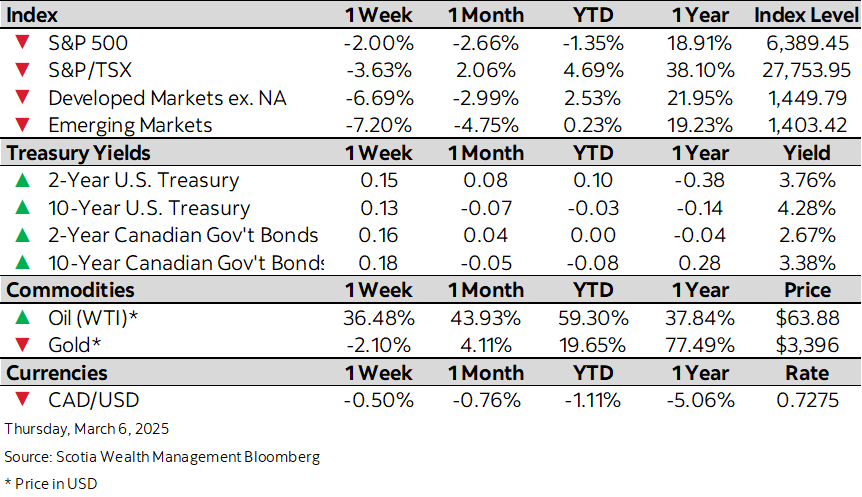
Equity markets were driven largely by escalating U.S.-Iran tensions, a sharp surge in energy prices, shifting policy expectations, and a weaker‑than‑expected U.S. employment report late in the week. In the U.S., early week risk aversion following the weekend Iran strikes pushed markets lower, while volatility intensified as oil supply fears, rising Treasury yields, softer payrolls data, and later week tariff headlines weighed on sentiment despite pockets of strong corporate earnings. In Canada, equity futures tracked global risk‑off moves, with markets pressured by higher domestic yields and sensitivity to oil‑driven inflation expectations. Europe faced the most acute selling, as soaring natural gas and crude prices prompted traders to scale back European Central Bank (ECB) and Bank of England (BoE) easing expectations, amplifying pressure on cyclicals. China and Emerging Markets saw broad weakness tied to energy price sensitivity, soft Chinese Purchasing Manager Index (PMI) data, and renewed trade policy uncertainty, though selective rebounds occurred after extreme moves in Korea and Hong Kong.

Highlights:

  • U.S. equities returned -2.00%1 as Middle East escalation drove oil and yields sharply higher, while later-week tariff signals and a softer-than-expected February employment report added to volatility regarding the future path of monetary policy despite pockets of stronger corporate earnings guidance.
  • Canadian equities returned -3.63%2 mirroring global risk-off sentiment as oil-driven inflation fears pushed domestic yields higher, over-shadowing energy-linked support for the currency and leaving markets sensitive to geopolitical headlines and implications for the Bank of Canada’s (BoC) trajectory.
  • European stocks returned -6.69%3 after experiencing outsized declines as surging crude and natural gas prices revived inflation concerns, causing investors to reduce expected ECB and BOE easing while tariff risks, political tensions, and softer corporate updated added persistent downwards pressure.
  • Emerging markets decreased -7.20%4 amid higher energy costs, soft Chinese manufacturing data, and renewed global trade uncertainty, with South Korea and Hong Kong particularly pressured before staging partial rebounds after margin-driven selling and geopolitical-linked volatility earlier in the week.

Bond yields broadly higher as energy shock reprices inflation and policy expectations

Fixed income markets were dominated by geopolitical escalation, a sharp rise in energy prices, and shifting monetary policy expectations that pushed global yields higher through most of the week. In the U.S., Treasurys initially sold off as crude driven inflation fears erased Friday’s haven bid, with additional pressure from resilient ADP data, firmer ISM services readings, and later week revisions to rate cut expectations following a weaker nonfarm payrolls report. In Canada, yields largely tracked U.S. moves, rising with concerns that elevated oil prices could complicate the Bank of Canada’s monetary policy path. Across Europe, inflationary risks from surging natural gas and crude prices led markets to scale back expectations for ECB and BoE easing, driving pronounced bear flattening. In Asia and Emerging Markets, Japanese yields moved modestly lower early in the week while broader EM rates faced upward pressure from geopolitical uncertainty, energy price shocks, and softer Chinese data.

Highlights:

  • The 2- and 10-Year U.S. Treasury yields were 15 bps and 13 basis point (bps) higher, respectively. In Canada, the 2- and 10-year yields were up 16 bps and 18 bps, respectively. Bond yields and prices move inversely to one another.
  • Global sovereign yields climbed through the week as surging oil prices, geopolitical escalation, resilient U.S. data, and reduced ECB and BoE easing expectations drove broad bear flattening and pressured rate cut assumptions across major markets.
  • Corporate markets absorbed rising yields and geopolitical volatility, with sentiment weakened by energy driven inflation risks and caution around private credit after BlackRock’s loan write off highlighted underwriting concerns in an already fragile credit environment.

Weekly dashboard


Canada’s economy contracted in the fourth quarter of 2025

Canada’s manufacturing sector grew for a second straight month in February as new business increased despite weak export sales and rising inflation pressures, data showed. The S&P Global Canada Manufacturing Purchasing Managers’ Index (PMI), a measure of factory sector health, rose to 51.0 last month from 50.4 in January, posting its highest level since January 2025.

Highlights:

  • The new orders index rose to 50.6 from 49.3 in January, marking the first month of growth since January last year, while the measure of new export orders was at 46.6, up from 44.6.
  • The employment index rose to 51.0 from 50.6 in January, driven by improved order books and long-term expansion plans. A measure of firms’ optimism climbed to the highest level since December 2024.
  • The input price index edged up to 59.1 from 59.0 in January, marking its highest level since August. Firms pointed to rising metals prices and higher imported raw material costs.

U.S. sheds 92,000 jobs in February; unemployment rate rises to 4.4%

The U.S. economy unexpectedly shed jobs in February amid a strike by healthcare workers and harsh winter weather, while the unemployment rate increased to 4.4%. Non-farm payrolls decreased by 92,000 jobs last month after a downwardly revised 126,000 increase in January, the U.S. Labor Department’s Bureau of Labor Statistics (BLS) said in its employment report. Economists had forecast payrolls advancing by 59,000 jobs after increasing by a previously reported 130,000 in January.

Highlights:

  • Economists said jobs gains in January had been boosted by an update of the birth-and-death model, which the BLS uses to estimate how many jobs were gained or lost because of companies opening or closing in a given month.
  • Job losses in February were broadly based. Healthcare jobs saw a huge swing down, going from 77,000 new jobs in January to 28,000 losses in February. Physician offices lost 37,000 jobs primarily due to strike activity. The information sector, which includes media and telecommunications, and transportation and warehousing trended down 11,000 each.
  • Federal government employment also continued to decline, dropping 10,000 last month. After reaching a peak in October 2024, federal government employment is down 11%, or 330,000 workers.

Eurozone inflation rises unexpectedly, with further risks on the horizon
Eurozone inflation picked up unexpectedly in February and could accelerate further if the rise in energy prices that followed U.S. and Israeli attacks on Iran is sustained. According to the European Union’s statistics agency Eurostat, consumer prices in the 21-member currency area were 1.9% higher than a year earlier compared with a 1.7% rise in January. That was above a consensus of economists, which expected the inflation rate to remain unchanged on month.

Highlights:

  • Eurozone energy prices, which are heavily influenced by international markets, slipped 3.2% in February compared with a 4% fall in January. Services inflation edged up to 3.4%.
  • A stronger euro, weak consumer demand and an influx of cheap goods from China have all put downward pressure on prices.
  • While Europe isn’t highly reliant on energy resources from the Persian Gulf region, an increase in global prices for oil and natural gas would ultimately feed through to prices in Europe, regardless of limited physical imports.

1  S&P 500 Index USD

2 S&P/TSX Composite Index USD

3 Bloomberg Developed Markets ex N. America Large & Mid Cap Price Return Index USD

4 Bloomberg EM Large & Mid Cap Price Return Index USD

This publication has been prepared by The Bank of Nova Scotia for Scotia Wealth Management clients. It is for general information purposes only and should not be considered or relied upon as personal and/or specific financial, tax, pension, insurance, legal or investment advice. We are not tax or legal advisors, and we recommend that individuals consult with their qualified advisors, including tax and legal advisors, before taking any action based upon the information contained in this publication. The opinions and projections contained in this publication are our own as of the date hereof and are subject to change without notice. Scotia Wealth Management is under no obligation to update this publication, and readers should assume the information contained herein will not be updated. While care and attention has been taken to ensure the accuracy and reliability of the material in this publication, neither The Bank of Nova Scotia nor any of its affiliates or any of their respective directors, officers or employees make any representations or warranties, express or implied, as to the accuracy or completeness of such material and disclaim any liability resulting from any direct or consequential loss arising from any use of this publication or the information contained herein. This publication may contain forward-looking statements based on current expectations and projections about future general economic factors. Forward-looking statements are subject to inherent risks and uncertainties which may be unforeseeable and such expectations and projections may be incorrect in the future. Forward-looking statements are not guarantees of future performance and you should avoid placing undue reliance upon them. This publication and all the information, opinions and conclusions contained herein are protected by copyright. This publication may not be reproduced in whole or in part without the prior express consent of The Bank of Nova Scotia. To the extent this document contains information or data obtained from third party sources, it is believed to be accurate and reliable as of the date of publication, but Scotia Wealth Management does not guarantee its accuracy or reliability.

® Registered trademark of The Bank of Nova Scotia, used under licence (where applicable). ™ Trademark of The Bank of Nova Scotia, used under licence (where applicable). Scotia Wealth Management® consists of a range of financial services provided by The Bank of Nova Scotia (Scotiabank®); The Bank of Nova Scotia Trust Company (Scotiatrust®); Scotia Jarislowsky Fraser, a service of 1832 Asset Management L.P.; 1832 Asset Management U.S. Inc.; Scotia Wealth Insurance Services Inc.; and ScotiaMcLeod®, a division of Scotia Capital Inc. Private banking services are provided by The Bank of Nova Scotia. Estate and trust services are provided by The Bank of Nova Scotia Trust Company. Portfolio management is provided by 1832 Asset Management L.P. and 1832 Asset Management U.S. Inc. Insurance services are provided by Scotia Wealth Insurance Services Inc. Wealth advisory and brokerage services are provided by ScotiaMcLeod, a division of Scotia Capital Inc. International investment advisory services are provided by Scotia Capital Inc. Financial planning services are provided by The Bank of Nova Scotia and ScotiaMcLeod. Scotia Capital Inc. is a member of the Canadian Investor Protection Fund and is regulated by the Canadian Investment Regulatory Organization. Scotia Wealth Insurance Services Inc. is the insurance subsidiary of Scotia Capital Inc., a member of the Scotiabank group of companies. When discussing life insurance products, ScotiaMcLeod advisors are acting as Life Insurance Agents (Financial Security Advisors in Quebec) representing Scotia Wealth Insurance Services Inc.

Scotia Wealth Management® in The Bahamas consists of a range of financial services provided by Scotiabank (Bahamas) Limited and The Bank of Nova Scotia Trust Company (Bahamas) Limited, which are entities licensed to operate within The Bahamas. International private banking and international investment advisory services are provided by Scotiabank (Bahamas) Limited. International wealth structuring solutions are provided by The Bank of Nova Scotia Trust Company (Bahamas) Limited. ® Registered trademark of The Bank of Nova Scotia, used under licence.

Scotia Wealth Management® in the Cayman Islands consists of a range of financial services provided by Scotiabank & Trust (Cayman) Ltd. International private banking services, international investment advisory services, and international wealth structuring solutions are provided by Scotiabank & Trust (Cayman) Ltd., an entity licensed by the Cayman Islands Monetary Authority. ® Registered trademark of The Bank of Nova Scotia, used under license.

Scotia Wealth Management® in Jamaica consists of a range of Private Banking services provided by the Scotiabank Group of companies (Scotiabank®). ®Registered trademark of The Bank of Nova Scotia, used under licence.