Subscribe to the 100% free rdnewsNOW daily newsletter!
sponsored

Market Watch – February 27, 2026

Feb 27, 2026 | 5:23 PM

This week’s highlights

  • AI disruption and rising inflation temper optimism
  • Global rates adjust to inflation signals and anticipated policy shifts
  • Canada’s economy contracted in the fourth quarter of 2025
  • U.S. consumer confidence improves modestly in February
  • German consumer confidence weakens as geopolitical uncertainty reigns

Week in review

AI disruption and rising inflation temper optimism

U.S. equities began the week under pressure as the administration’s tariff hike to 15% and the Supreme Court ruling on International Emergency Economic Powers Act (IEEPA) duties injected uncertainty, weighing on risk sentiment and legacy tech while IBM’s sharp selloff added further drag. Markets briefly firmed mid‑week as investors awaited Nvidia’s results and digested improving consumer confidence, but optimism faded when Producer Price Index (PPI) inflation surprised to the upside, pushing yields lower. In Canada, equities tracked U.S. swings while softer‑than‑expected GDP and inventory‑related volatility limited follow‑through. European markets were broadly constructive early on, supported by strong corporate earnings, before losing momentum on firmer inflation prints. In China and broader EM, mixed tech performance and uneven post‑holiday trading kept gains contained.

Highlights:

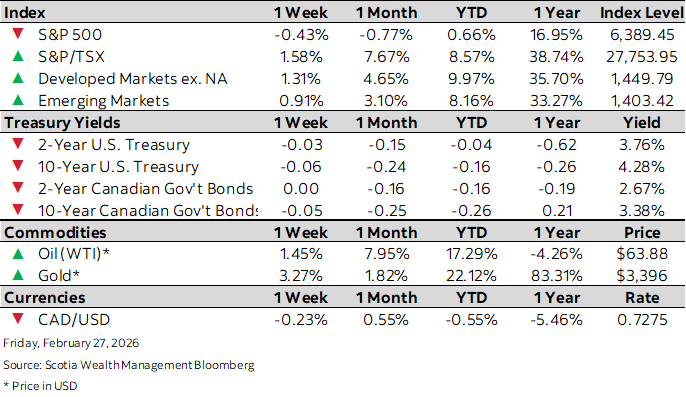
  • U.S. equities returned -0.43%1, fluctuating as escalating tariff uncertainty, tech weakness tied to AI disruption, and hotter-than-expected PPI data pressured sentiment despite strong megacap earnings and a mid-week boost from firmer consumer expectations.
  • Canadian equities returned 1.58%2 despite U.S. volatility, with weaker-than-forecast GDP driven by inventory swings and subdued domestic investment tempering early-week gains, even as consumption and exports strengthened into year-end.
  • European stocks returned 1.31%3, initially lifted by earnings strength and selective sector gains, but sentiment turned cautious as firmer inflation in France and Spain reinforced expectations for a more hawkish ECB policy.
  • Emerging markets increased 0.91%4 with holiday-related reopening dynamics, pressure on Hong Kong tech shares, and subdued mainland momentum contrasting with modest rebounds elsewhere in Asia.

Global rates adjust to inflation signals and anticipated policy shifts

U.S. rates traded defensively through the week as tariff uncertainty and shifting inflation expectations kept yields more sensitive to risk sentiment, with investors initially leaning toward safe‑haven duration before mid‑week consumer confidence data and firmer inflation expectations nudged yields higher. Canada’s curve moved in parallel, with modest early week declines giving way to slight upward pressure before Friday’s softer‑than‑expected GDP print tempered moves, as markets looked through inventory driven volatility. The weakness in risk assets also aided a flight to quality. European sovereign bonds held a mild bid for much of the week amid cautious policy expectations, though upside surprises in French and Spanish inflation later weakened the tone. Japanese yields rose on expectations of a more dovish Bank of Japan board, while other regional curves stayed largely tethered to global macro headlines.

Highlights:

  • The 2- and 10-Year U.S. Treasury yields were 3 bps and 6 basis point (bps) lower, respectively. In Canada, the 2- and 10-year yields were flat and 5 bps lower, respectively. Bond yields and prices move inversely to one another.
  • Sovereign debt traded on shifting macro signals, with U.S. yields pressured by tariff uncertainty and firmer inflation expectations, while Canada, Europe, and Japan saw curves rise modestly to softer GDP, mixed inflation data, and dovish BoJ developments.
  • Investment grade and high yield credit sentiment tracked broader macro dynamics, benefiting early from defensive positioning and stable earnings before late week inflation surprises and uncertainty around AI‑related investment cycles tempered risk appetite across higher beta segments.

Weekly dashboard


Canada’s economy contracted in the fourth quarter of 2025

Canada’s economy contracted in the fourth quarter, coming below expectations, as manufacturers heavily dipped into their inventories to meet demand instead of producing fresh goods, data showed. According to Statistics Canada (StatCan) gross domestic product (GDP) contracted at an annualized pace of 0.6% in the October-December quarter, compared with a revised 2.4% increase in the prior quarter.

Highlights:

  • This brings the country’s overall growth in 2025 to 1.7%, the slowest pace of annual growth since the decline in 2020, StatCan said.
  • Even though exports, household spending and government investment aided growth, it was not enough to offset the big dent caused by the impact of inventory drawdown last quarter as businesses withdrew $23.46 billion from their inventories.
  • Besides inventory impact, investments into building of apartments, condos and houses were the only other major factor that pulled the GDP down in the fourth quarter, with residential structure investment falling by an annualized 4.4% in the fourth quarter.

U.S. consumer confidence improves modestly in February

The American consumer’s confidence in the U.S. economy improved slightly in February. The U.S. Conference Board reported that its consumer confidence index rose to 91.2 in February from an upwardly revised 89 last month. A measure of Americans’ short-term expectations for their income, business conditions and the job market rose four points to 72, remaining well below 80, the marker that can signal a recession ahead. It was the 13th consecutive month that reading has come in under 80.

Highlights:

  • Respondents’ references to prices and inflation were little changed but remain elevated. Mentions of trade and politics increased, while references to labour market conditions eased as perceptions of the job market improved modestly.
  • According to the survey, consumers’ plans to buy big-ticket items over the next six months rose, with plans to buy used cars, furniture, TVs and smartphones leading the way.
  • Home-buying expectations were little changed in February, generally a slow time for the housing market, which has been mired in a yearslong slump.

German business sentiment strengthens as early signs of recovery emerge

Sentiment among German companies strengthened in February as the ifo Business Climate Index – a survey of 9,000 German businesses – improved, reflecting better assessments of current conditions and more optimistic expectations. Manufacturing and services showed notable gains, with logistics also rebounding. Construction confidence continued to firm, supported by improved outlooks despite a slow recovery in orders. Only the trade sector softened slightly, as weaker retail sentiment offset modest wholesale improvements.

Highlights:

  • The ifo Business Climate Index rose to 88.6 from 87.6, driven by companies reporting greater satisfaction with their current situation and modestly improved expectations, suggesting early signs of economic stabilization.
  • Manufacturing saw another increase, supported by significantly better evaluations of current business conditions, improving order trends, and an upward shift in production planning despite slightly weaker expectations.
  • Services and construction both reported improved business climates, with service‑sector expectations rising and construction firms more positive about both current activity and future conditions, though construction orders are recovering only gradually.

1  S&P 500 Index USD

2 S&P/TSX Composite Index USD

3 Bloomberg Developed Markets ex N. America Large & Mid Cap Price Return Index USD

4 Bloomberg EM Large & Mid Cap Price Return Index USD

Disclaimer

This publication has been prepared by The Bank of Nova Scotia for Scotia Wealth Management clients. It is for general information purposes only and should not be considered or relied upon as personal and/or specific financial, tax, pension, insurance, legal or investment advice. We are not tax or legal advisors, and we recommend that individuals consult with their qualified advisors, including tax and legal advisors, before taking any action based upon the information contained in this publication. The opinions and projections contained in this publication are our own as of the date hereof and are subject to change without notice. Scotia Wealth Management is under no obligation to update this publication, and readers should assume the information contained herein will not be updated. While care and attention has been taken to ensure the accuracy and reliability of the material in this publication, neither The Bank of Nova Scotia nor any of its affiliates or any of their respective directors, officers or employees make any representations or warranties, express or implied, as to the accuracy or completeness of such material and disclaim any liability resulting from any direct or consequential loss arising from any use of this publication or the information contained herein. This publication may contain forward-looking statements based on current expectations and projections about future general economic factors. Forward-looking statements are subject to inherent risks and uncertainties which may be unforeseeable and such expectations and projections may be incorrect in the future. Forward-looking statements are not guarantees of future performance and you should avoid placing undue reliance upon them. This publication and all the information, opinions and conclusions contained herein are protected by copyright. This publication may not be reproduced in whole or in part without the prior express consent of The Bank of Nova Scotia.

® Registered trademark of The Bank of Nova Scotia, used under licence (where applicable). ™ Trademark of The Bank of Nova Scotia, used under licence (where applicable). Scotia Wealth Management® consists of a range of financial services provided by The Bank of Nova Scotia (Scotiabank®); The Bank of Nova Scotia Trust Company (Scotiatrust®); Scotia Jarislowsky Fraser, a service of 1832 Asset Management L.P.; 1832 Asset Management U.S. Inc.; Scotia Wealth Insurance Services Inc.; and ScotiaMcLeod®, a division of Scotia Capital Inc. Private banking services are provided by The Bank of Nova Scotia. Estate and trust services are provided by The Bank of Nova Scotia Trust Company. Portfolio management is provided by 1832 Asset Management L.P. and 1832 Asset Management U.S. Inc. Insurance services are provided by Scotia Wealth Insurance Services Inc. Wealth advisory and brokerage services are provided by ScotiaMcLeod, a division of Scotia Capital Inc. International investment advisory services are provided by Scotia Capital Inc. Financial planning services are provided by The Bank of Nova Scotia and ScotiaMcLeod. Scotia Capital Inc. is a member of the Canadian Investor Protection Fund and is regulated by the Canadian Investment Regulatory Organization. Scotia Wealth Insurance Services Inc. is the insurance subsidiary of Scotia Capital Inc., a member of the Scotiabank group of companies. When discussing life insurance products, ScotiaMcLeod advisors are acting as Life Insurance Agents (Financial Security Advisors in Quebec) representing Scotia Wealth Insurance Services Inc.

Scotia Wealth Management® in The Bahamas consists of a range of financial services provided by Scotiabank (Bahamas) Limited and The Bank of Nova Scotia Trust Company (Bahamas) Limited, which are entities licensed to operate within The Bahamas. International private banking and international investment advisory services are provided by Scotiabank (Bahamas) Limited. International wealth structuring solutions are provided by The Bank of Nova Scotia Trust Company (Bahamas) Limited. ® Registered trademark of The Bank of Nova Scotia, used under licence.

Scotia Wealth Management® in the Cayman Islands consists of a range of financial services provided by Scotiabank & Trust (Cayman) Ltd. International private banking services, international investment advisory services, and international wealth structuring solutions are provided by Scotiabank & Trust (Cayman) Ltd., an entity licensed by the Cayman Islands Monetary Authority. ® Registered trademark of The Bank of Nova Scotia, used under license.

Scotia Wealth Management® in Jamaica consists of a range of Private Banking services provided by the Scotiabank Group of companies (Scotiabank®). ®Registered trademark of The Bank of Nova Scotia, used under licence.