
Subscribe to the 100% free rdnewsNOW daily newsletter!
(Image Credit: Scotia Wealth Management)
Sponsored

Market Watch: February 20

Feb 23, 2026 | 3:06 PM

This week’s highlights

  • Equities seek direction amid flurry of mixed data, policy, and geopolitical news
  • Sovereign yields converge on mixed economic data and shifting policy expectations
  • Canada’s annual inflation rate edges down in January as gasoline costs drop
  • U.S. Q4 GDP up just 1.4%, missing estimate; inflation firms at 3%
  • Europe’s exports to U.S. fell as imports from China rose

Week in review

Equities seek direction amid flurry of mixed data, policy, and geopolitical news

U.S. equities began the week cautiously as AI‑related disruption weighed on software names, though sentiment improved mid‑week on solid durable goods data, firmer housing indicators, and anticipation of the Fed minutes. Markets were strong to end the week despite weaker GDP print and a higher‑than‑expected Personal Consumption Expenditures (PCE) reading – the Federal Reserve’s preferred inflation gauge – revived risk aversion. This played out against the backdrop of the Supreme Court ruling IEEPA‑based tariffs unconstitutional and the administration announcing a re‑issued flat 10% tariff on all countries, with full details still forthcoming. In Canada, equities opened softer as cooler Consumer Price Index (CPI) data shifted rate expectations toward cuts, weakening the currency and offering limited support to stocks despite firmer retail sales later in the week. European markets were mixed early on divergent country performance, then strengthened on moderating U.K. inflation and better‑than‑expected Purchasing Managers’ Index (PMI) readings, though global risk‑off flows later pressured indices. Asian and broader EM equities were subdued amid Lunar New Year closures, Japan’s relative strength, and rising geopolitical uncertainty that supported commodities but dampened risk appetite.

Highlights:

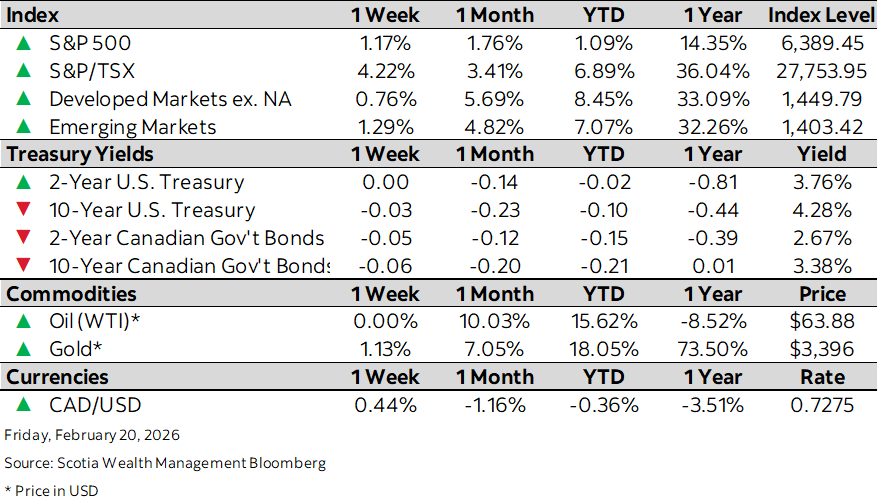
  • U.S. equities returned 1.17%1 as markets whipsawed on solid durable goods and housing data, contrasted against AI-related software weakness, disappointing GDP and PCE, and more hawkish Fed minutes.
  • Canadian equities returned 4.22%2 with stocks restrained mid-week after soft CPI data shifted expectations towards BoC cuts and weakened the CAD, limiting equity momentum despite firmer January retail sales later in the week and a modest pick-up in commodity stocks relating to heightened geopolitical tensions.
  • European stocks returned 0.76%3, with regional divergences early on, but broader strength emerging mid-week on moderating UK inflation and strong Eurozone PMIs, later succumbing to a more risk-off sentiment tied to U.S.-Iran tensions.
  • Emerging markets increased 1.29%4 amid widespread Lunar New Year closures, with Japan being a notable outperformer following last-week’s election. Broader Emerging Market sentiment softened amid U.S.-Iran tensions lifting commodities and the USD which weighed on regional risk appetite.

Sovereign yields converge on mixed economic data and shifting policy expectations

U.S. rates traded in narrow ranges early in the week, with Treasury yields inching higher as durable goods and housing data surprised to the upside and investors looked ahead to Fed minutes that signaled no urgency to cut rates. Mid‑week, stronger‑than‑expected core PCE and a disappointing GDP print kept front‑end yields supported as markets maintained expectations for only modest easing this year. In Canada, cooler‑than‑expected CPI shifted rate expectations toward cuts, pulling yields lower across the curve before stabilizing alongside retail sales data. European yields were mixed as U.K. employment and inflation releases reinforced confidence in near‑term BoE cuts, while Eurozone PMIs later supported long‑end declines. Across Asia and broader EM, Japanese yields fell following a strong 5‑year auction, while EM sovereign curves softened amid geopolitical‑driven commodity gains and a firmer U.S. dollar.

Highlights:

  • The 2- and 10-Year U.S. Treasury yields were flat and down 3 basis point (bps), respectively. In Canada, the 2- and 10-year yields were down 5 bps and 6 bps, respectively. Bond yields and prices move inversely to one another.
  • Sovereign bonds traded with a mild upward bias as firmer U.S. data, hotter PCE, and weaker GDP kept front‑end curves supported, while softer Canadian CPI and steady European PMIs created convergent moves across major markets.
  • Corporate credit held firm despite rate volatility, with solid earnings breadth and stable demand supporting IG spreads, while HY sentiment was more fragile as geopolitical tensions and rate uncertainty tempered risk appetite.

Weekly dashboard


Canada’s annual inflation rate edges down in January as gasoline costs drop

Canada’s annual inflation rate in January accelerated at a slower pace than the previous month as a big drop in gasoline prices helped cushion the impact of higher food and clothing prices, Statistics Canada (StatCan) reported. The consumer price index (CPI) rose 2.3% in January compared with 2.4% in December, beating analysts’ expected rise in consumer prices at 2.4%. On a monthly basis, the CPI was unchanged from the prior month, according to data.

Highlights:

  • Gasoline prices fell on average 16.7% in January, after a decline of 13.8% in December. Excluding gasoline, the CPI rose 3% in January, matching the increase in December, StatCan said.
  • Food prices rose 7.3%, largely based on food from restaurants, and the category containing primarily alcoholic beverages rose 4.8% in January. Excluding food and energy, the CPI rose 2.4% year-over-year in January, following a 2.5% increase in December.
  • Shelter costs, which account for the biggest weight in the CPI basket, continued to rise at a slower pace and rose 1.7% last month from a year earlier.

    U.S. Q4 GDP up just 1.4%, missing estimate; inflation firms at 3%

    U.S. growth slowed more than expected near the end of 2025 as the government shutdown impacted spending and investment, while a key inflation metric showed high prices are still a factor for the economy, according to data released by the U.S. Commerce Department. Gross domestic product (GDP) rose at an annualized rate of just 1.4%, well below analysts’ estimate for a 2.5% gain.

    Highlights:

    • Consumer spending increased at a slower pace for the period while government spending tumbled sharply in a quarter marked by the record-length shutdown.
    • For the full year in 2025, the U.S. economy grew at a 2.2% pace, down from the 2.8% increase in 2024.
    • The core personal consumption expenditures price index, which excludes food and energy, rose 3% in December, up 0.2% from November, according to a separate release. That matched the consensus forecast but kept the pivotal inflation measure well above the Fed’s 2% target.

      Europe’s exports to U.S. fell as imports from China rose
      The European Union’s exports to the U.S. fell last year amid higher tariffs imposed by President Donald Trump, with those increased duties pushing Chinese businesses to seek and find new customers in the bloc. The European Union’s statistics agency reported exports of goods from the EU to the rest of the world rose 2% in 2025 to €2.6 trillion.

      Highlights:

      • The strength of exports has surprised policymakers and is one of the reasons why the eurozone economy grew more rapidly last year than many had expected. Eurostat confirmed that the eurozone’s gross domestic product increased 1.5% last year, its fastest expansion since 2022.
      • However, imports increased at a faster 2.4% pace to €2.5 trillion. As a result, the EU’s trade surplus in goods fell to €133.5 billion from €140.6 billion in 2024.
      • For many European policymakers, the rise in imports is partly the result of weak demand and too much capacity in China largely due to subsidies and other government interventions.