Subscribe to the 100% free rdnewsNOW daily newsletter!
(Image Credit: Scotia Wealth Management)
Sponsored

Market Watch: February 13, 2026

Feb 17, 2026 | 4:04 PM

This week’s highlights

  • Markets remain resilient despite AI pressures continuing to ripple though global markets
  • Cooler U.S. inflation continues bond rally
  • Canada building permits rebound in December
  • U.S. adds 130,000 jobs in January, beating expectations
  • China’s consumer inflation eases, producer prices stay in decline

Week in review

Markets remain resilient despite AI pressures continuing to ripple though global markets

U.S. and Canadian equities began the week on a positive note ahead of an updated U.S. jobs report coming later in the week and a rebound in technology stocks from last week’s slide. However, by mid-week, investors renewed their selloff of technology shares as ⁠investors worried about artificial intelligence disruption and the potential for fewer U.S. Federal Reserve (Fed) interest rate cuts than previously hoped, with industrial and metal mining shares leading the declines. By Friday, losses were pared after a softer-than-expected inflation report renewed hopes the Fed would deliver further interest rate cuts this year. Canadian markets saw a record closing high on Tuesday, but this was reversed later in the week with a technology selloff and a drop in oil prices as investors weighed the International Energy Agency’s lowering of its global oil demand forecast for 2026. After a softer-than-expected U.S. inflation report, stocks rebounded Friday. European stocks were mixed early on but became broadly green mid-week. This was reversed by week’s end as Wall Street’s AI selloff caused stocks to trade lower despite some large-cap aerospace and defense names like Safran rallying. Asian markets had a strong start to the week on the back of Japan’s election results after PM Takaichi’s ruling coalition took a super majority as markets are betting on Takaichi to further open the stimulus taps. This positive trend continued through the week despite a pullback on Friday over tech concerns and some profit taking.

Highlights:

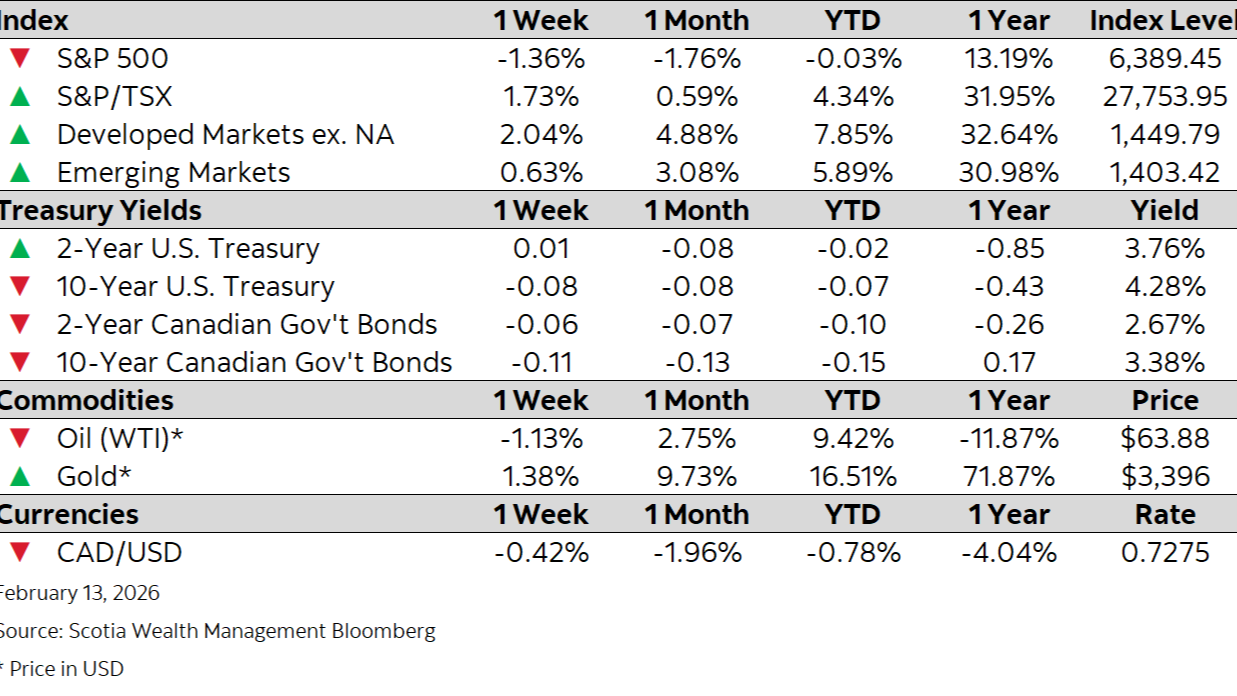
  • U.S. equities returned -1.36%1 as enthusiasm of a better-than expected January jobs report faded and AI disruption concerns continued. Markets were steadied on Friday after an encouraging update on inflation helped calm Wall Street.
  • Canadian equities returned 1.73%2, with performance driven by commodity swings and continued AI anxieties. The week was capped by a rising index on Friday led by consumer discretionary and mining shares, and positive U.S. inflation data.
  • European stocks returned 2.04%3 having reached record highs earlier in the week but tracked lower as investors digested a fresh batch of corporate earnings economic data and AI tech concerns.
  • Emerging markets increased 0.63%4 reaching all-time highs. Despite a mostly solid week, global AI driven tech volatility revealed the ripple effects across sectors, regions and asset classes and tempered growth by week’s end.

Cooler U.S. inflation continues bond rally

In the U.S., bond markets opened the week continuing their rally while waiting on key jobs and inflation data. While a better-than-expected jobs report drove U.S. bond yields higher, a softer than expected reading on inflation Friday helped continue the bond rally. Despite cooler than expected inflation, the Fed is still expected be on hold until June with the potential for three rate cuts by year end. European sovereigns followed the U.S.’ lead with eurozone GDP coming in as expected while U.K. GDP slightly disappointed. On the corporate debt side, recent volatility seen in software equities is having a modest effect on the high yield (HY) market.

Highlights:

  • Two-year U.S. Treasury yields were up 1 basis point (bps) while 10-year Treasuries were down 8 bps. In Canada, the 2- and 10-year yields were down 6 bps and 8 bps, respectively. Bond yields and prices move inversely to one another.
  • Sovereign curves were driven primarily by improving U.S. employment and inflation with Canada light on data and European GDP coming relatively in line with expectations.
  • Credit premiums continued to trade higher in the past month but remain relatively low by historical standards. The recent disruption in the software sector is affecting small pockets of credit in the HY market, which has relatively low exposure to the space (estimated at less than 5.0%, whereas software debt comprises about 15.0% of leveraged loans index.

Weekly dashboard


Canada building permits rebound in December

According to Statistics Canada, the total value of building permits issued in Canada in December increased $821.3 million (+6.8%) to $12.8 billion. The increase was led by the residential sector (+$533.5 million) and supported by the non-residential sector (+$287.8 million). On a constant dollar basis, the total value of building permits issued in December grew 6.6% from the previous month and was down 6.3% on a year-over-year basis.

Highlights:

  • Residential construction intentions increased $533.5 million, bringing the total value to $8.0 billion. Gains recorded in the multi-unit component (+$653.2 million to $5.5 billion) were tempered by a decline in the single-family component (-$119.7 million to $2.5 billion).
  • The multi-unit component gains were largely attributed to Ontario, Manitoba and Quebec, with a total of six provinces and two territories contributing to the increase, while a decline in the single-family component was driven by Ontario and Saskatchewan.
  • The value of non-residential building permits increased $287.8 million to $4.8 billion. The institutional component drove the growth, while both the commercial (-$71.1 million) and industrial (-$53.8 million) components moderated it.

    U.S. adds 130,000 jobs in January, beating expectations

    The U.S. added 130,000 jobs in January, surging past expectations and marking a strong start to the year following a weak year of job growth. The January numbers from the U.S. Labor Department were above the seasonally adjusted 48,000 jobs added in December, which were revised slightly lower. Economists were expecting 55,000 jobs in January.

    Highlights:

    • The unemployment rate, which is based on a separate survey from the jobs figures, fell to 4.3% from 4.4%.
    • The U.S. Federal Reserve at its last meeting in late January held interest rates steady after three consecutive cuts, with Fed Chair Jerome Powell citing stronger economic growth and tentative signs of labour market stabilization.
    • Economists say that tax cuts and investment incentives created by last summer’s sprawling tax-and-spending legislation could boost hiring in 2026, even amid uncertainties surrounding inflation and tariffs.

      China’s consumer inflation eases, producer prices stay in decline
      China’s consumer inflation eased at the start of 2026 after reaching a near three-year high in December, as food prices declined. According to the National Bureau of Statistics, the consumer price index (CPI) rose 0.2% in January from a year earlier, slowing from December’s 0.8% gain. Economists had forecast a 0.4% increase.

      Highlights:

      • Food prices fell 0.7% on year, reversing December’s 1.1% rise. Non-food prices increased 0.4%, compared with a 0.8% gain in December. Core CPI, which excludes food and energy, rose 0.8% from a year earlier, down from December’s 1.2% increase.
      • China’s producer price index fell 1.4% in January from a year earlier, narrowing from December’s 1.9% decline but remaining in deflation for a 40th straight month. The reading compared with economists’ expectations for a 1.5% drop.
      • On a monthly basis, PPI rose 0.4% in January from December, accelerating from a 0.2% increase, driven by a surge in nonferrous metal prices, the statistics bureau said.

        1  S&P 500 Index USD2 S&P/TSX Composite Index USD3 Bloomberg Developed Markets ex N. America Large & Mid Cap Price Return Index USD4 Bloomberg EM Large & Mid Cap Price Return Index USD