Subscribe to the 100% free rdnewsNOW daily newsletter!
Sponsored

Market Watch – Jan. 23, 2026

Jan 26, 2026 | 10:32 AM

This week’s highlights

  • Markets stabilize after early-week geopolitical unrest
  • Yields jump on tariff shock, settle mid-week
  • Canada’s inflation rate rises to 2.4% in December, but core measures ease
  • Fed’s preferred inflation measure ticks higher as Americans keep spending
  • China reports robust economic growth, thanks to resilient exports

Week in review

Markets stabilize after early-week geopolitical unrest

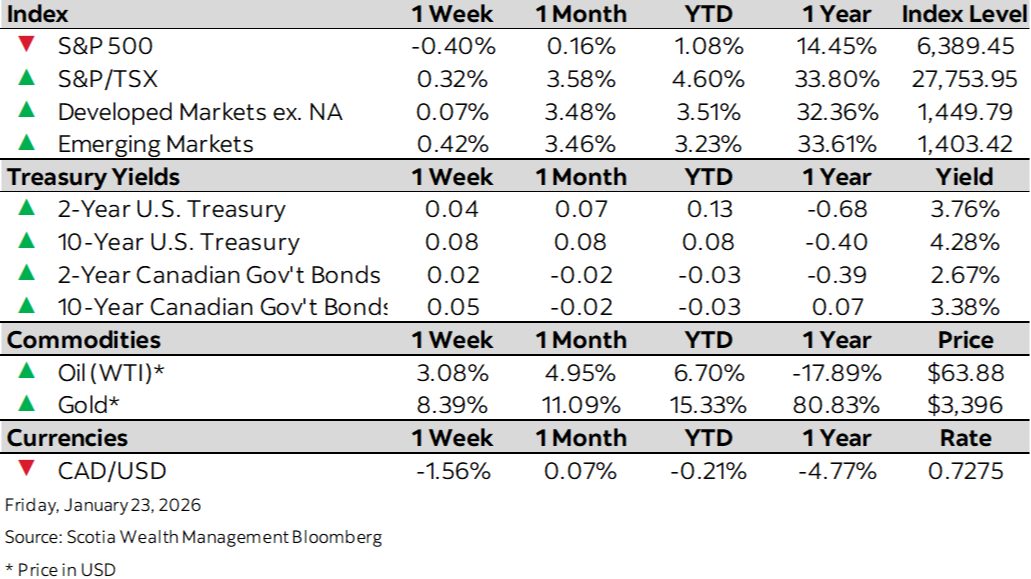
U.S. equities began the week on Tuesday under pressure as escalating U.S.–EU trade tensions over Greenland and rising global bond yields weighed on sentiment, with volatility intensifying mid‑week as geopolitical risks overshadowed earnings. Markets stabilized Thursday after the U.S. softened its stance, helped by strong U.S. GDP revisions and resilient labour data, though Friday’s tone remained muted on mixed corporate results. In Canada, softer core inflation, cautious sentiment in Bank of Canada (BoC) surveys, and stable yields kept equities moving largely in line with broader risk appetite. European markets mirrored North America with tariff fears, rising sovereign yields, uneven PMI data, and U.K. inflation dynamics crowded out by the flurry of macro headlines. In China and EM, uneven Chinese growth data, subdued consumption, and ongoing property sector drag tempered gains despite solid industrial activity and a constructive global tech backdrop.

Highlights:

  • U.S. equities returned -0.40%1 as early‑week tariff threats and rising yields collided with firmer GDP data and a resilient labour market, all against a backdrop of softer corporate guidance.
  • Canadian equities returned 0.32%2, pressured by geopolitical tension and survey‑based signs of softer business and consumer sentiment, while easing core inflation and relatively stable yields anchored expectations ahead of next week’s BoC decision.
  • European stocks returned 0.07%3 as mounting tariff risks, higher yields, and mixed PMIs dragged, with sentiment only briefly lifting as geopolitical tensions eased.
  • Emerging markets returned 0.42%4 with weak consumption and property strain in China balancing stronger industrial production and exports, while late-week sentiment improved as geopolitical tensions eased and AI-linked momentum provided a tail wind.

Yields jump on tariff shock, settle mid-week

U.S. rates swung sharply as early‑week tariff threats and widening fiscal concerns drove long‑end underperformance, with yields climbing before stabilizing mid‑week as geopolitical tensions eased and GDP revisions and firm labour data helped anchor expectations for unchanged near‑term Fed policy. In Canada, softer core inflation and subdued business and consumer survey results kept the curve relatively steady, with markets maintaining expectations for a patient BoC. European yields moved higher through most of the week as tariff risks, stronger PMIs, and upside surprises in U.K. retail sales and inflation added pressure before moderating slightly. In Japan, snap‑election uncertainty and expectations for expanded fiscal spending pushed ultralong JGB yields to multi‑decade highs early in the week before partial retracement following official efforts to calm markets.

Highlights:

  • The 2- and 10-year U.S. Treasury yields rose 4 basis points (bps) and 8 bps, respectively. In Canada, the 2- and 10-year yields were up 2 bps and 5 bps, respectively. Bond yields and prices move inversely to one another.
  • Sovereign bond markets saw sharp early week selloffs as tariff risks, fiscal uncertainty, and Japan’s snap election volatility pushed global yields higher before moderating mid week when geopolitical tensions eased and U.S. data steadied rate expectations.
  • Credit markets navigated widening macro uncertainty, with soft corporate guidance and rising government yields pressuring spreads early in the week, while late week stabilization in geopolitical risk helped IG and HY sentiment firm modestly.

Weekly dashboard

Canada’s inflation rate rises to 2.4% in December, but core measures ease

Statistics Canada (StatCan) says the end of the federal government’s tax holiday a year earlier pushed the annual pace of inflation up to 2.4% in December. Economists had expected the annual inflation rate would hold steady at 2.2%. StatCan said Ottawa’s move to take GST off some items for two months starting mid-December in 2024 dropped prices for dining out, alcohol, children’s toys and more a year earlier, but those discounts fell out of the annual comparison and pushed the consumer price index higher to end the year.

Highlights:

  • Overall, the cost of food bought from the grocery store rose 5% annually, though StatCan said price levels were broadly unchanged month-to-month.
  • Grocery store inflation has been accelerating in recent months, the agency said the price of coffee was up more than 30% in December, while the cost of fresh or frozen beef rose 16.8%.
  • Offsetting December’s inflation hike was a 13.8% drop in the cost of gasoline. Statscan pointed to an oversupply of crude oil globally that drove down prices.

Fed’s preferred inflation measure ticks higher as Americans keep spending

The U.S. Federal Reserve’s (Fed) preferred inflation gauge, the Personal Consumption Expenditures Index (PCE) ticked up in November, the latest sign that prices remain stubbornly elevated, while consumers spent at a healthy pace. The U.S. Commerce Department reported that consumer prices rose 2.8% in November from a year earlier, up from a 2.7% annual pace in October. Excluding the volatile food and energy categories, core prices also increased 2.8% in November from a year ago.

Highlights:

  • Consumer spending climbed 0.5% in November from the previous month, the report also showed, a solid increase that hits at an economy growing at a healthy pace in the final three months of last year.
  • The figures point to a mostly strong economy with inflation still elevated, but down sharply from a four-decade peak in June 2022. Hiring has slowed, leaving job-seekers frustrated even as the unemployment rate stays low.
  • The report’s findings (delayed by the six-week government shutdown last fall)  suggest that the Fed may be less likely to reduce its key interest rate when it meets next week, a tact typically used if it is worried about a stumbling economy.

China reports robust economic growth, thanks to resilient exports
A surge in exports powered China’s growth last year, defying expectations that a trade war with the U.S. would hobble the world’s second-biggest economy. China’s gross domestic product (GDP) expanded 5% last year when adjusted for deflation, according to data released this week by the country’s National Bureau of Statistics. That met Beijing’s official growth target and was in line with the 5% real GDP growth notched in 2024.

Highlights:

  • Exports made up 33% of China’s economic growth last year, according to the statistics bureau, the highest share since 1997. Last week, China’s customs agency reported a record US$1.19 trillion trade surplus for 2025, driven by a 5.5% increase in exports.
  • Some economists call China’s growth two-speed or K-shaped. Exports keep surging, while the property market labours, consumer spending is tepid and much of the economy is struggling with deflation, eating away at profits and income.
  • Momentum stalled as the year went on, signalling the difficulty of keeping up the pace of expansion in 2026. For the fourth quarter, China said its economy grew 4.5% from the same period a year prior, slowing from 4.8% for the third quarter.