
Get the free daily rdnewsNOW newsletter by subscribing here!
sponsored

Market Watch – Dec. 5, 2025

Dec 8, 2025 | 12:49 PM

This week’s highlights

  • Mid-week sentiment surge moves equity markets into positive territory
  • Divergent policy signals drive rate swings
  • Canada’s unemployment rate falls to 6.5%, driven by rise in part-time work
  • U.S. manufacturing contracts for ninth straight month
  • China’s manufacturing gauge shows slightly firmer growth momentum

Week in review

Mid-week sentiment surge moves equity markets into positive territory

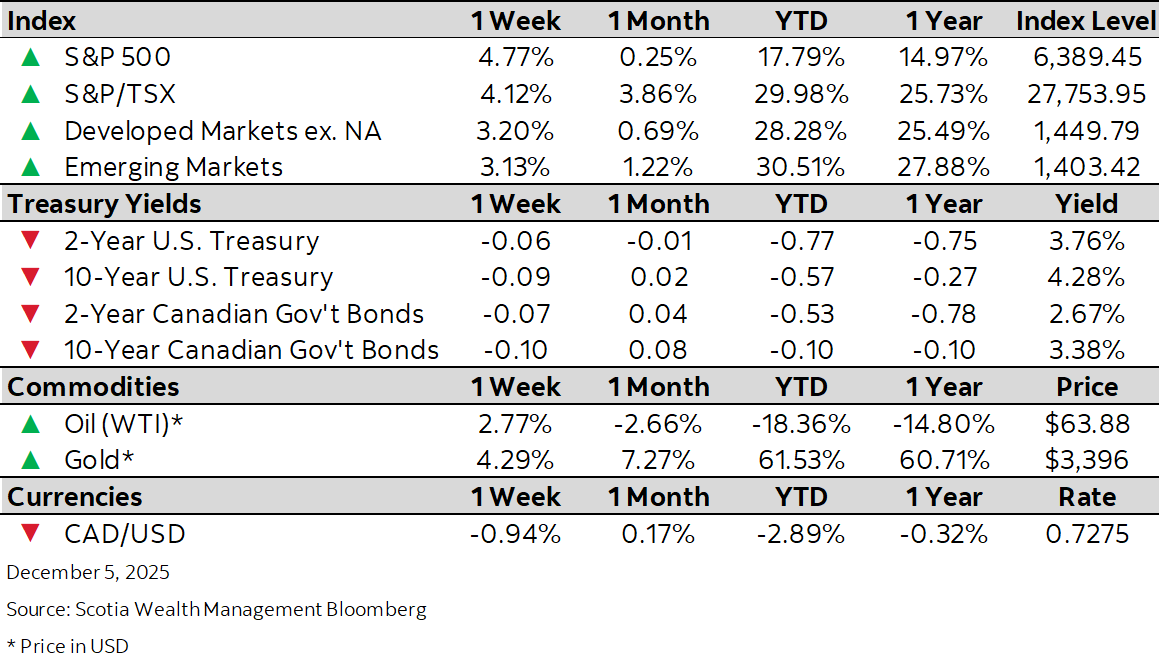
U.S. equities began the week rangebound as hawkish Bank of Japan (BoJ) signals and cautious sentiment tempered optimism around Fed easing, with valuations remaining a headwind. Mid-week, momentum softened after reports of weaker AI-related demand at Microsoft and a disappointing ADP employment print reinforced labour market concerns, while Thursday’s Challenger and ISM data highlighted persistent weakness across services and manufacturing—supporting expectations for continued Fed cuts and offering some relief to equities. Canadian markets mirrored early U.S. moves but later found support from a strong November jobs report, which erased rate-cut bets and boosted the loonie. European stocks advanced on steady inflation readings and upbeat retail earnings, while in Asia, Japanese equities swung on BoJ hike expectations and Chinese benchmarks lagged as PMI data underscored slowing growth and property sector stress.

Highlights:

  • U.S. equities returned 4.77%1 with headlines regarding Microsoft’s AI sales and weaker labour data shifting attention to economic fragility and central bank support that placed a bid under equities.
  • Canadian equities returned 4.12%2, initially mirroring rangebound U.S. markets, but diverging late-week as a strong jobs report erased rate-cut bets, lifted the currency, and tempered expectations for further near-term monetary easing.
  • European stocks rose 3.20%3 supported by inflation readings that validated the European Central Bank’s (ECB) wait-and-see stance and upbear retail earnings despite broader global uncertainty. .
  • Emerging markets were 3.13%4 higher despite Chinese benchmarks lagging on weak PMI readings and deepening property-sector-stress, while muted domestic demand reinforced concerns about slowing growth. Elsewhere, sentiment was uneven as commodity-linked markets tracked geopolitical risks and currency volatility.

Divergent policy signals drive rate swings

U.S. rates moved higher across the full curve throughout the week; beginning with a bear-steepener early in the week as hawkish BoJ commentary and heavy corporate issuance pushed yields towards the long-end of the curve higher, before reversing midweek on dovish Fed expectations following soft labour signals from ADP and ISM surveys. Canadian bonds mirrored global weakness initially but rose sharply Friday after a strong jobs report erased easing bets and even introduced speculation of future hikes. In Europe, gilts and Bunds saw modest swings, with steady inflation reinforcing the ECB’s hold stance, while late-week fiscal headlines in Germany added colour without shifting the broader tone. Japanese yields climbed throughout as markets priced near-certainty of a December BoJ hike despite fiscal stimulus chatter, contrasting with muted moves elsewhere in Asia as Chinese data underscored slowing growth without prompting immediate policy action.

Highlights:

  • The 2- and 10-year U.S. Treasury yields fell 6 basis points (bps) and 9 bps, respectively. In Canada, the 2- and 10-year yields were down 7 bps and up 10 bps, respectively. Bond yields and prices move inversely to one another.
  • Government bond markets swung on policy expectations, with U.S. and Canadian yields initially rising on hawkish BoJ signals before easing midweek on soft labour data, while Japanese curves steepened sharply as jobs strength and hike odds dominated late-week moves.
  • Credit spreads faced pressure early amid middling sentiment and heavy issuance, but stabilized as dovish Fed expectations gained traction; high-yield performance remained sensitive to tech headlines and labour softness, reflecting cautious positioning into year-end.

Weekly dashboard

Canada’s unemployment rate falls to 6.5%, driven by rise in part-time work

Canada’s unemployment rate once again defied expectations and fell to a 16-month low in November as a solid gain in part-time jobs boosted the number of people employed for the third time in a row. According to Statistics Canada (StatCan), the unemployment rate fell 0.4 percentage points in November to 6.5%, the lowest since July 2024, adding it was led by 53,600 net job gains in November mainly among youth. Analysts had forecast employment to reduce by 5,000 jobs in November and the jobless rate to tick up to 7%.

Highlights:

  • The job gains were driven by 63,000 net additions in part-time work force linked to healthcare and social assistance sector, StatCan said.
  • With three months in a row of job gains, the Canadian economy has now added 181,000 new jobs since September, offsetting an almost no change in jobs for the first eight months when U.S. tariffs and trade uncertainty choked hiring.
  • The average hourly wage of permanent employees, a gauge closely tracked by the Bank of Canada to ascertain inflationary trends, stayed at 4% in November, same as the previous month.

U.S. manufacturing contracts for ninth straight month

U.S. manufacturing activity contracted for the ninth consecutive month in November, a decline manufacturers attribute largely to U.S. President Trump’s tariffs. The Institute for Supply Management’s PMI for manufacturing came in at 48.2, a decrease from 48.7 in October. The level was below the 50 score that divides contraction from expansion. The level was below the 50 score that divides contraction from expansion.

Highlights:

  • Tariffs on U.S. imports has made it more expensive for U.S. producers to source materials from abroad needed in their processes. Uncertainty concerning tariff levels has also weighed on manufacturers, as duty levels have fluctuated for much of the year.
  • Many companies have held back on hiring as they try to manage higher input costs and weakening orders. In ISM’s survey, 67% of respondents said they were managing head count as opposed to hiring.
  • Industries that contracted included apparel, textiles, paper products, chemicals and transportation equipment. Transportation in particular, tariffs have led some companies to move manufacturing overseas instead of reshoring to the U.S., said ISM.

China’s manufacturing gauge shows slightly firmer growth momentum
China’s official factory gauge edged up on stronger production and demand in November but remained in contraction for an eighth straight month. According to China’s National Bureau of Statistics, the official manufacturing purchasing managers index rose to 49.2 in November, compared with 49.0 in October. The result undershot the forecast of 49.3 made by economists.

Highlights:

  • The production subindex rose to 50.0 in November from 49.7 in October. New orders increased to 49.2, compared with October’s 48.8, while new export orders rose to 47.6 in November from 45.9 in October.
  • China’s nonmanufacturing PMI, which covers both service and construction activity, fell to 49.5 in November from 50.1 in October.
  • The subindex tracking service activity fell to 49.5 in November, compared with 50.2 in October, and construction remained in contraction territory amid the country’s prolonged property slump.

1 S&P 500 Index USD
2 S&P/TSX Composite Index USD
3 Bloomberg Developed Markets ex N. America Large & Mid Cap Price Return Index USD
4 Bloomberg EM Large & Mid Cap Price Return Index USD

This publication has been prepared by The Bank of Nova Scotia for Scotia Wealth Management clients. It is for general information purposes only and should not be considered or relied upon as personal and/or specific financial, tax, pension, insurance, legal or investment advice. We are not tax or legal advisors, and we recommend that individuals consult with their qualified advisors, including tax and legal advisors, before taking any action based upon the information contained in this publication. The opinions and projections contained in this publication are our own as of the date hereof and are subject to change without notice. Scotia Wealth Management is under no obligation to update this publication, and readers should assume the information contained herein will not be updated. While care and attention has been taken to ensure the accuracy and reliability of the material in this publication, neither The Bank of Nova Scotia nor any of its affiliates or any of their respective directors, officers or employees make any representations or warranties, express or implied, as to the accuracy or completeness of such material and disclaim any liability resulting from any direct or consequential loss arising from any use of this publication or the information contained herein. This publication may contain forward-looking statements based on current expectations and projections about future general economic factors. Forward-looking statements are subject to inherent risks and uncertainties which may be unforeseeable and such expectations and projections may be incorrect in the future. Forward-looking statements are not guarantees of future performance and you should avoid placing undue reliance upon them. This publication and all the information, opinions and conclusions contained herein are protected by copyright. This publication may not be reproduced in whole or in part without the prior express consent of The Bank of Nova Scotia.

® Registered trademark of The Bank of Nova Scotia, used under licence. ™ Trademark of The Bank of Nova Scotia, used under licence. Scotia Wealth Management® in Canada consists of a range of financial services provided by The Bank of Nova Scotia (Scotiabank®); The Bank of Nova Scotia Trust Company (Scotiatrust®); Private Investment Counsel, a service of 1832 Asset Management L.P.; 1832 Asset Management U.S. Inc.; Scotia Wealth Insurance Services Inc.; and ScotiaMcLeod®, a division of Scotia Capital Inc. Private banking services are provided by Scotiabank. Estate and trust services are provided by The Bank of Nova Scotia Trust Company. Portfolio management is provided by 1832 Asset Management L.P. and 1832 Asset Management U.S. Inc. Insurance services are provided by Scotia Wealth Insurance Services Inc. Wealth advisory and brokerage services are provided by ScotiaMcLeod, a division of Scotia Capital Inc. International investment advisory services are provided by Scotia Capital Inc. Financial planning services are provided by Scotiabank and ScotiaMcLeod. Scotia Capital Inc. is a member of the Canadian Investor Protection Fund and regulated by the Canadian Investment Regulatory Organization. Scotia Wealth Insurance Services Inc. is the insurance subsidiary of Scotia Capital Inc., a member of the Scotiabank group of companies. When discussing life insurance products, ScotiaMcLeod advisors are acting as Life Insurance Agents (Financial Security Advisors in Quebec) representing Scotia Wealth Insurance Services Inc.

Scotia Wealth Management® in The Bahamas consists of a range of financial services provided by Scotiabank (Bahamas) Limited and The Bank of Nova Scotia Trust Company (Bahamas) Limited, which are entities licensed to operate within The Bahamas. International private banking and international investment advisory services are provided by Scotiabank (Bahamas) Limited. International wealth structuring solutions are provided by The Bank of Nova Scotia Trust Company (Bahamas) Limited. ® Registered trademark of The Bank of Nova Scotia, used under licence.

Scotia Wealth Management® in the Cayman Islands consists of a range of financial services provided by Scotiabank & Trust (Cayman) Ltd. International private banking services, international investment advisory services, and international wealth structuring solutions are provided by Scotiabank & Trust (Cayman) Ltd., an entity licensed by the Cayman Islands Monetary Authority. ® Registered trademark of The Bank of Nova Scotia, used under license.

Scotia Wealth Management® in Jamaica consists of a range of Private Banking services provided by the Scotiabank Group of companies (Scotiabank®). ®Registered trademark of The Bank of Nova Scotia, used under licence.