Get the free daily rdnewsNOW newsletter by subscribing here!
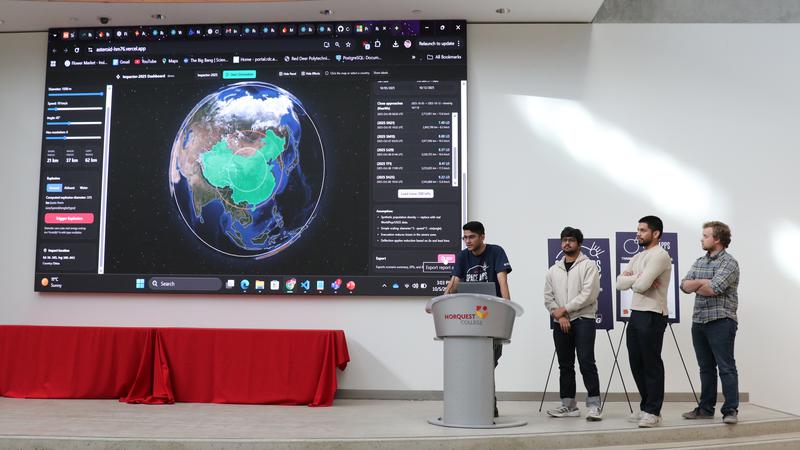
A team from Red Deer Polytechnic won a recent hackathon at NorQuest College. (Supplied)
eureka!

RDP team wins NorQuest hackathon by simulating impact of asteroid hitting Earth

Oct 20, 2025 | 12:40 PM

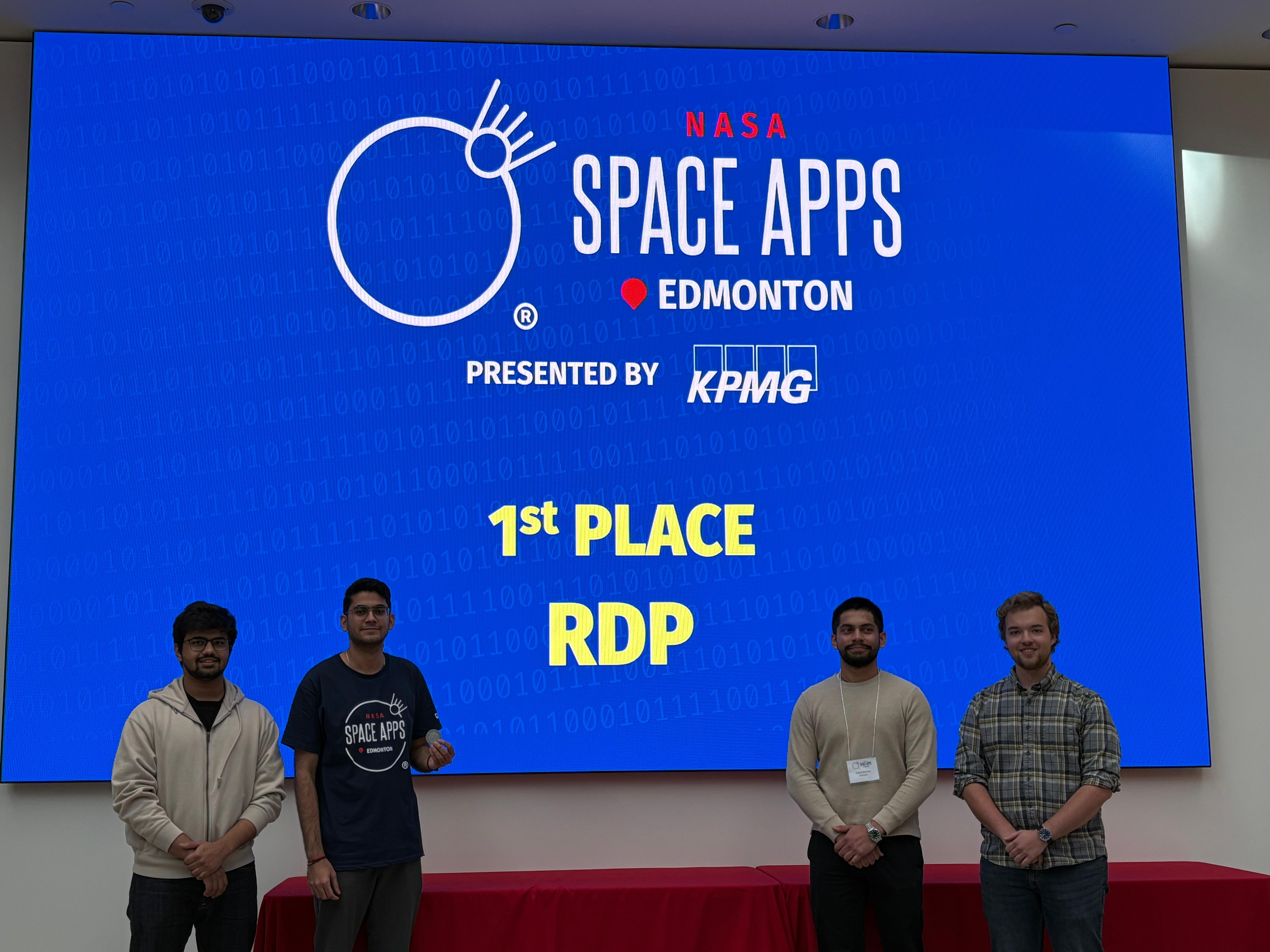
A group of Red Deer Polytechnic students recently put their big brains to the test, and won a hackathon at Edmonton’s NorQuest College.

The competition gave participants the chance to test their agriculture, science, and story-telling skills during what was officially dubbed the NASA International Space Apps Challenge.

Participants used open data from NASA and the Canadian Space Agency to address hypothetical unique challenges on Earth and in space.

Akshun Chauhan, a computer programming diploma graduate from RDP, explained that his team developed an interactive web-based simulation tool that models the impact of an asteroid on Earth in real time.

“The project combined data visualization, physics modeling, and artificial intelligence to help users understand and respond to a potential asteroid threat,” he explained.

“Built with a React frontend and a Node.js backend, the tool features a 3D globe where users can choose any location on Earth, customize asteroid properties like size, speed, and angle, and instantly visualize the resulting damage zones, population impact, and potential casualties. Using technologies like Three.js and Deck.gl, we created a high-performance, immersive 3D experience that’s both educational and engaging.”

The team also included three second-year computer programming diploma students: Jaren Wheeler, Yaksh Sharma and Avi Pancholi.

(Supplied)

Chauhan further explained that their model wasn’t just a visualization, but also a decision support system.

“After simulating the impact, the user can request AI-generated mitigation strategies, which include early deflection missions, emergency evacuation plans, and post-impact recovery actions,” he shared.

“This transforms the experience from theoretical science into practical planetary defense planning, bridging the gap between data, technology, and policy.”

Chauhan added the biggest takeaway was seeing how data and technology can play a crucial role in planetary defense, while also highlighting the power of global collaboration.

“The hackathon showed us that by combining science, AI, and user-focused design, even complex issues like asteroid impacts can be made understandable and actionable for a wide audience.”

For winning, the group will be nominated for a similar international competition, in which their work will be reviewed by NASA. Each team member also received recognition from the Canadian Space Agency, along with an Artemis mission patch of astronaut Jeremy Hansen.