
Get the free daily rdnewsNOW newsletter by subscribing here!
sponsored

Market Watch – Oct. 3, 2025

Oct 3, 2025 | 4:28 PM

This week’s highlights

  • Risk appetite improves on tech strength amid mixed economic signals
  • Bond markets price in additional Fed easing as shutdown delays key data
  • Canadian manufacturing PMI falls in September as downturn deepens
  • U.S. lost 32,000 jobs in September as labour force continues to deteriorate
  • Eurozone inflation hits 5-month high, ECB expected to stay cautious

Week in review

Risk appetite improves on tech strength amid mixed economic signals

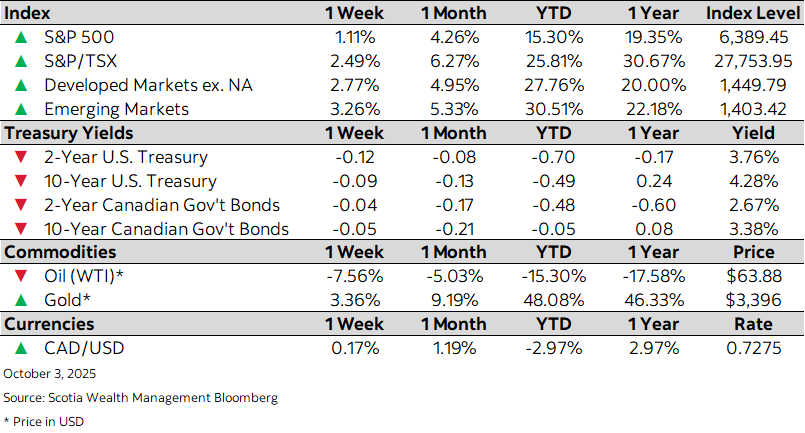
In the U.S., equities advanced steadily throughout the week despite the government shutdown, with the index buoyed by mega-cap tech and AI optimism following OpenAI’s record valuation. Markets shrugged off political gridlock and a sharp ADP payrolls miss, while weak ISM manufacturing data reinforced expectations for further Federal Reserve (Fed) easing. Canadian equities largely mirrored U.S. strength, supported by technology and materials, though trading volumes were muted earlier in the week due to a market holiday. In Europe, stocks were mixed initially as inflation data from Germany, France and Italy aligned with expectations, before rallying Thursday on technology and autos. In China, official Purchasing Manager Index (PMI) data signalled ongoing softness despite modest improvement, while additional stimulus and stronger private survey data underpinned slight equity gains across emerging markets.

Highlights:

  • U.S. equities returned 1.11%1 as investors looked past the government shutdown, focusing instead on mega-cap tech strength and AI-driven optimism, while softer labour and manufacturing data bolstered easing expectations.
  • Canadian equities were also up 2.49%2 alongside Wall Street, supported by technology and materials; sentiment continued to improve throughout the week as global risk appetite strengthened, and commodity prices stabilized.
  • European stocks rose 2.77%3, initially range-bound amid mixed inflation prints from Germany, France and Italy, before rallying late in the week on technology and auto sector gains, aided by stable ECB policy signals.
  • Emerging markets were up 3.26%4 as incremental PMI improvements and fresh stimulus measures offset lingering demand concerns, while a stronger private survey hinted at improving export momentum.

Bond markets price in additional Fed easing as shutdown delays key data

U.S. yields drifted lower early in the week as investors positioned for key labour data and a potential government shutdown, with the latter raising concerns about delayed economic releases. The sharp downside surprise in ADP payrolls on Wednesday accelerated the rally, reinforcing expectations for additional Fed easing, while softer ISM manufacturing data added to the bid. Canadian bonds followed a similar trajectory, though activity was muted by a market holiday before pricing in higher odds of a near-term Bank of Canada (BoC) cut. In Europe, rates initially firmed on stronger German inflation but reversed as Eurozone CPI aligned with expectations and ECB officials signaled policy stability. Credit markets tightened early before widening midweek as weaker macro data and heavy September issuance weighed on sentiment.

Highlights:

  • The 2- and 10-year U.S. Treasury yields were down 12 basis points (bps) and 9 bps, respectively. In Canada, the 2- and 10-year yields fell 4 bps and up 5 bps, respectively. Bond yields and prices move inversely to one another.
  • Government bonds rallied as weaker U.S. labour data and persistent policy uncertainty drove yields lower, with markets pricing in additional Fed and BoC easing amid delayed economic releases from the government shutdown.
  • Credit markets remained resilient despite seasonal headwinds, though elevated valuations and heavy September issuance left investors cautious about potential repricing if macro weakness persists.

Weekly dashboard

Canadian manufacturing PMI falls in September as downturn deepens

Canada’s manufacturing sector contracted at a steeper pace in September as an uncertain trading environment weighed on production and new orders, data showed. The S&P Global Canada Manufacturing Purchasing Managers’ Index (PMI) fell to 47.7 in September from 48.3 in August, marking the eighth straight month that the index was below the 50 threshold.

Highlights:

  • According to the report, output, new orders and exports all continued to fall, with the uncertain trading environment also leading firms to make cuts to purchasing, inventories and employment.
  • A Positive from the report was the dissipation of price pressures, with both input costs and selling prices rising at slower rates indicating that a reduction in underlying inflation pressures may be underway.
  • The input price index fell to 57.3 from 61.6 in August and the measure of output prices was at 51.2, its lowest level since October 2024.

U.S. lost 32,000 jobs in September as labour force continues to deteriorate

The U.S. shed 32,000 private-sector jobs in September, payroll-processing company ADP. That is down from a revised loss of 3,000 in August. Economists had expected an increase of 45,000. ADP’s report doesn’t include government workers, but economists are giving it a closer look this month. That is because the U.S. Bureau of Labor Statistics’ monthly jobs report, which was scheduled to come out is delayed due to the U.S. government shut down. The surprise job loss is the latest sign that the labour market is weakening.

Highlights:

  • The U.S. Federal Reserve last month lowered short-term interest rates by a quarter percentage point and signalled more cuts are likely, citing weak hiring.
  • The leisure and hospitality sector shed 19,000 jobs last month, the largest decline among major sectors. Education and health services were bright spots, with a collective gain of 33,000 jobs.
  • The gap between small and large establishments in the labour market continued to widen last month. Small establishments with fewer than 50 employees shed 40,000 jobs, while those with 500 or more employees added 33,000 jobs.

Eurozone inflation hits 5-month high, ECB expected to stay cautious
Price pressures across the eurozone picked up pace in September, reaching their highest level since April, but the rise is unlikely to alter the European Central Bank’s (ECB’s) wait-and-see approach. Annual inflation in the eurozone rose to 2.2% in September, up from 2.0% in August, according to Eurostat’s flash estimate. The reading was in line with economist expectations. On a month-on-month basis, prices edged up 0.1%, mirroring August’s figure.

Highlights:

  • Core inflation, which excludes volatile food and energy prices, held steady at 2.3% for the fifth month running, offering reassurance that underlying price pressures are not gaining momentum, even as headline figures rise.
  • Among inflation’s key drivers, services led the pack with a 3.2% annual increase, slightly up from 3.1% in August.
  • Food, alcohol and tobacco prices rose 3.0%, easing from 3.2%, while non-energy industrial goods were stable at 0.8%. Energy prices continued to shrink, but at a slower rate, down 0.4%, compared to 2.0% in August.

1 S&P 500 Index USD
2 S&P/TSX Composite Index USD
3 Bloomberg Developed Markets ex N. America Large & Mid Cap Price Return Index USD
4 Bloomberg EM Large & Mid Cap Price Return Index USD