Get the free daily rdnewsNOW newsletter by subscribing here!
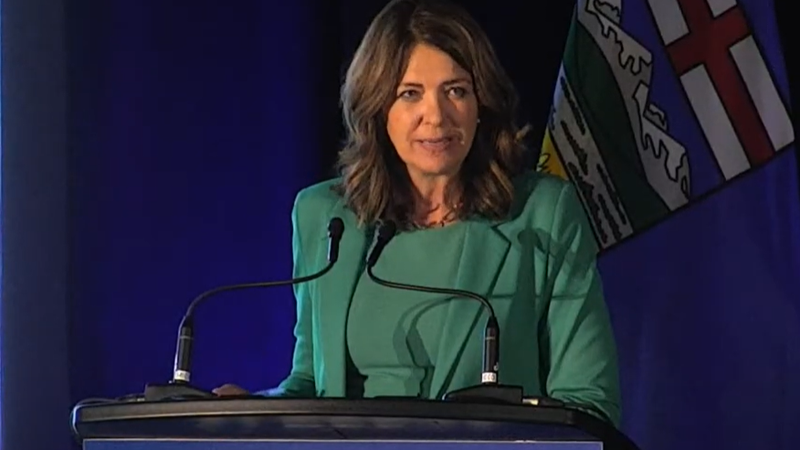
Danielle Smith during Alberta Next Panel in Medicine Hat. Courtesy/Danielle Smith YouTube
POLITICS

Mixed reaction during Alberta Next Panel in Medicine Hat

Sep 3, 2025 | 10:02 AM

A crowd of about 400 people showed up to the Cypress Centre in Medicine Hat Tuesday night for the Alberta Next Panel, with Premier Danielle Smith coming in to loud applause from the crowd.

Throughout the event, there was mixed reaction from the crowd, with large shows of support for several items being discussed, but also a stream of questions in opposition.

Six issues were highlighted by the panel during the two-and-a-half hour meeting, looking to push back against Ottawa.

These issues included federal transfers and equalization, an Alberta Pension Plan, Constitutional changes, a provincial police force, immigration and tax collection.

The panel suggested the idea of increasing the portion of taxation the provincial government receives to be more proportionate with the expenses that fall under its responsibility.

Joe from Medicine Hat, who declined to give his last name, said a lot of it is looking at Quebec’s role in Canada and how they have that little bit more autonomy.

“I think that’s kind of what the sentiment is going to be here is to get those kinds of things in there, whether it’s pension plans and police force and all those kinds of things,” Joe said.

“I think that’s where it’s looking at, just more modeled after Quebec’s place in the Constitution and in Canada.”

A polarizing issue during the meeting was over whether immigrants are being scapegoated for the province’s problems.

Discussions centred around creating a provincial police service, and reforming equalization payments had their own debates, but the province’s proposal to take greater control over immigration by restricting some newcomers’ access to social services brought strong opinions from audience members.

Several said they’re concerned the province’s messaging is promoting hostility toward immigrants who don’t bear responsibility for the province’s problems.

Smith said Alberta’s immigration system would be geared toward finding people who can work in the jobs that are available.

Moderator Bruce McAllister, also executive director of the premier’s office, argued the question was simpler: “Is it too many too fast and should we have more control over what we’re doing?”

One woman from the nearby community of Brooks said she’s concerned the province’s language is dangerous and “encourages anti-immigrant sentiment” at a time when Alberta needs “to be building understanding and not fear.”

“It’s really easy to scapegoat immigrants for all sorts of things that they are not particularly responsible for, and I’m concerned that this discussion is edging in that direction,” said another audience member who did not identify themselves.

The town halls have aimed to address grievances with the federal government that Smith says are fostering separatist sentiment.

Smith, who represents the riding of Brooks-Medicine Hat in the Alberta legislature, told the crowd that dealing with so many newcomers to Alberta has been challenging.

“When you end up with 150,000 people coming a year versus 50,000 a year which has been our experience the last few years, it becomes overwhelming,” Smith said.

“Of all our systems, you’re seeing it in classrooms that are overcrowded. Complexity in classrooms. English language learners. People can’t find a family doctor. We can’t build homes fast enough. There just is a pace that you can’t keep up with.”

Scott Payne, the son of former Medicine Hat MP Lavar Payne, said he has a separatist sentiment when it comes to immigration.

“The only way is get out of Canada, we control our own immigration, bring in immigrants who want to be part of the country, who want to be peaceful and Christian values,” Payne said.

“They don’t have to follow the religion, but the values are pretty good. That’s what built the western world.”

The Alberta premier and her panel’s proposals to reform Alberta’s relationship with Ottawa were met with largely unanimous support, but numerous audience members expressed frustration that the discussions were artificially tilted to the government’s preferences, and several people were cut off from the mic.

“My biggest disappointment tonight was with the moderator. A moderator, if you look up the definition, is supposed to be a neutral person, and is supposed to try to bring agreement within the crowd,” Kym Porter said.

“I feel like he did a very poor job of that, and he was more of what’s the opposite of a moderator, an agitator.”

Another individual who came to the town hall wasn’t impressed by it either.

“I was disgusted by having to sit through propaganda videos prior to answering or having questions answered,” Kim Large said.

“I was also disgusted with the tribalism in the room, especially when we were talking about things like immigration and such,” she added.

“Pretty disgusting thoughts and ideas floating around there. Not a great place to be.”

In response to one audience question, Smith said one of the reasons her government is introducing a digital health card — a point that prompted brief jeers from the crowd — is because Alberta currently has 600,000 more health cards than people.

“We need to figure out why that is, and we need to make sure that we are protecting our taxpayers so that we are not paying for expensive health care for people who don’t even live here, or who are only here to take advantage of the social programs and never pay in.

“I know there’s some questions about why we’re doing it. That’s why we’re doing it,” she said of the digital wallet she unveiled this week.

The panel will travel to Lethbridge for another town hall next week.

This will be followed by stops in Airdrie, Grande Prairie and Calgary to wrap up the panel’s stops before the end of September.

– With files from the Canadian Press