
Get the free daily rdnewsNOW newsletter by subscribing here!
sponsored

Market Watch – Aug. 29, 2025

Aug 30, 2025 | 11:15 AM

This week’s highlights

  • Markets diverge on dovish central bank signals and mixed growth and inflation data
  • Yields shift as central banks lean towards easing amid data uncertainty
  • Canada’s economy contracts more than expected in second quarter as tariffs hit exports
  • U.S. reports solid July consumer spending, core inflation firmer
  • German consumers feel ever gloomier as economy slumps

Week in review

Markets diverge on dovish central bank signals and mixed growth and inflation data

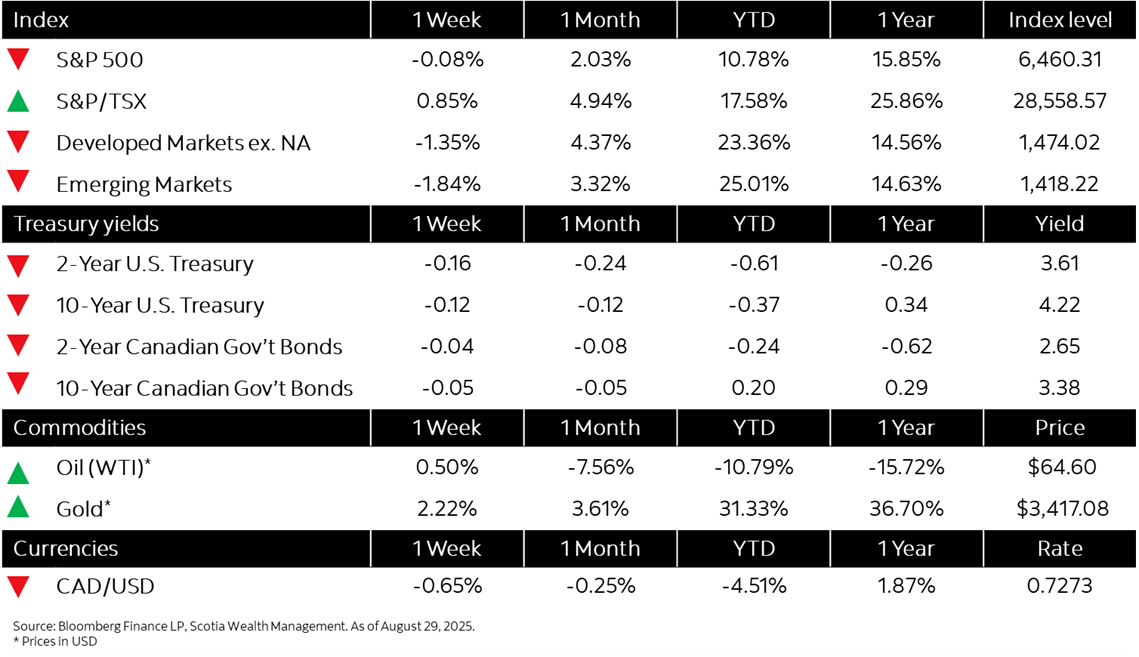
Equity markets were buoyed early in the week by Fed Chair Powell’s dovish pivot at Jackson Hole, which signaled a shift toward labour market support and opened the door to rate cuts. U.S. GDP was subsequently revised higher, reinforcing optimism, but Friday’s inflation and trade data tempered gains as sticky services inflation and a widening trade deficit raised questions about growth sustainability amid heightened policy uncertainty. In Canada, equities found midweek support from resilient domestic demand and solid bank earnings, with investors largely brushing off Friday’s disappointing GDP contraction and export weakness driven by U.S. tariffs. European equities were weighed down by soft inflation prints and political uncertainty in France, while Chinese and emerging markets rallied on regional rate cut prospects and tech optimism following Alibaba’s chip announcement.

Highlights:

  • U.S. equities returned -0.08%1 on dovish Fed signals and strong GDP revisions, but firm core PCE inflation and a widening trade deficit later in the week tempered optimism, keeping rate cut expectations cautiously in play.
  • Canadian equities were up 0.85%2 on resilient domestic demand and upbeat bank earnings, but sentiment cooled after a sharper-than-expected GDP contraction and tariff-driven export declines raised uncertainty around growth and increased odds of a rate cut.
  • European stocks declined -1.35%3, facing pressure from weaker-than-expected inflation data and political instability in France, reinforcing expectations that the European Central Bank (ECB) will remain on hold until spring despite mixed signals from country-level price trends.
  • Emerging markets were down -1.84%4 as regional central banks signaled easing, while tech sentiment improved following Alibaba’s chip announcement, helping offset global trade concerns and subdued consumer confidence in Japan.

Yields shift as central banks lean towards easing amid data uncertainty

U.S. fixed income markets rallied early in the week as Powell’s dovish tone at Jackson Hole shifted focus toward labor market risks, driving front-end yields lower and boosting rate cut expectations. However, firm core PCE inflation and a widening trade deficit later in the week tempered the rally, steepening the curve. In Canada, soft GDP data and tariff-driven export weakness pushed yields lower at the short end of the curve, increasing the probability of a rate cut at the September BoC meeting. European bond markets were volatile amid political uncertainty in France and mixed inflation data, with yields rising modestly before stabilizing. In emerging markets, expectations of rate cuts in Korea and the Philippines supported local bonds, while Japan’s inflation data kept JGBs range-bound.

Highlights:

  • The 2- and 10-year U.S. Treasury yields were down 16 basis points (bps) and 12 bps, respectively. In Canada, the 2- and 10-year yields were down 4 bps and 5 bps, respectively. Bond yields and prices move inversely to one another.
  • Canadian rates were broadly lower, led by the front-end with the release of Canada’s Q2 GDP report while U.S. rates are higher by 1-2 bps on the back of firm PCE data. Canada is outperforming European bond markets as well, as the general rise in sovereign yields continued late-week, with the curve steepening further.
  • Credit markets remained quiet throughout the latter half of the week and spreads unchanged ahead of the holiday weekend both north and south of the border.

Weekly dashboard

Canada’s economy contracts more than expected in second quarter as tariffs hit export

Canada’s economy contracted in the second quarter by a much larger degree than anticipated on an annualized basis as U.S. tariffs squeezed exports, but higher household and government spending cushioned some of the impact. According to Statistics Canada (StatCan), gross domestic product (GDP) for the quarter that ended June 30 decelerated by 1.6% on an annualized basis from a downwardly revised growth of 2.0% posted in the first quarter, taking the total annualized growth in the first six months of the year to 0.4%.

Highlights:

  • StatCan said the economy contracted by 0.1% in June, mainly led by a decline in output from goods-producing industries, which accounts for a quarter of the country’s GDP.
  • This was the third month in a row that the GDP, based on industry output declined and was the first time in three years that the economy contracted for three consecutive months.
  • An advance estimate for July showed the economy could likely grow by 0.1% on a month-on-month basis, signalling that the third quarter might not be as bad as the previous one.

U.S. reports solid July consumer spending, core inflation firmer

U.S. consumer spending increased solidly in July while underlying inflation picked up as tariffs on imports raised prices of some goods, but that data will probably not prevent the U.S. Federal Reserve from cutting interest at its next meeting against the backdrop of softening labour market conditions.

Highlights:

  • The U.S. Commerce Department reported consumer spending, which accounts for more than two-thirds of economic activity, rose 0.5% last month after an upwardly revised 0.4% gain in June. Economists had forecast spending would rise 0.5% after a previously reported 0.3% advance in June.
  • According to the Bureau of Economic Analysis, the Personal Consumption Expenditures (PCE) Price Index increased 0.2% last month after an unrevised 0.3% rise in June. In the 12 months through July, the PCE Price Index rose 2.6%, matching the gain in June.
  • Excluding the volatile food and energy components, the PCE Price Index increased 0.3% last month, matching the rise in June. In the 12 months through July, the so-called core inflation figure advanced 2.9% after increasing 2.8% in June.

German consumers feel ever gloomier as economy slumps
The mood among German consumers continued to darken as the pressures besetting Europe’s largest economy take their toll on sentiment. The consumer-climate index published by research groups GfK and the Nuremberg Institute for Market Decisions worsened for the third month in a row, falling to minus 23.6 in its forecast for September, down 1.9 points in August. Economists had expected the gauge to be stronger at minus 21.5.

Highlights:

  • Concerns around unemployment drove the gloomier mood among Germans.
  • The decline in sentiment comes after data last week showed the German economy shrank by more than previously estimated in the three months through June. Amid that slump, confidence in the economy dropped to its lowest in six months, the index showed.
  • “Consumers’ hopes for a recovery of the German economy before the end of this year are likely to have fallen further,” GfK said. “Rising unemployment, the somewhat bumpy start of the new federal government, and the uncertain customs policy of the U.S. are not currently creating a mood of optimism among consumers.”

1 S&P 500 Index USD
2 S&P/TSX Composite Index USD
3 Bloomberg Developed Markets ex N. America Large & Mid Cap Price Return Index USD
4 Bloomberg EM Large & Mid Cap Price Return Index USD