
Get the free daily rdnewsNOW newsletter by subscribing here!
sponsored

Market Watch – Aug. 22, 2025

Aug 25, 2025 | 10:05 AM

This week’s highlights

  • Equities mixed for the week as policy signals and PMI data drive volatility across regions
  • Rates stabilize on inflation and policy cues
  • Canada’s inflation rate slows to 1.7% in July, led by falling gasoline prices
  • U.S. housing starts tick higher in July, led demand for rental housing
  • European trade takes fresh tariff hit as U.S. exports slump

Week in review

Equities mixed for the week as policy signals and PMI data drive volatility across regions

U.S. equities were flat early in the week as investors awaited clarity from the Jackson Hole Symposium and digested mixed signals from Fed officials. Markets turned lower midweek following hawkish Federal Open Market Committee (FOMC) minutes and strong Purchasing Manager Index (PMI) data, which showed the fastest pace of expansion this year and reignited inflation concerns, particularly around tariffs and input costs. Sentiment reversed late in the week after dovish commentary from Fed officials at Jackson Hole, which helped ease rate cut uncertainty and lifted equities. In Canada, Consumer Price Index (CPI) data showed moderation, but sticky shelter and food prices kept the Bank of Canada (BoC) cautious; retail sales data later signaled softening momentum. European equities were supported by stronger-than-expected PMIs, especially in manufacturing, though inflationary pressures and geopolitical risks capped gains. In China and emerging markets, early-week optimism on trade de-escalation faded as tech sector volatility and renewed tariff concerns weighed on sentiment.

Highlights:

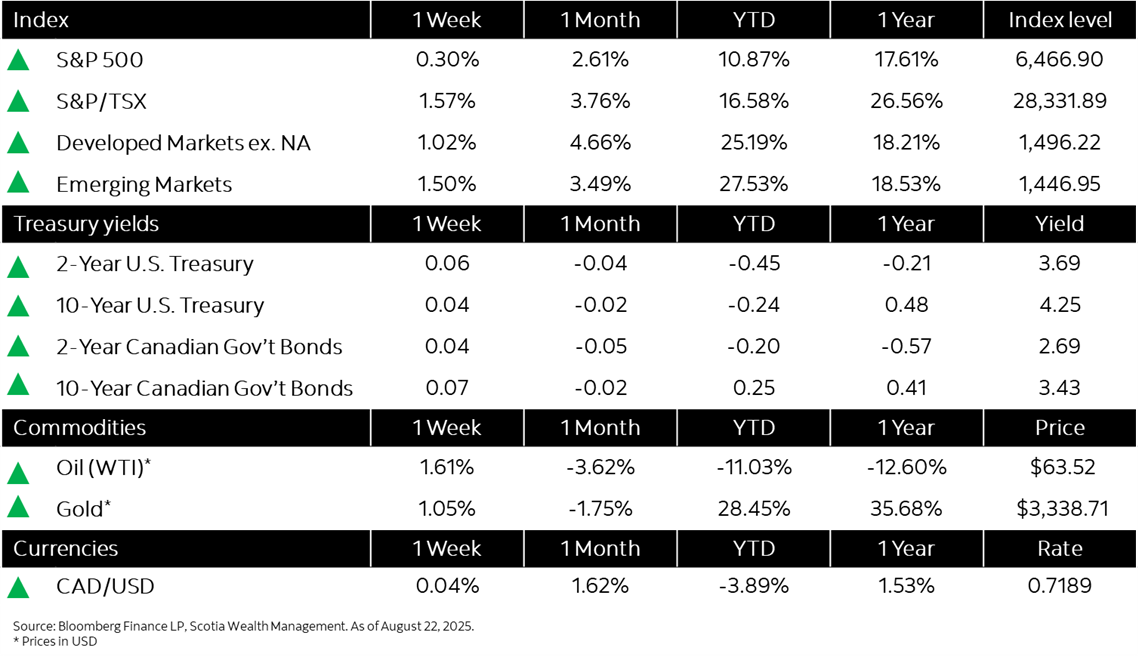
  • U.S. equity markets rose 0.30%1 for the week, declining midweek on hawkish Fed minutes and strong PMIs, then rebounding late week as dovish commentary from Jackson Hole eased concerns around inflation and future rate cuts.
  • Canadian equities were up 1.57%2, with July CPI showing inflation moderating, but sticky shelter and food prices kept policy expectations unchanged; retail sales data later signaled slowing momentum, reinforcing the case for a continued pause.
  • European stocks rose 1.02%3 on stronger-than-expected PMIs, particularly in manufacturing, but gains were capped by persistent inflationary pressures and geopolitical uncertainty, including ongoing discussions around Ukraine and trade tensions with the U.S.
  • Emerging markets were up 1.50%4, rallying early on easing tariff concerns and strong manufacturing data, but momentum faded midweek as tech sector volatility and renewed trade tensions, especially around AI exports, weighed on investor sentiment.

Rates stabilize on inflation and policy cues

Fixed income markets were largely range bound early in the week, with U.S. Treasury yields steady ahead of the FOMC minutes and Jackson Hole Symposium. Midweek, rates edged higher as strong PMI data and hawkish Fed minutes (from the July meeting) highlighted concerns about persistent inflation, particularly from tariffs, and somewhat dampening the fixed income market’s expectations for near-term monetary easing. However, dovish commentary from Fed officials at Jackson Hole helped stabilize yields Friday morning. In Canada, softer-than-expected July CPI and retail sales data (June) gave the Bank of Canada room to maintain its pause, while bond markets remained supported by expectations of future BoC purchases. European yields rose midweek on hotter U.K. inflation and stronger Eurozone PMIs, though sentiment cooled as business confidence weakened.

Highlights:

  • The 2-year U.S. Treasury yield was flat while the 10-year yield rose 3 bps. In Canada, the 2-year yield was also flat while the 10-year yield was up 2 bps. Bond yields and prices move inversely to one another.
  • U.S. and Canadian rates firmed into Friday following Thursday’s selloff, while European yields edged lower with U.K. Gilts underperforming amid light trading ahead of central bank speeches at Jackson Hole.
  • Credit spreads remained firm amid little new issuance in the latter half of the week. High yield (HY) bonds have been selling off, with yields rising close to three-week highs. Spreads have widened also, though at a slow pace, driving losses for a third consecutive session.

Weekly dashboard

Canada’s inflation rate slows to 1.7% in July, led by falling gasoline prices

Canada’s inflation rate fell to 1.7% in July, slowing slightly more than expected and easing some fears about sticky price growth. According to Statistics Canada, the deceleration in consumer price index (CPI) was led by a decline in gasoline prices, which reflected the removal of the consumer carbon price.

Highlights:

  • In the July data, gasoline’s downward pull was countered by grocery prices rising 3.4%, led by jumps in prices for coffee (up 28.6%) and cocoa products (up 11.8%) due to poor weather in producing regions.
  • Shelter costs also picked up for the first time since early 2024, rising 3.0% year-over-year. Rent inflation reached 5.1%, while mortgage interest costs eased slightly but were still 4.8% higher than a year ago.
  • Excluding gasoline, inflation was 2.5%. The Bank of Canada’s preferred measures, CPI-trim and CPI-median, remained at 3.0% and 3.1%, respectively, in July, though most economists note that both have softened on a three-month basis.

U.S. housing starts tick higher in July, led demand for rental housing

Housing construction in the U.S. jumped much more than expected last month, reflecting a recovery in the multifamily market as developers respond to demand for rental housing. According to the U.S. Census Bureau, housing starts, a measurement of home construction, were 12.9% higher in July compared with a year earlier. Economists had expected a 2.8% increase.

Highlights:

  • Rental housing drove the big increase. Construction of projects with five units or more was 27.4% higher in July compared with last year, while starts of single-unit projects were 7.8% higher.
  • The July spike also represents a divergence in the housing market: Apartment construction is recovering steadily while single-family construction is declining. Construction of projects with five units or more is 18.1% higher from the start of the year.
  • Home-builder confidence, meanwhile, is hovering around the lowest levels of the past decade, reflecting high interest rates and increasing material costs due to tariffs. Since the start of the year, single-family housing starts are down 4.2%

European trade takes fresh tariff hit as U.S. exports slump
European exports to the U.S. continued to slow sharply, underscoring the drag the continent’s trade faces from U.S. President Trump’s trade tariffs. Exports to the U.S. from the 27 nations that make up the European Union dropped 10% on year in June to hit their lowest level since the end of 2023, at a little over €40 billion, according to figures by statistics agency Eurostat. The bloc’s overall trade surplus shrank to just €1.8 billion, down from €12.7 billion a month earlier.

Highlights:

  • Compared with a month earlier, June’s shrinking surplus was driven in particular by weaker exports of chemicals, an important export sector for many European economies. A strong euro is also paring demand for European goods.
  • European exports to China, another important market, meanwhile also fell sharply on year, highlighting the broader negative effects of the global trade backdrop.
  • The eurozone economy has proved more resilient in the face of the tariff onslaught, growing 0.1% over the second quarter. But exports are likely to remain under pressure from the strong euro and broader uncertainty

1 S&P 500 Index USD
2 S&P/TSX Composite Index USD
3 Bloomberg Developed Markets ex N. America Large & Mid Cap Price Return Index USD
4 Bloomberg EM Large & Mid Cap Price Return Index USD