
Get the free daily rdnewsNOW newsletter by subscribing here!
sponsored

Market Watch – Aug. 15, 2025

Aug 15, 2025 | 4:46 PM

This week’s highlights

  • Equity markets mixed as rate cut expectations meet inflation surprises
  • Inflation signals stir caution across global bond markets
  • Bank of Canada governing council split on need for more rate relief, summary says
  • U.S. inflation held steady at 2.7% in July
  • German financial confidence falls on trade-deal frustration

Week in review

Equity markets mixed as rate cut expectations meet inflation surprises

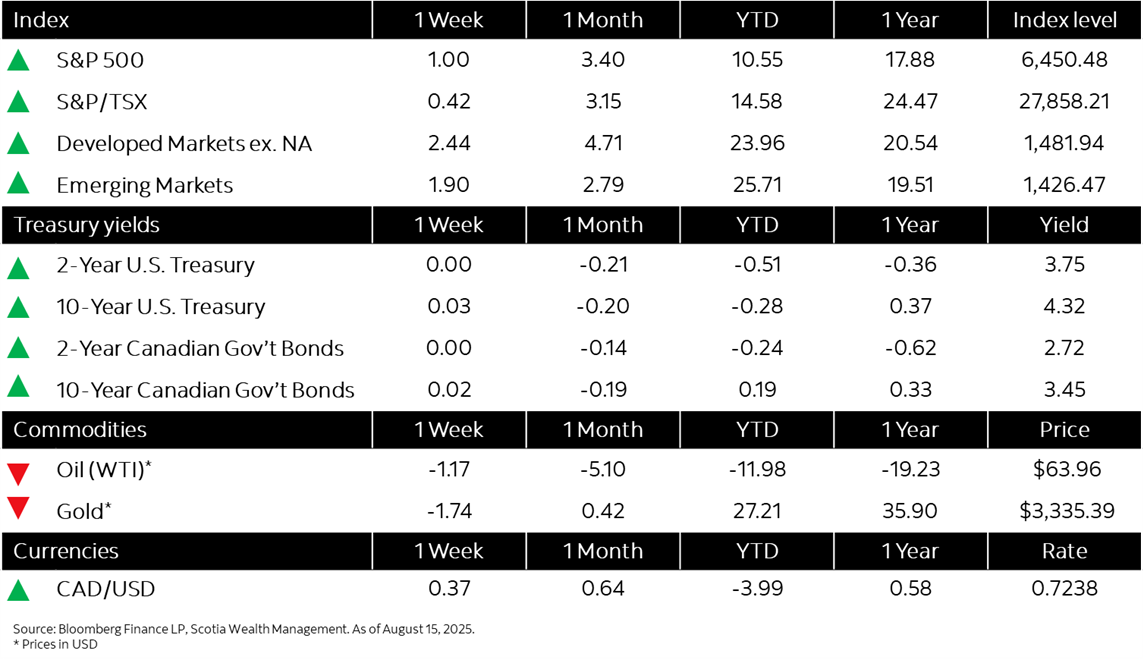
U.S. equity markets began the week on a positive note, buoyed by July Consumer Price Index (CPI) data that printed in line with expectations and reinforced bets on near-term Fed rate cuts, further supported by strong Q2 corporate earnings and a temporary extension of the U.S.-China tariff truce. However, sentiment turned cautious midweek following a hotter-than-expected Producer Price Index (PPI) report, which raised concerns about margin pressures and potentially resurgent inflation. Canadian equities were largely range-bound, with mixed manufacturing data and limited impact on rate expectations, as markets priced in a hold from the Bank of Canada (BoC). In Europe, equities gained steadily on better-than-expected U.K. labour and GDP data, supporting a gradual pace of Bank of England (BoE) easing. Chinese and broader EM markets faced headwinds from weak July activity data, including slowing retail sales and fixed asset investment, prompting fresh stimulus measures amid fading policy-driven momentum.

Highlights:

  • U.S. equity markets rose 1.00%1 for the week, rallying early in the week on in-line CPI data and strong Q2 earnings, but momentum faded after a hotter-than-expected PPI print raised concerns about inflation persistence and margin pressures.
  • Canadian equities were relatively muted, up 0.42%2, with mixed manufacturing data and tariff-related cost pressures offering little direction, while markets continued to price in a hold from the Bank of Canada at its September meeting.
  • European stocks advanced steadily, rising 2.44%3, supported by stronger-than-expected U.K. labour and GDP data, reinforcing expectations for a measured pace of monetary easing from the Bank of England despite lingering inflation concerns.
  • Emerging markets were up 1.90%4, pressured from weak July activity data in China, including slowing retail sales and investment, prompting fresh stimulus measures amid fading momentum and persistent property sector weakness.

Inflation signals stir caution across global bond markets

U.S. fixed income markets were driven by a sequence of inflation data, with early-week CPI figures reinforcing expectations for a September rate cut, while a hotter-than-expected PPI print midweek introduced caution around pricing pressures. Treasury yields initially fell but retraced as producer price data suggested tariff pass-through may be accelerating. In Canada, rates moved modestly higher, with mixed manufacturing data and tariff-related cost concerns offering little to shift expectations for a hold at the BoC’s next meeting. European yields rose steadily, led by the U.K., where stronger labour and GDP data supported a slower pace of monetary easing. In China and emerging markets, weak July activity data and fresh stimulus measures—including consumer loan subsidies—highlighted growing pressure on local bond markets amid fading growth momentum.

Highlights:

  • The 2-year U.S. Treasury yield was flat while the 10-year yield rose 3 basis points. In Canada, the 2-year yield was flat while the 10-year was up 2 bps. Bond yields and prices move inversely to one another.
  • Yields fluctuated modestly throughout the week, with U.S. inflation data initially supporting rate cut expectations before hotter producer prices tempered the rally, with global central banks maintaining a cautious easing stance amid mixed signals.
  • Credit spreads continue to compress for both investment (IG) and speculative (HY) grade bonds. IG primary supply will likely come short of expectations this week as seasonal effects kick in for the rest of the month. Despite marginally low premiums, the rally in corporate bonds stalled late-week as yields climbed higher driven by the weakness in rates.

Weekly dashboard

Bank of Canada governing council split on need for more rate relief, summary says

The Bank of Canada’s governing council is divided on whether more interest rate relief may be needed to navigate the economic slowdown caused by the trade war with the United States, according to a summary of the discussions ahead of last month’s rate decision. The central bank held its benchmark policy rate at 2.75% for the third consecutive time on July 30. There was consensus on the seven-member governing council, led by Governor Tiff Macklem, for a hold. But there were differing views about where monetary policy should go from here, and what role the bank should play in helping the Canadian economy adjust to a new global trading regime defined by U.S. protectionism.

Highlights:

  • According to the summary, some members held the view that, having reduced the policy interest rate to the middle of the bank’s estimated range of the neutral interest rate, and the economy showing some resilience to U.S. tariffs, the bank may have already provided sufficient support to aid in this transition.
  • Others highlighted that further monetary policy support would likely be needed given the estimated amount and persistence of slack in the economy, particularly if the labour market softened further.
  • The bank has explicitly left the door open to further interest rate cuts, saying that more rate relief could be in the pipeline if the economic growth stalls and unemployment rises while inflation remains contained.

U.S. inflation held steady at 2.7% in July

In the U.S., year-over-year inflation held steady in July, but a key measure of underlying price growth picked up. Consumer prices were up 2.7% in July from a year earlier, the U.S. Labor Department reported, unchanged from June’s gain. That was below the 2.8% rise expected by economists. Prices either fell or stabilized in the categories that consumers tend to pay the most attention to; shelter, energy and groceries. That helped keep overall inflation in check.

Highlights:

  • Prices excluding food and energy categories, the so-called core measure economists watch in an effort to better capture inflation’s underlying trend, rose 3.1% over the past 12 months, above forecasts for a 3% increase.
  • Energy prices declined 1.1% compared with June, with gasoline down 2.2%. Groceries fell 0.1% and rent returned to a more normal 0.3% increase after a period of big jumps.
  • A few categories exposed to tariffs went up compared with June. Furniture prices were up 0.9%, tires rose 1% and pet products increased 0.5%

German financial confidence falls on trade-deal frustration
German confidence in the economy sank back this month, buffeted by disillusion over the European Union’s (EU) trade deal with the U.S. and Germany’s weaker-than-expected economic performance in the second quarter. The ZEW Indicator of Economic Sentiment, which this month tracked the expectations of 182 analysts at banks, insurance companies and other businesses, decreased 18.0 points on month to 34.7 in August. Economists expected a slightly stronger score of 38.0.

Highlights:

  • The decrease came after several months when expectations for Europe’s largest economy rose, as industrial production showed signs of resilience, the European Central Bank continued its cycle of interest-rate cuts and the new German government settled in.
  • Economic activity contracted slightly in the three months to June, defying expectations that it would grow slightly, official data published late in July said.
  • The outlook has worsened in particular for the chemical, pharmaceutical, mechanical engineering and metal sectors. All are export-oriented industries subject to or threatened with import tariffs into the U.S.

1 S&P 500 Index USD
2 S&P/TSX Composite Index USD
3 Bloomberg Developed Markets ex N. America Large & Mid Cap Price Return Index USD
4 Bloomberg EM Large & Mid Cap Price Return Index USD