Subscribe to the 100% free rdnewsNOW daily newsletter!
Sponsored

Market Watch: July 4, 2025

Jul 4, 2025 | 4:21 PM

This week’s highlights

  • Markets close higher despite tariff threats tempering labour-driven gains
  • Labour strength and tariff tensions steepen curves
  • Canada’s trade deficit narrows in May, exports to U.S. decrease for fourth straight month
  • Steady hiring added 147,000 jobs to U.S. economy in June
  • Eurozone inflation hits 2% target, raising chance of ECB rate hold

Week in review

Markets close higher despite tariff threats tempering labour-driven gains

U.S. equity markets began the week on solid footing, buoyed by stronger-than-expected job openings and a robust nonfarm payrolls report, which reinforced labour market resilience and pushed back expectations for near-term Federal Reserve (Fed) rate cuts. As the week progressed, ISM data showed continued contraction in manufacturing and a mixed services rebound, with tariff-related disruptions weighing on new orders and employment. Markets were frothy but positive following President Trump’s announcement of sweeping new tariffs—20% on Vietnamese exports and threats of 60–70% rates on a broader set of countries starting August 1—while the passage of the $3.4 trillion “One Big Beautiful Bill” raised concerns over fiscal expansion and inflation but was also broadly supportive. In Canada, a narrowing trade deficit offered modest relief, though persistent weakness in U.S.-bound exports underscored vulnerability to cross-border tensions. European equities were initially supported by easing political concerns in the U.K., but later declined alongside Asian markets on tariff escalation.

Highlights:

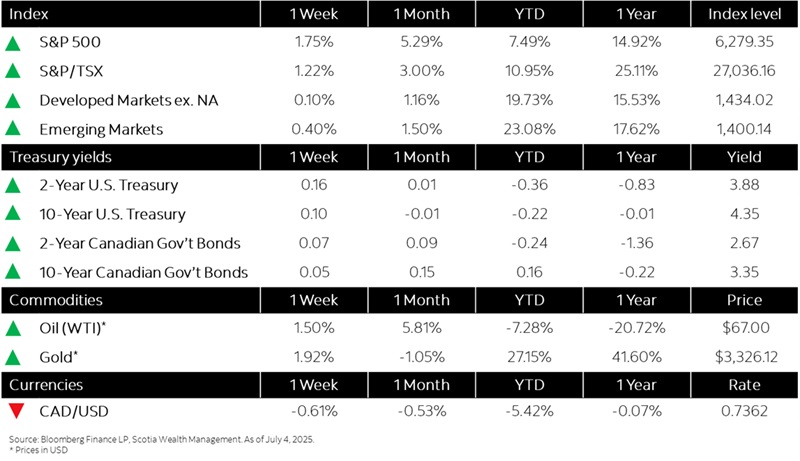
  • U.S. markets returned 1.75%1, rising early in the week on strong job openings and payrolls data, and continuing to rise even after President Trump announced sweeping new tariffs, including 60–70% rates on imports from multiple countries starting August.
  • Canadian markets returned 1.22%2 in a holiday-shortened week, with a narrower trade deficit offering modest support, though continued weakness in U.S.-bound exports underscored the economy’s sensitivity to cross-border trade disruptions and softening external demand.
  • European markets gained 0.10%3 supported by easing political uncertainty in the UK. Renewed tariff threats and weak manufacturing data weighed on investor sentiment and export outlooks later in the week.
  • Emerging markets gained 0.40%4, pressued by escalating U.S. tariff rhetoric despite the easing of chip software export restrictions, while geopolitical tensions and weak global demand continue to cloud the regional growth picture.

Labour strength and tariff tensions steepen curves

U.S. Treasury yields rose early in the week as stronger-than-expected job openings and payrolls data reinforced the Fed’s higher-for-longer stance, with markets paring back expectations for a July rate cut. The move was further supported by a downside surprise in the unemployment rate and the passage of a large fiscal package, which raised concerns about increased issuance and inflationary pressures. Canadian yields followed U.S. rates higher initially but outperformed later in the week amid softer domestic import data and a narrowing trade deficit. In Europe, bond markets rallied after a sharp midweek selloff, led by Gilts, as political uncertainty in the U.K. eased. Emerging market debt faced renewed pressure as U.S. tariff threats escalated, clouding the global growth outlook and weighing on risk sentiment.

Highlights:

  • The 2- and 10-year U.S. Treasury yields rose 16 basis points (bps) and 10 bps, respectively. In Canada, the 2-year yield was up 7 bps while the 10-year was up 5 bp. Bond yields and prices move inversely to one another.
  • The House passed President Trump’s tax bill, a $3.4 trillion fiscal package, that cuts taxes, curtails spending on safety-net programs and it is set to raise the federal government’s debt ceiling by $5 trillion, among other measures.
  • Credit spreads have been tightening since April driven by a robust demand. High yield (HY) primary supply for Jun came in above projections, 70% of which was dominated by refinancing. Investment grade (IG) funding cost is currently at 5.3% on average, with BBB rated paper leading the June issuance.

Weekly dashboard

Canada’s trade deficit narrows in May, exports to U.S. decrease for fourth straight month

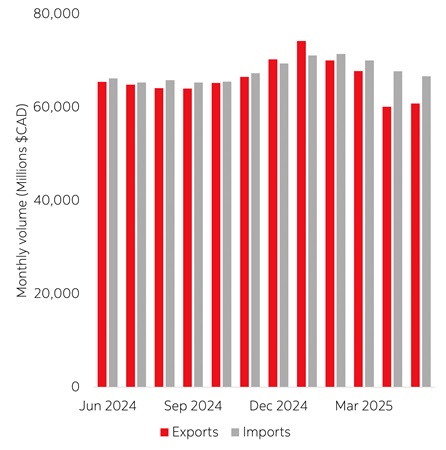
Canada’s trade deficit with the world narrowed in May from a record high the previous month, as tariffs continued to weigh on exports to the United States. Statistics Canada reported that the country’s trade deficit, which reflects the difference between its exports and imports, fell to $5.9 billion from $7.6 billion.

Highlights:

  • Exports to the United States slipped for a fourth consecutive month, decreasing by 0.9%, with imports of motor vehicles and parts falling 5.3%.
  • Meanwhile, exports to countries other than the U.S. continued to rise last month, increasing by 5.7% and reaching a record high.
  • A sharp rise in gold exports drove up total exports to the world by 1.1%, while imports fell by 1.6%, marking the third consecutive decrease.

Steady hiring added 147,000 jobs to U.S. economy in June

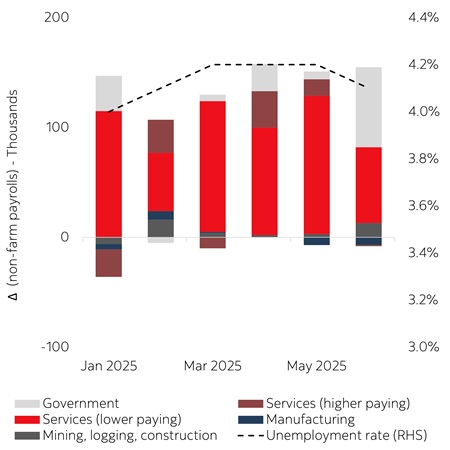
U.S. job growth continued at a steady pace in June, surprising economists who had predicted a slowdown in hiring amid uncertainty over trade and fiscal policy. The U.S. added 147,000 jobs in June, the U.S. Labor Department reported, above the gain of 110,000 jobs economists had expected.

Highlights:

  • The unemployment rate, which is based on a separate survey of U.S. households, fell to 4.1% from 4.2%, driven in part by a drop in the number of people looking for work. The labour-force participation rate slipped to 62.3% from 62.4% in May, the lowest level since late 2022.
  • Private-sector employers added just 74,000 jobs in June, down from 137,000 in May, the lowest number since October 2024.
  • An area of concern, manufacturing employment, fell for the second straight month as employers are holding off on hiring because of uncertainty over tariffs.

Eurozone inflation hits 2% target, raising chance of ECB rate hold
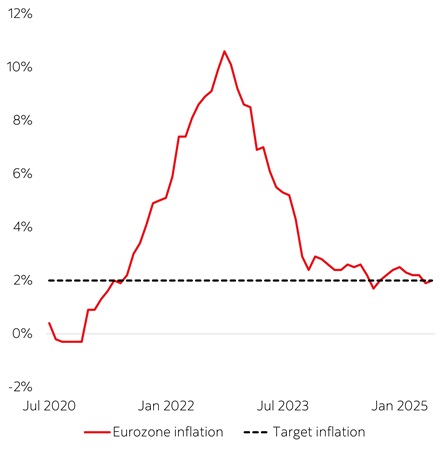
Inflation in the eurozone crept up in June, hitting the European Central Bank’s (ECB) target and raising expectations that policymakers will leave the key interest rate unchanged later this month. According to the statistics agency Eurostat, consumer prices were 2.0% higher than the same month last year, up from the 1.9% of May, matching expectations from economists.

Highlights:

  • The June pickup in inflation in the 20-nation currency area was particularly based on energy prices, with the core rate, which excludes more volatile food and energy prices, holding steady, Eurostat said.
  • Oil prices rose sharply after Israel’s attack on Iran in June, but they pared back somewhat after hostilities eased.
  • The ECB cut its key interest rate last month for an eighth time since June last year. Investors anticipate policymakers will reduce rates again later in 2025 but stand pat in their July meeting.

1 S&P 500 Index USD
2 S&P/TSX Composite Index USD
3 Bloomberg Developed Markets ex N. America Large & Mid Cap Price Return Index USD
4 Bloomberg EM Large & Mid Cap Price Return Index USD