
Subscribe to the 100% free rdnewsNOW daily newsletter!
sponsored

Market Watch: June 27, 2025

Jun 30, 2025 | 10:11 AM

This week’s highlights

  • Markets advance as Mideast geopolitical tensions ease despite cautious tone from Fed
  • Bond yields relatively steady amid data surprises complicating the monetary policy outlook
  • Canadian May inflation holds steady at 1.7% as economy shrinks
  • U.S. consumer spending falls in May while prices tick up
  • German business sentiment climbs as expectations brighten

Week in review

Markets advance as Mideast geopolitical tensions ease despite cautious tone from Fed

Equity markets were initially buoyed by easing geopolitical tensions and dovish interpretations of Federal Reserve (Fed) Chair Powell’s testimony, which emphasized patience on rate cuts despite sticky inflation and tariff-related risks. However, sentiment in the U.S. turned mixed midweek as downward GDP revisions and soft consumer spending data tempered optimism, even as durable goods orders rebounded. In Canada, equities faced pressure from a surprise turn in U.S. trade negotiations following a statement from President Trump as well as an uptick in May inflation and a second consecutive monthly GDP contraction which complicated the Bank of Canada’s policy outlook. European markets were supported early by subdued inflation and defense spending pledges, but gains faded as weak PMIs and regulatory hurdles for key M&A deals weighed on sentiment. In China and emerging markets, optimism grew late in the week after trade negotiations with the U.S. advanced, culminating in a rare earth export framework and easing tech restrictions, lifting risk appetite globally.

Highlights:

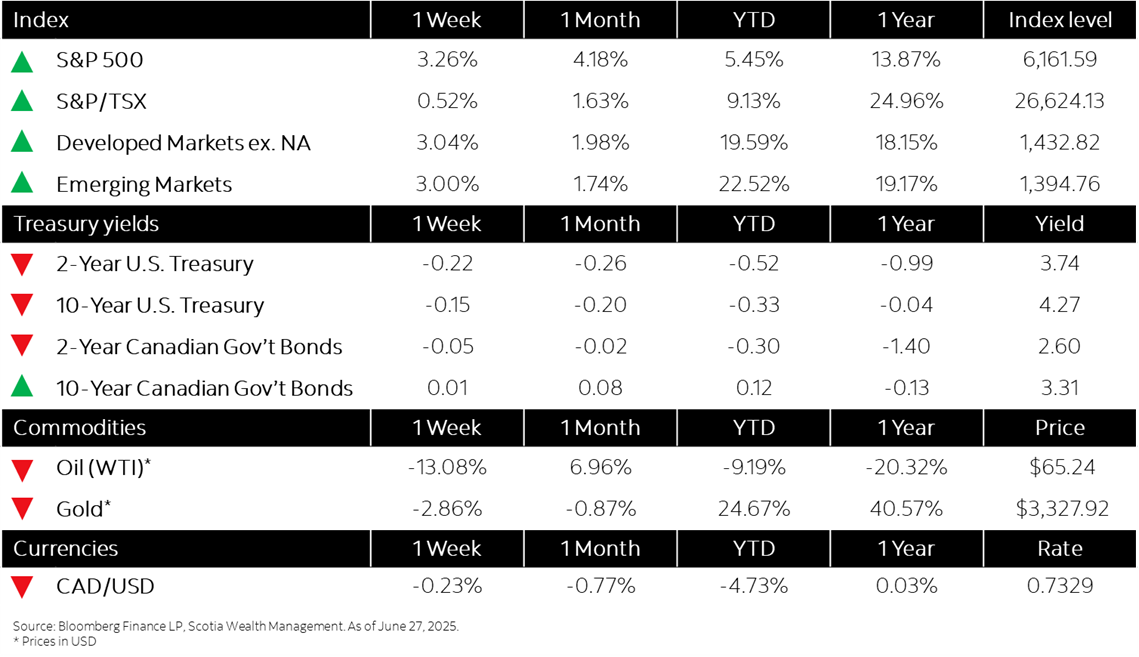
  • S. markets returned 3.26%1 following an easing of Middle East tensions despite Fed Chair Powell’s cautious tone and a spate of softer-than-expected economic data including weaker GDP revisions, soft consumer spending, and persistent inflation.
  • Canadian markets returned 0.52%2, facing headwinds from a surprise uptick in May inflation and a second consecutive monthly GDP contraction, which clouded the outlook for further rate cuts and raised concerns about underlying economic momentum.
  • European markets declined 3.04%3 supported by subdued inflation and NATO’s defense spending pledge, but weak PMIs, persistent manufacturing contraction, and regulatory setbacks for key M&A activity weighed on investor confidence later in the week.
  • Emerging markets gained 3.00%4 as trade optimism surged following confirmation of a rare earth export framework and easing of U.S. tech restrictions, boosting global risk appetite.

Bond yields relatively steady amid data surprises complicating the monetary policy outlook

Fixed income markets were shaped by geopolitical tensions early in the week, with rates initially falling on news of U.S. strikes in Iran before rebounding as Middle East risks de-escalated and Powell’s testimony signaled no urgency for rate cuts. Treasury yields moved higher midweek on stronger durable goods data and a modest uptick in core PCE inflation, though the dovish tone from the Fed and soft GDP revisions helped cap the move. In Canada, sticky inflation and weak GDP data created a push-pull dynamic, with bond yields rising early on CPI surprises before retreating on signs of economic contraction. European yields climbed steadily, driven by defense spending commitments and soft inflation prints.

Highlights:

  • The 2- and 10-year U.S. Treasury yields fell 22 basis points (bps) and 15 bps, respectively. In Canada, the 2-year yield was down 5 bps while the 10-year was up 1 bp. Bond yields and prices move inversely to one another.
  • Despite recent comments from the Fed and the accompanying inflation forecast, the Fed’s preferred price index is at some of the lowest levels in two years, strengthening the case of a policy shift towards employment conditions..
  • Credit spreads have remained firm and have been trading within a tight range this month. Markets have enjoyed a relative calm this week sparking an influx of new issuance. Ongoing budget negotiations in Washington, July 9 tariff deadline and potential soft macro data could all bring near-term volatility into July.

Weekly dashboard

Canadian May inflation holds steady at 1.7% as economy shrinks

Inflation in Canada held steady in May, potentially allaying concerns at the Bank of Canada (BoC) about an acceleration in core inflation caused by the trade war with the United States. According to Statistics Canada (StatCan), the consumer price index rose at an annual rate of 1.7% last month. The agency also reported that the Canadian manufacturing sector saw its largest decline in four years as gross domestic product (GDP) dipped slightly.

Highlights:

  • Rent, food prices and mortgage interest costs all saw smaller increases in May compared with the prior month. Gasoline prices were also sharply lower year-over-year as a result of the removal of the carbon tax in April, although gas prices increased month-to-month.
  • StatCan said the manufacturing sector contracted by 1.9%, marking the largest drop since April 2021.
  • Meanwhile, real GDP decreased 0.1% in April, falling below StatCan’s advance estimate. A preliminary estimate for May suggests another 0.1% decline

U.S. consumer spending falls in May while prices tick up

U.S. consumer spending unexpectedly fell in May as the boost from the pre-emptive buying of goods – like motor vehicles – ahead of tariffs faded, while monthly inflation increases remained moderate. According to the U.S. Commerce Department’s Bureau of Economic Analysis (BEA), consumer spending, which accounts for more than two-thirds of economic activity, dropped 0.1% last month after 0.2% gain in April.

Highlights:

  • The BEA also reported that the Personal Consumption Expenditures (PCE) Price Index gained 0.1% in May, matching the rise in April. In the 12 months through May, PCE inflation increased 2.3% after climbing 2.2% in April.
  • Stripping out the volatile food and energy components, the PCE Price Index increased 0.2% last month. That followed a 0.1% rise in so-called core PCE inflation in April.
  • In the 12 months through April, core inflation advanced 2.7% after rising 2.6% in April.

German business sentiment climbs as expectations brighten
Business confidence in Germany improved in June as firms shrugged off much of the impact of tariffs on Europe’s economy. The Ifo Institute reported that its business-climate index rose to 88.4 in June from 87.5 in May, stronger than the 88.0 expected by economists. Indexes for the four sectors cited by Ifo, manufacturing, services, trade and construction, all improved.

Highlights:

  • German firms’ expectations for the next six months brightened in particular, Ifo said, likely a result of cooling trade tensions between the European Union and U.S. after the latter suspended proposed 50% tariffs on goods imports until July.
  • Planned fiscal loosening by Germany’s new government to spend more on defense and infrastructure also contributed to the outlook. The European Central Bank is also expected to cut interest rates further before the end of 2025.
  • The Ifo report came after closely watched business surveys showed Germany’s manufacturing sector rebounded somewhat this month, as new orders rose at their fastest rate in three years.

1 S&P 500 Index USD
2 S&P/TSX Composite Index USD
3 Bloomberg Developed Markets ex N. America Large & Mid Cap Price Return Index USD
4 Bloomberg EM Large & Mid Cap Price Return Index USD