
Subscribe to the 100% free rdnewsNOW daily newsletter!
Sponsored

Market Watch: June 20

Jun 23, 2025 | 2:18 PM

This week’s highlights

  • Equity markets constrained by Middle Eastern geopolitical instability
  • Bond markets continue to benefit from haven flows
  • Canadian home sales rose in May for the first time since November
  • U.S. Federal Reserve keeps interest rates unchanged, sees two cuts in 2025
  • Japan’s exports fell for first time in eight months as tariffs weighed

Week in review

Equity markets constrained by Middle Eastern geopolitical instability

Equity markets began the week supported by expectations of steady central bank policy and solid economic data, but midweek sentiment turned cautious as escalating Middle East tensions dampened risk appetite and flattened returns. In the U.S., early optimism from strong retail sales control group data – a measure used for GDP tracking purposes – and a Fed hold gave way to caution as Chair Powell’s hawkish tone and geopolitical tensions weighed on risk appetite. Canadian equities tracked global sentiment, with attention on the G7+ summit and mixed retail and housing data offering little directional clarity. In Europe, markets were pressured by persistent inflation in the U.K. and dovish surprises from the BoE and other central banks, which signalled concern over deflationary risks and U.S. trade policy. In China and broader emerging markets, upbeat industrial and retail figures pointed to policy-supported momentum, but persistent weakness in real estate and subdued private-sector confidence underscored the fragility of the recovery, reinforcing expectations for additional targeted stimulus to sustain growth near the 5% target.

Highlights:

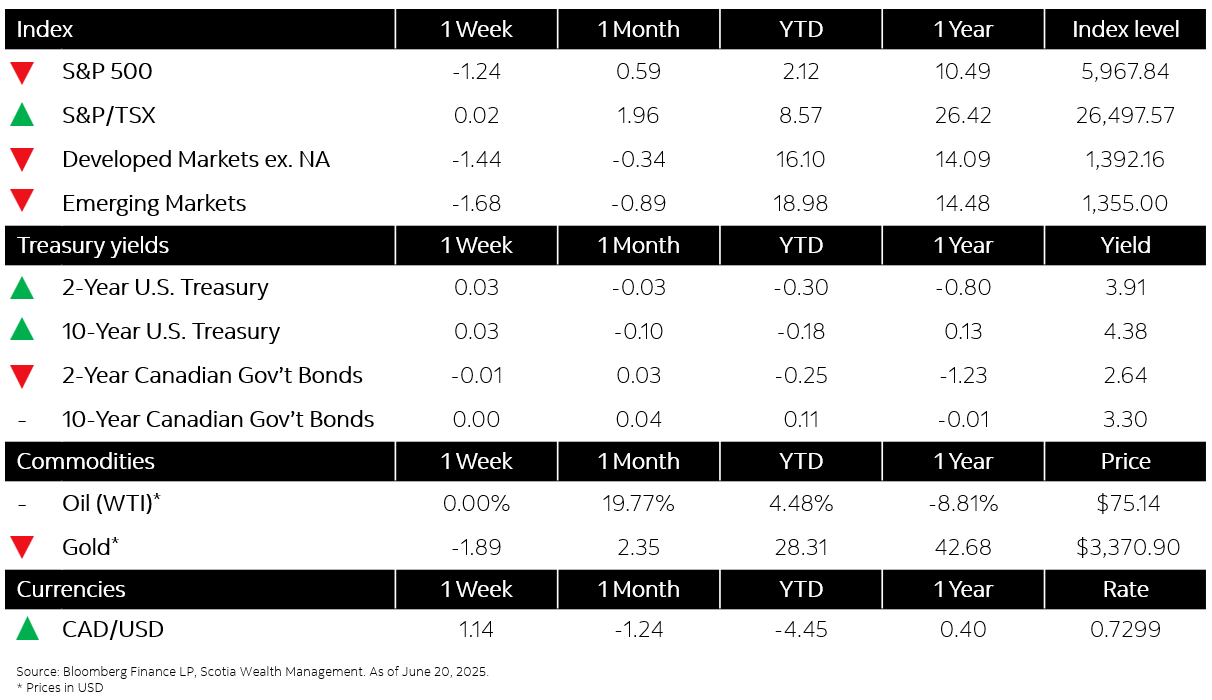
  • U.S. markets returned -1.24%1 as early optimism from resilient retail control group data faded after the Fed struck a hawkish tone, signaling fewer rate cuts ahead, while geopolitical tensions in the Middle East weighed on sentiment.
  • Canadian markets returned 0.02%2 with the index rangebound as investors split their attention between the G7+ summit in Alberta and mixed domestic data; retail sales showed modest strength, but housing starts and inflation signals offered little clarity on the policy path.
  • European markets declined -1.44%3 amid persistent inflation pressures in the UK and dovish surprises from the BoE, SNB and Norges Bank, which highlighted growing concerns over deflation and the potential impact of U.S. trade policy.
  • Emerging markets closed -1.68%4 higher, supported by strong industrial and retail data, particularly in high-tech and durable goods, but gains were capped by ongoing weakness in real estate and fragile private-sector confidence.

Bond markets continue to benefit from haven flows

U.S. fixed income markets were steady early in the week as investors awaited the Fed’s decision, with rates drifting lower on soft retail sales and industrial production data. However, yields rose midweek after Chair Powell struck a hawkish tone, signaling fewer cuts ahead and citing elevated uncertainty, which pressured bonds. In Canada, rates followed U.S. moves, with little domestic data to shift expectations, while the Juneteenth holiday muted activity. European bond markets saw a notable pivot as the Swiss National Bank, Norges Bank, and Riksbank all delivered dovish surprises, citing deflationary pressures and currency strength, pushing yields lower.

Highlights:

  • The 2- and 10-year U.S. Treasury yields both rose 3 basis points (bps). In Canada, the 2-year yield was down 1 bp while the 10-year was flat. Bond yields and prices move inversely to one another.
  • Markets now expect just one rate cut from the Federal Reserve in 2025, down from two previously, as updated projections reflect stronger inflation persistence and reduced confidence in near-term easing.
  • Three European central banks unexpectedly cut rates, reversing prior guidance, as deflationary pressures and stronger local currencies raised concerns—particularly around U.S. trade policy—while the Bank of England held steady, maintaining a cautious stance.

Weekly dashboard

Canadian home sales rose in May for the first time since November

Canadian home sales climbed 3.6% in May in the first increase since November, but the real estate industry cautions it is too early to say the country’s housing market is rebounding after a two-year slump. There were 37,626 home sales last month after adjusting for seasonal influences, according to the Canadian Real Estate Association (CREA). That was higher than April when selling activity was essentially flat after months of consecutive declines. The swell in activity was similar to November when sales rose 3.2% month over month.

Highlights:

  • The national home price index, which adjusts for pricing volatility, was essentially unchanged at $690,900 in May after mostly declining since the summer of 2023.
  • Many prospective home buyers still find prices remain relatively high even though they have decreased, and do not want to make a purchase if they believe home prices will continue to fall.
  • More homeowners put their properties up for sale, with new listings rising 3.1% from April to May. Sales as a percentage of new listings were 47%, which was essentially the same as April but down about six percentage points from May of last year.

U.S. Federal Reserve keeps interest rates unchanged, sees two cuts in 2025

The U.S. Federal Reserve held interest rates steady and policymakers signalled borrowing costs are still likely to fall this year but slowed the overall pace of expected future rate cuts in the face of estimated higher inflation flowing from the Trump administration’s tariff plans. The Fed’s policy rate remains in the range between 4.25% and 4.5%.

Highlights:

  • In new economic projections, policymakers sketched a modestly stagflationary picture of the U.S. economy, with economic growth slowing to 1.4% this year, unemployment rising to 4.5% by the end of this year, and inflation finishing 2025 at 3%, well above the current level.
  • While policymakers still anticipate cutting rates by half a percentage point this year, as they projected in March and December, they slightly slowed the pace from there to a single quarter-percentage-point cut in each of 2026 and 2027 in a protracted fight to return inflation to the central bank’s 2% target.
  • Under the new projections, inflation remains elevated at 2.4% through 2026 before falling to 2.1% in 2027 amid largely stable unemployment.

Japan’s exports fell for first time in eight months as tariffs weighed
Japan’s exports fell for the first time in eight months in May, bolstering views that the impact of U.S. President Trump’s tariffs could tie the Bank of Japan’s hands on rate hikes. Exports, a main engine of growth for Japan’s economy, declined 1.7% in May from a year earlier, compared with April’s 2.0% rise, Ministry of Finance data showed. That marked the first on-year drop since September 2024.

Highlights:

  • The weak results came a day after the Japanese central bank kept its policy rate unchanged again amid trade uncertainty, and its governor sent cautious messages about the outlook.
  • The data showed that exports to the U.S. dropped 11.1% in May due to weakness in shipments of cars, auto parts and chip-making machinery. Japan’s trade surplus with the U.S. shrank 4.7% from a year earlier, marking the first decline in five months.
  • The value of U.S.-bound automobile exports fell more sharply than the volume, the figures showed, suggesting that Japanese automakers are trying to contain tariff costs on their own by making significant price cuts.