
Subscribe to the 100% free rdnewsNOW daily newsletter!
sponsored

Market Watch: May 30, 2025

May 30, 2025 | 11:30 PM

This week’s highlights

  • Strong start for equity markets tempered by uncertain tariff policies
  • Bond markets advance cautiously as environment for further central bank rate cuts becomes more opaque
  • Canada’s first quarter GDP expands by 2.2% annualized rate, beating estimates
  • U.S. PCE inflation cools further in April as consumer spending slows
  • Eurozone’s economic outlook picks up after tariff turmoil abates

Week in review

Strong start for equity markets tempered by uncertain tariff policies

Equity markets were initially buoyed by easing trade tensions and strong corporate earnings, particularly in the U.S., where Nvidia’s blockbuster results and a pause in proposed tariffs supported tech-led gains, pushing the index well into positive territory. However, sentiment soured by week’s end as President Trump reignited trade tensions with China and April’s Personal Consumption Expenditures (PCE) data confirmed slowing consumer spending. In Canada, equities were supported early by stronger-than-expected Q1 GDP, driven by exports and inventories, though weak domestic demand and soft April manufacturing data tempered optimism. European markets rallied on delayed U.S. tariffs and cooling inflation in Germany, Spain, and Italy, reinforcing expectations for a European Central Bank (ECB) rate cut next week. In Asia, Japanese equities rose on signs of renewed yield curve control, while emerging markets responded positively to dovish signals from central banks, though volatility persisted amid shifting global trade dynamics.

Highlights:

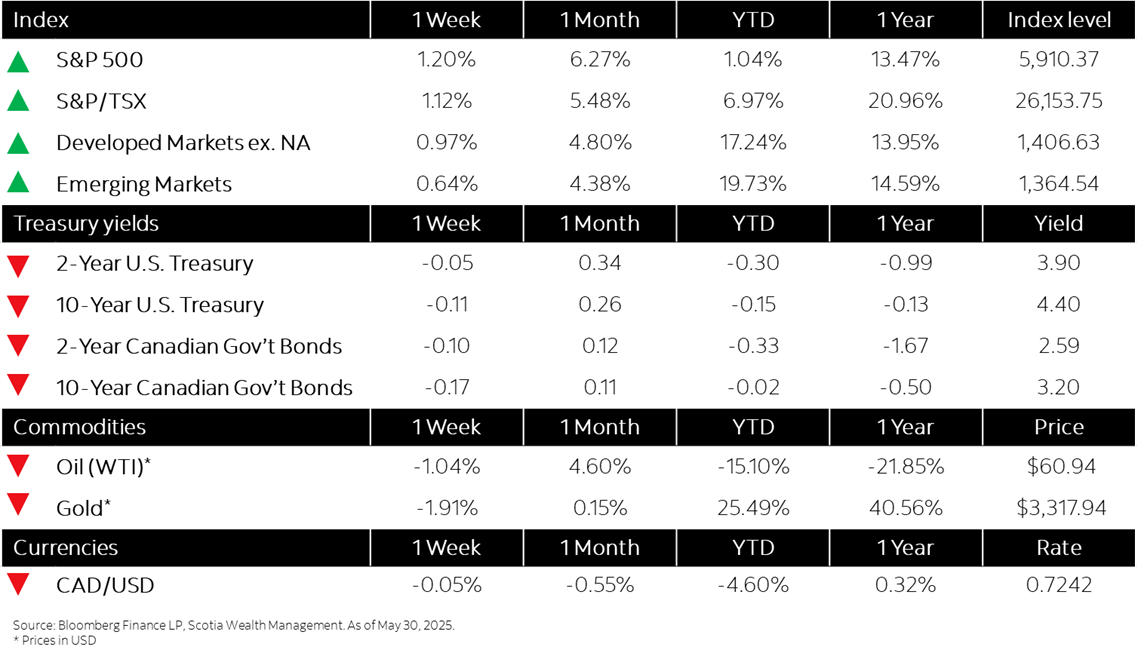
  • U.S. markets returned 1.20%1, rallying early on Nvidia’s strong earnings and easing tariff threats, but reversed course Friday as renewed U.S.-China trade tensions and slowing consumer spending in April’s PCE data weighed on sentiment.
  • Canadian markets returned 1.12%2, lifted by stronger-than-expected Q1 GDP driven by exports and inventories, though gains were capped by weak domestic demand, soft April manufacturing data, and cautious expectations ahead of the Bank of Canada’s upcoming rate decision.
  • European markets returned 0.97%3 on delayed U.S. auto tariffs and cooling inflation, reinforcing expectations for an ECB rate cut next week, though late-week U.S. trade headlines introduced renewed uncertainty.
  • Emerging markets closed 0.64%4 amid dovish signals from regional central banks and optimism around trade negotiations, though volatility persisted due to shifting global tariff dynamics and geopolitical risks.

Bond markets advance cautiously as environment for further central bank rate cuts becomes more opaque

U.S. fixed income markets were initially unchanged as investors awaited key data, but yields drifted lower midweek following softer-than-expected durable goods orders and a downward revision to consumer spending in Q1 GDP. The April PCE report confirmed a cooling inflation trend, reinforcing expectations that the Federal Reserve (Fed) can remain on hold while it continues to evaluate incoming data. In Canada, rates moved modestly higher by week’s end as a stronger-than-expected Q1 GDP report and resilient April growth reduced the likelihood of near-term Bank of Canada easing at its upcoming June 4 meeting. European yields declined early in the week on softer inflation prints from France, Germany, and Spain, cementing expectations for an ECB rate cut next week. In Asia, Japanese bond yields fell after officials signaled renewed focus on managing issuance, while dovish central bank actions across emerging markets supported local bond markets.

Highlights:

  • The 2- and 10-year U.S. Treasury yields fell by 5 basis points (bps) and 11 bps, respectively. In Canada, the 2- and 10-year yields were down 10 bps and 17 bps, respectively. Bond yields and prices move inversely to one another.
  • April U.S. PCE data came in mostly as expected with previous core measures revised slightly higher. U.S. Inflation is trending towards target, booking the lowest CPI and PCE year-over-year (YoY) data in two years. This gives some room for the Fed to maneuver, and shift focus on employment, if need be.
  • Credit spreads have stabilized the last couple of weeks in the middle of the four-month range. This month saw a flood of new issuance in the high yield space reaching $31.0bn, the most since September last year. Investment grade primary sales are also hitting record levels while higher yields driving the demand.

Weekly dashboard

Canada’s first quarter GDP expands by 2.2% annualized rate, beating estimates

Canada’s economy grew faster than expected in the first quarter, primarily driven by exports as companies in the U.S. rushed to stockpile before President Donald Trump’s tariffs. However, an increase in imports that led to inventory build-up, lower household spending, and weaker final domestic demand indicated that the economy was battling on the domestic front. According to Statistics Canada (StatCan), gross domestic product (GDP) in the first quarter grew by 2.2% on an annualized basis as compared with the downwardly revised 2.1% growth posted in the previous quarter.

Highlights:

  • First-quarter growth was led by a rise in exports, which jumped 1.6% after increasing 1.7% in the fourth quarter of 2024. Business investment in machinery and equipment also increased 5.3%.
  • Growth in household spending slowed to 0.3% in the first quarter, after rising 1.2% in the prior quarter.
  • GDP grew 0.1% in March after contracting 0.2% in February. According to StatCan, referring to a flash estimate, the economy is likely to expand by 0.1% in April.

U.S. PCE inflation cools further in April as consumer spending slows

The most recent U.S. PCE report – the Fed’s preferred gauge for inflation – showed a continued cooling, aligning with market expectations and reinforcing the Fed’s cautious stance. Both headline and core PCE decelerated, reflecting softer household consumption and a notable drop in imports. While income growth remained solid, spending momentum slowed, suggesting consumers may be becoming more cautious amid ongoing trade uncertainty.

Highlights:

  • Headline PCE inflation slowed to 2.1% year-over-year in April, down from 2.3% in March, with nondurable goods contributing negatively for the first time since October 2024.
  • Core PCE inflation eased to 2.5% year-over-year, down from 2.7% in March, driven by a deceleration in services spending.
  • Consumer spending rose just 0.2% month-over-month, a sharp slowdown from March’s 0.7%, reflecting reduced household outlays and broader economic caution.

Eurozone’s economic outlook picks up after tariff turmoil abates
Confidence in the economic outlook in the euro area recovered modestly in May as consumers and industry shook off some of the turmoil prompted by the Trump administration’s tariff policies in April, according to a monthly survey. The European Commission said its economic sentiment indicator increased to 94.8 this month from 93.8 in April, stronger than the 94.0 expected by economists.

Highlights:

  • Confidence among consumers and in the industrial sector drove overall sentiment higher, though it inched downward for the services sector. The commission said the retail and construction sectors also contributed to the uptick.
  • The survey was conducted between May 1 and May 20, ahead of President Trump’s threat of 50% tariffs on European Union goods imports last week. He agreed later to suspend those levies until July 9, as talks between the EU and the U.S. continue.
  • While the final outcome of the ongoing trade negotiations remains unknown, the EU will most likely have to contend with continued uncertainty from fluctuating tariff policy as the index remains below its long-term average of 100.

1 S&P 500 Index CAD
2 S&P/TSX Composite Index CAD
3 Bloomberg Developed Markets ex N. America Large & Mid Cap Price Return Index CAD
4 Bloomberg EM Large & Mid Cap Price Return Index CAD