Subscribe to the 100% free rdnewsNOW daily newsletter!
sponsored

Market Watch: May 9, 2025

May 9, 2025 | 4:26 PM

This week’s highlights

  • Equity markets show cautious optimism amid evolving trade deal discussions
  • Rates move higher following policy decisions by Central Banks
  • Canada’s trade deficit narrows more than expected in March as imports fall
  • U.S. Federal Reserve holds rates steady, cites rising risk of higher inflation and unemployment
  • China services sector gauge slips to seven-month low amid trade spat

Week in review

Equity markets show cautious optimism amid evolving trade deal discussions

U.S. equity markets experienced a relatively calm week compared to recent volatility, with global trade developments remaining the focal point for investors. Markets reacted positively to the announcement of a limited bilateral trade agreement between the U.S. and U.K. on Thursday, the first deal of Trump’s second term, sparking guarded optimism for progress in tariff negotiations with other countries. Stocks also rose following the Trump administration’s plan to roll back some Biden-era restrictions on chipmakers. Investors remain particularly focused on any news related to tariffs on China, ahead of the highly anticipated trade talks scheduled for this weekend between U.S. and Chinese officials in Switzerland. U.S. equity funds saw outflows for the fourth consecutive week through Wednesday, driven by uncertainties around trade tariffs and as investors awaited more clarity from the upcoming U.S.-China trade discussions.

Highlights:

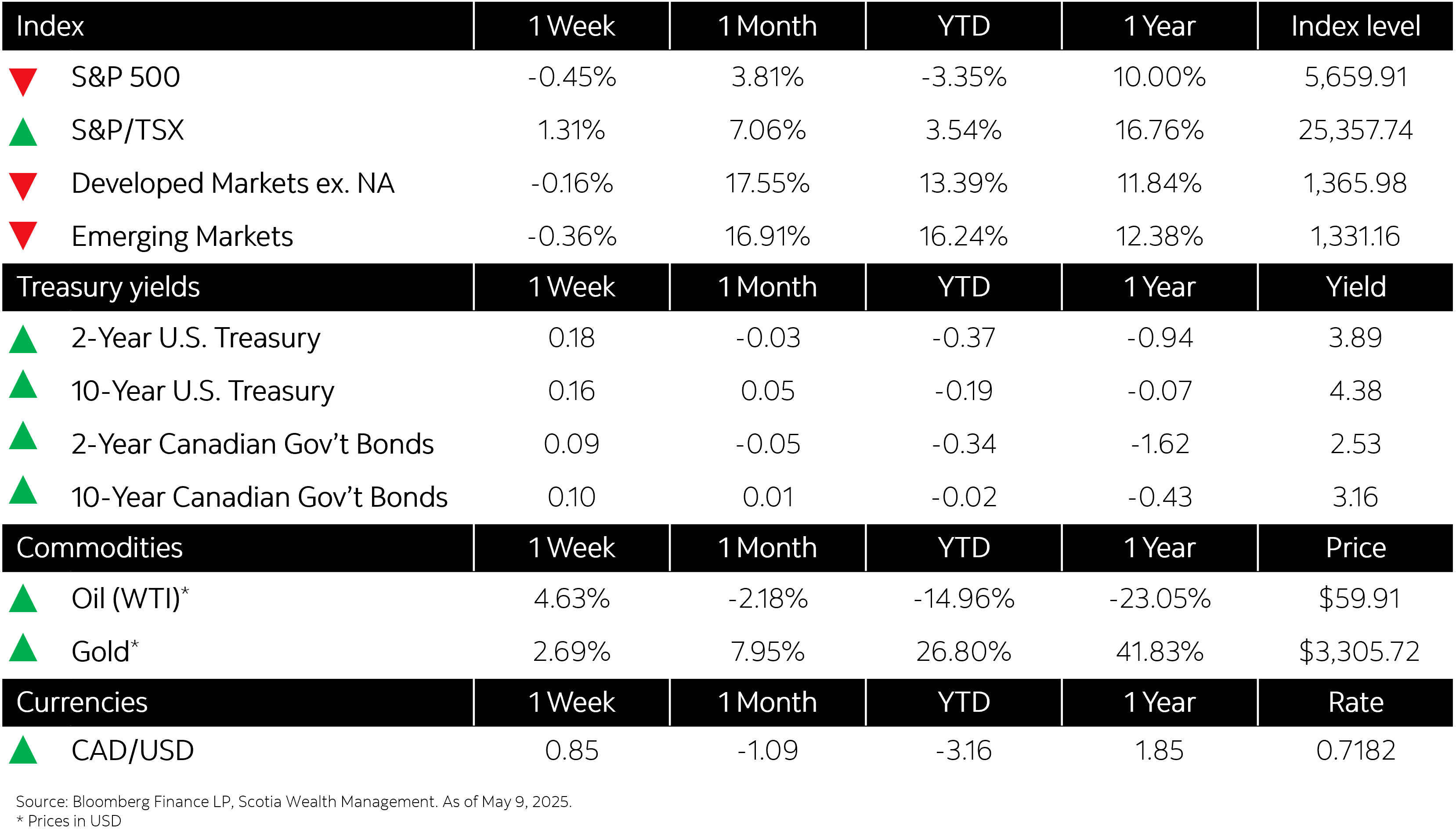
  • U.S. markets returned -0.45%1 for the week on the back of the trade deal with the U.K. and the Federal Reserve (Fed) policy stance.
  • Contrary to their southern counterparts, Canadian markets returned 1.31%2 for the week as investors parsed corporate earnings and U.S.-U.K. trade deal, which could signal a reduction in tariff-related uncertainty.
  • European markets returned -0.16%3 for the week, as Germany’s Friedrich Merz failed to secure the necessary parliamentary votes in his first attempt to become chancellor, increasing political uncertainty in Europe’s largest economy.
  • Emerging markets closed -0.36%4 after China reported a more than 20% drop in exports to the United States due to Trump’s steep tariff increases. However, overall exports rose at a faster-than-expected 8.1% annual pace in April.

Rates move higher following policy decisions by Central Banks

Seven central bank decisions were on deck this week, including those from the U.S. Federal Reserve and the Bank of England. U.S. and Canadian rates edged higher this week after the Federal Open Market Committee decided to keep rates unchanged. During the press conference, Fed Chair Jerome Powell maintained a ‘wait-and-see’ approach regarding the tariff’s impact on the economy, emphasizing that monetary policy remains in a “good place.” This holding stance and neutral tone came amid a weaker U.S. macroeconomic backdrop compared to September, when the Fed cut its policy rate 50 basis points. Following the Fed meeting, markets began pricing in a mid-summer rate cut of 25 basis points. Meanwhile, the Bank of England lowered its policy rate 25 basis points to 4.25%, aligning with market expectations.

Highlights:

  • The 2-year and 10-year U.S. Treasury yields were both up by 18 basis points (bps) and 16 bps, respectively. In Canada, the 2-year yields were up by 9 bps and 10-year yields were 10 bps higher. Bond yields and prices move inversely to one another.
  • The benchmark U.S. 10-year has been trading sideways since March, including April’s volatile swings, and has currently stabilized close to 3-month averages. April’s U.S. and European Consumer Price Index reports are due next week, along with Canadian housing stats, and U.S. Producer Price Index and retail sales.
  • Credit spreads continue to trade tighter on generally positive tariff headline news this week. Investment-grade primary volumes are likely to surpass projections. High yield bonds rebounded during the week across all ratings, but new issuance is still running low for May with just $7.8bn priced thus far, according to data compiled by Bloomberg.

Weekly dashboard

Canada’s trade deficit narrows more than expected in March as imports fall

According to data from Statistics Canada (StatCan), Canada’s trade deficit narrowed to $506 million in March, beating expectations as imports fell faster than the drop in exports. Imports of goods dropped 1.5% in March, driven by a 2.9% slump in imports from the United States after Canada imposed retaliatory tariffs on its neighbour following President Donald Trump’s 25% tariff on Canadian steel and aluminum from March 12.

Highlights:

  • Statistics Canada said exports to the United States also dropped by 6.6%, but an increase in exports to the rest of the world almost compensated for this.
  • Canada’s overall exports for March came in at $69.9 billion, down from $70.04 billion in February, led by the United States. This was the second month in a row when exports fell. In volume terms, exports rose by 1.8% in March.
  • However, imports fell in both value and volume terms, dropping for the first time in five months. Metal and non-metallic mineral products contributed 15.8% and energy products 18.8%, respectively. In volume terms, total imports edged down 0.1% in March.

U.S. Federal Reserve holds rates steady, cites rising risk of higher inflation and unemployment

The U.S. Federal Reserve (Fed) announced it would hold interest rates steady in the 4.25%-4.50% range. Still, it said the risks of higher inflation and unemployment had risen, further clouding the economic outlook as the U.S. central bank grapples with the impact of Trump administration tariff policies. The economy overall has “continued to expand at a solid pace,” the Fed said in a policy statement, attributing a drop in first-quarter output to record imports as businesses and households rushed to front-run new import taxes.

Highlights:

  • The labour market also remained “solid” and inflation was still “somewhat elevated,” the central bank’s policy-setting Federal Open Market Committee (FOMC) said, repeating the language used in its previous statement.
  • The latest statement highlighted developing risks that could leave the Fed with difficult choices in the coming months. A weaker job market would typically strengthen the case for rate cuts; higher inflation would call for monetary policy to remain tight.
  • The policy direction will depend on which of those job and inflation risks develops, or, in the more difficult outcome, whether inflation and unemployment increase together, forcing the Fed to choose which risk is more important to try to offset with monetary policy.

China services sector gauge slips to seven-month low amid trade spat

A private gauge of China’s services sector signalled that activity slowed in April, falling to a seven-month low as U.S. President Trump’s hefty tariffs fueled trade tensions and hurt new orders and market sentiment. The Caixin services purchasing managers’ index dropped to 50.7 last month from 51.9 in March. It was the weakest showing since September, when Beijing rolled out a series of stimulus measures to help reinvigorate the economy. Still, the index stayed above the 50 mark separating activity expansion from contraction, extending its streak to a 28th consecutive month.

Highlights:

  • Disruptions to trade caused by higher tariffs hurt some service providers in April, leading to the slowest increase in overall new business in 28 months, according to Caixin. New export orders increased marginally, with some companies reporting improved foreign demand.
  • Business confidence among service providers slipped to the second-lowest reading since data collection began in November 2005 as concerns about shifting trade policies weighed on sentiment.
  • Caixin said employment in the services sector shrank for a second straight month in April, marking the fourth contraction in the past five months.

1 S&P 500 Index CAD
2 S&P/TSX Composite Index CAD
3 Bloomberg Developed Markets ex N. America Large & Mid Cap Price Return Index CAD
4 Bloomberg EM Large & Mid Cap Price Return Index CAD