
Subscribe to the 100% free rdnewsNOW daily newsletter!
SPONSORED

Market Watch: May 2, 2025

May 2, 2025 | 3:42 PM

This week’s highlights

  • Equity markets demonstrate resilience despite shaky fundamentals
  • Bond market investors moving past tariff headlines to economic data ahead of FOMC meeting
  • Canada’s GDP contracted by 0.2% in February, slight growth likely in March
  • U.S. economy shrank in first quarter as imports surged ahead of tariffs
  • Eurozone economy picks up pace ahead of tariff disruption

Week in review

Equity markets demonstrate resilience despite shaky fundamentals

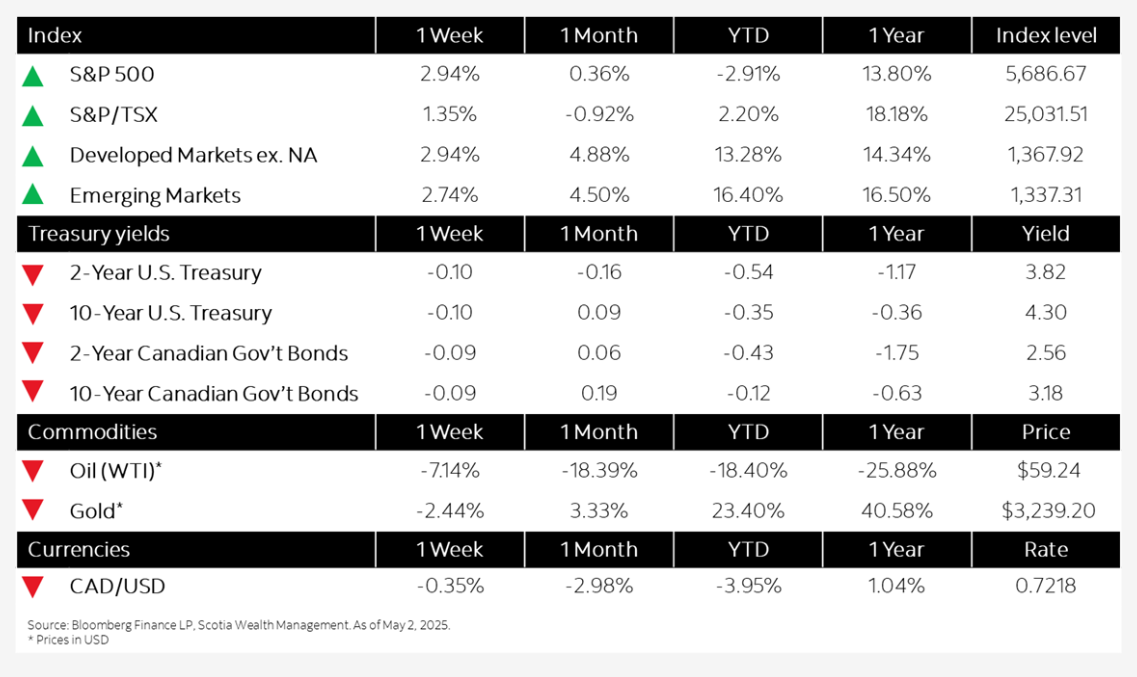
U.S. equity markets were positive for the week despite mixed earnings reports from major tech companies and ongoing trade policy uncertainty, with notable impacts from General Motors’ revised guidance and Visa’s resilient earnings. The U.S. and Canadian March GDP readings, which showed a contraction of 0.3% QoQ and 0.2% MoM, respectively, led to a slight contraction on Wednesday as it highlighted the negative impact of tariffs on businesses and consumers alike. Additionally, the Canadian federal election results fomented some volatility which proved to be short-lived. European equities were buoyed by stronger-than-expected GDP growth, despite inflation concerns, while the Bank of Japan’s dovish stance and China’s factory activity contraction influenced Asian markets. Emerging markets continue to grapple with the fallout from U.S. tariffs, with China’s Commerce Ministry setting tough preconditions for trade talks. Crude prices also moved lower as future demand forecasts continue to be soft and OPEC+ looks to move up output hikes.

Highlights:

  • S. markets returned 2.94%1 for the week despite mixed earnings reports from major tech companies, ongoing trade policy uncertainty, and a Q1 GDP contraction of 0.3%, highlighting the negative impact of tariffs and a surge in imports.
  • Similar to their southern counterparts, Canadian markets returned 1.35%2 for the week with federal election results and weaker-than-expected GDP data leading to bouts of volatility as economic challenges come into the spotlight amid the U.S.’ continued tariff agenda.
  • European markets returned 2.94%3 for the week, buoyed by stronger-than-expected GDP growth despite inflation concerns, with positive sentiment driven by robust economic data and corporate earnings reports.
  • Emerging markets closed 2.74%4 higher even as fallout from U.S. tariffs continues to reverberate, with Chinese factory activity contracting and the Commerce Ministry setting tough preconditions for trade talks, adding to economic uncertainty.

Bond market investors moving past tariff headlines to economic data ahead of FOMC meeting

U.S. fixed income markets were influenced by mixed economic data, including a Q1 GDP contraction report and resilient nonfarm payrolls, which impacted interest rate expectations and leading to a relatively unchanged week in sovereign bond yields. Canadian rates were affected by weaker-than-expected GDP data and federal election results, adding uncertainty to fiscal policy. European fixed income markets saw movements driven by stronger-than-expected GDP growth and inflation concerns, while the Bank of Japan’s dovish stance and China’s factory activity contraction influenced Asian markets. Overall, fixed income markets experienced fluctuations driven by economic data releases, policy announcements, and geopolitical developments across these regions.

Highlights:

  • The 2- and 10-year U.S. Treasury yields were both 10 basis points (bps) lower. In Canada, the 2- and 10-year yields were both 9 bps lower. Bond yields and prices move inversely to one another.
  • The U.S. 10-year benchmark yield had been moving lower over last couple of weeks on the back of weaker macro data but Friday’s U.S. nonfarm payrolls, which were better than expected, halted the decline. Market expectations have pushed back the timing of possible rate cuts from the Fed with the first one for 2025 now expected in late July.
  • Credit spreads have tightened amid a risk-on sentiment. Investment grade issuance may surprise to the high end of May historical averages as companies try to get ahead of any additional tariff-policy turmoil. Historically, May has also been a positive month for high yield returns.

Weekly dashboard

Canada’s GDP contracted by 0.2% in February, slight growth likely in March

Statistics Canada (StatCan) reported that Canada’s gross domestic product (GDP) contracted by 0.2% in February on a monthly basis for the first time since November as activities across mining, oil and gas and construction sectors shrank. While a part of the decline was due to bad weather conditions and snowstorms across provinces in February, the Bank of Canada and economists have predicted that growth will continue to slow in the coming months due to the impact of U.S. tariffs. StatsCan said that the economy is likely to expand by 0.1% in March, and on an annualized basis, the GDP is expected to grow by 1.5% in the first quarter.

Highlights:

  • Following two consecutive monthly increases, the mining, quarrying, and oil and gas extraction sector became the largest detractor from growth, down 2.5% in February, as most subsectors contracted.
  • The biggest dent to GDP came from the goods-producing industries, which contracted 0.6%. Construction fell 0.5%, its first decline in four months, led by residential building construction, which fell 0.9%.
  • Services-producing industries such as real estate rental and leasing, finance and insurance, and educational services contracted 0.1%.

U.S. economy shrank in first quarter as imports surged ahead of tariffs

The U.S. economy contracted in the first three months of 2025, as businesses rushed to stock up on imports ahead of the Trump administration’s tariffs and consumer spending slowed. The U.S. Commerce Department reported that U.S. gross domestic product (GDP), the value of all goods and services produced across the economy, fell at a seasonally and inflation-adjusted 0.3% annual rate in the first quarter. That was the first contraction since the first quarter of 2022.

Highlights:

  • Consumer spending, the economy’s main engine, rose at a 1.8% pace in the first quarter, the smallest increase since mid-2023. Federal spending fell as the U.S. Department of Government Efficiency cut jobs and contracts.
  • However, President Trump’s trade war was the main driver of the first-quarter contraction. Net exports, the difference between U.S. imports and exports, subtracted nearly 5% from headline GDP. That was the biggest quarterly drag on net exports since 1947.
  • Businesses rushed to get ahead of tariffs that began to come into effect during the first three months of the year and were dramatically increased in the current, second quarter. Imports rose at the fastest pace since the third quarter of 2020, when the economy was reopening from pandemic lockdowns.

Eurozone economy picks up pace ahead of tariff disruption
The eurozone economy grew at a faster pace than the U.S. for the first time in almost three years, aided by American businesses building up stocks of imported goods in anticipation of higher tariffs. According to the European Union’s statistics agency Eurostat, the 20-nation economy expanded 0.4% on quarter in the first three months of the year, faster than the 0.2% in the final quarter of 2024. However, activity is likely to weaken as the implementation of those U.S. tariffs weigh on demand for European exports.

Highlights:

  • An increase in production helped support growth during the first quarter. However, a weakening U.S. demand for eurozone goods from the start of April is expected to hamper growth during the remainder of 2025.
  • Pharmaceuticals and machinery were the leading European goods exported to the U.S., but in-demand items also included German cars, French champagne, and Italian olive oil.
  • Germany, the eurozone’s largest economy, grew 0.2% in the first quarter of 2025, reversing the equivalent drop in the final quarter of last year. France rose 0.1% while Italy and Spain expanded 0.3% and 0.6% respectively. Ireland’s growth at 3.2% was especially boosted by stockpiling ahead of U.S. tariffs.