Get the free daily rdnewsNOW newsletter by subscribing here!
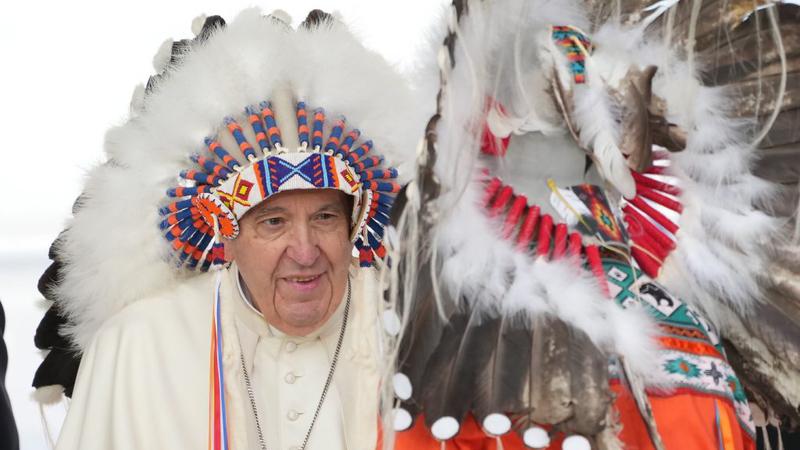
Pope Francis was given a traditional headdress to wear following his apology to Indigenous people during a ceremony in Maskwacis on July 25, 2022. (The Canadian Press/Nathan Denette)
the monumental apology: podcast & story

Reflections on Pope Francis’s 2022 visit to Maskwacis

Apr 25, 2025 | 11:34 AM

Listen now to a new episode of The Everything Red Deer Podcast, with companion written piece below:

The apology Pope Francis delivered to Indigenous people on July 25, 2022 in Maskwacis, Alta. was monumental, if you ask Reverend (Rev.) Tony Snow.

Snow, who was there, is a member of the Stoney Nakoda First Nation west of Calgary, and is the Indigenous minister for the Chinook Winds (southern Alberta) region of the United Church of Canada.

His father was Rev. John Snow, and the family is descendants of the signatories to Treaty 7, which covers Alberta from the southern border to the Red Deer River, halfway through the city of Red Deer.

“A lot of groups thought that this may never happen and when it did, it was monumental — the recognition of our shared trauma and shared experience being identified from an institution like the Catholic Church. It helped validate for all Canadians what the role of the residential school efforts had been, [and] what the response [should be] towards those who deny that anything bad happened,” Snow told rdnewsNOW and The Everything Red Deer Podcast in the wake of Francis’s death.

“This was something he did not have to do, and it was something he was requested to do. Even while in Canada, he was being informed, changing his views and bringing himself to a better understanding as all people do when they start to realize the impacts of these traumas.”

A strong advocate for Indigenous rights, among other things, Rev. Snow said, retrospectively, the apology always should’ve been looked at as a first step, and not as something that could wipe the slate clean.

Snow referenced the 1986 apology made by the United Church to Indigenous people for its part in colonization; this apology was acknowledged in 1988. The United Church then apologized again in 1998, this time specifically for its role in the residential school system.

“”There’s a lot of work that’s been ongoing since that time, on how to build a better understanding of what it’ll take to truly reconcile. It took a long time for us to get here and it’ll take a generation to work through and find a real balance and solutions for the things that affected us in the past and continue to do so,” said Snow.

“We are hopeful that with our work, inter-denominationally, in the interfaith community and in others, we can find a workable solution that will uphold and honour the rights of all people, especially Indigenous people who were first here.”

That means prosperity for future generations, whom he reiterated are today dealing with the intergenerational trauma in many forms, including addiction and suicide, women going missing and being murdered, as well as poverty, unemployment, over-representation in the correctional system, and the list goes on.

“We need to look at these issues with compassion, and with a plan towards changing the outcomes, because it’s unsustainable for communities to deal with that much trauma,” he added.

In the end, Francis’s apology hit many of the right notes for some, but there will continue to be differing opinions on its lasting impact.

READ MORE: July 25, 2022 — Local Indigenous members speak on Pope Francis visit to Maskwacis

Former rdnewsNOW journalist Alessia Proietti covered the event in-person, and recalled the ambience as somewhat split.

“That day, there was something of a hesitancy, a little bit of reluctance, and people were curious what he was going to say,” Proietti shared, speaking to us from Montreal. “People who were more Catholic were very happy with the apology, and others thought it was lacking, particularly with respect to the Doctrine of Discovery, which they wanted him to renounce. So there was some disappointment.”

The Doctrine of Discovery, which was a set of ideas used by early colonizers to justify the seizing of land which they had “discovered” was repudiated by the Holy See eight months after his trip to Alberta.

Proietti concluded, saying empathy and listening to people’s stories could go a long way in building upon the message the late Pope expressed three years ago.

“A lot of people may choose not to listen to this or that side of the story because they have preconceived notions. To assume things about others is really what makes the world a challenging place,” she said.

“If we go into every conversation with an open mind, ask genuine questions, and truly want to understand the person and what they’re going through, or why they’re going through it and how they feel, we’ll be able to get through all the difficult battles which life hands us.”

Supports are available for those affected by the ongoing impacts of residential schools, and those triggered by media reports.

A national Indian Residential School Crisis Line remains available to provide support for former students and those affected. People can access emotional and crisis referral services by calling the 24-hour national crisis line: 1-866-925-4419.

Individuals impacted by the issue of Missing and Murdered Indigenous Women and Girls are encouraged to contact the MMIWG Crisis Line toll-free at 1-844-413-6649.

First Nations, Inuit and Métis seeking immediate emotional support can contact the Hope for Wellness Help Line toll-free at 1-855-242-3310, or by online chat at hopeforwellness.ca.