Subscribe to the 100% free rdnewsNOW daily newsletter!
Sponsored

Market Watch: January 26

Jan 29, 2024 | 4:04 PM

This week’s highlights

  • Global equities advance cautiously on growth and inflation data
  • Fixed income markets rally on inflation data and rate cut hopes
  • Bank of Canada keeps key interest rate at 5%
  • U.S. economy grew 3.1% over the past year
  • China moves to boost bank lending in broad effort to prop up growth
  • Concerns arise over potential supply chain shock in wake of Red Sea attacks

Week in review

Global equities advance cautiously on growth and inflation data

Markets exhibited markedly strong performance despite mixed reactions to strong economic data out of the U.S. and ongoing geopolitical events. Equities got a boost from strong Gross Domestic Product (GDP) growth and Personal Consumption Expenditures (PCE) inflation that was in line with expectations. Overall, investors displayed a cautious balance between optimism towards what seems to be a relatively strong and broad economic recovery and a potential relaxation of monetary policy, and concerns over conflict in the Middle East that could reignite inflation and uncertainty surrounding China’s future growth prospects.

Highlights:

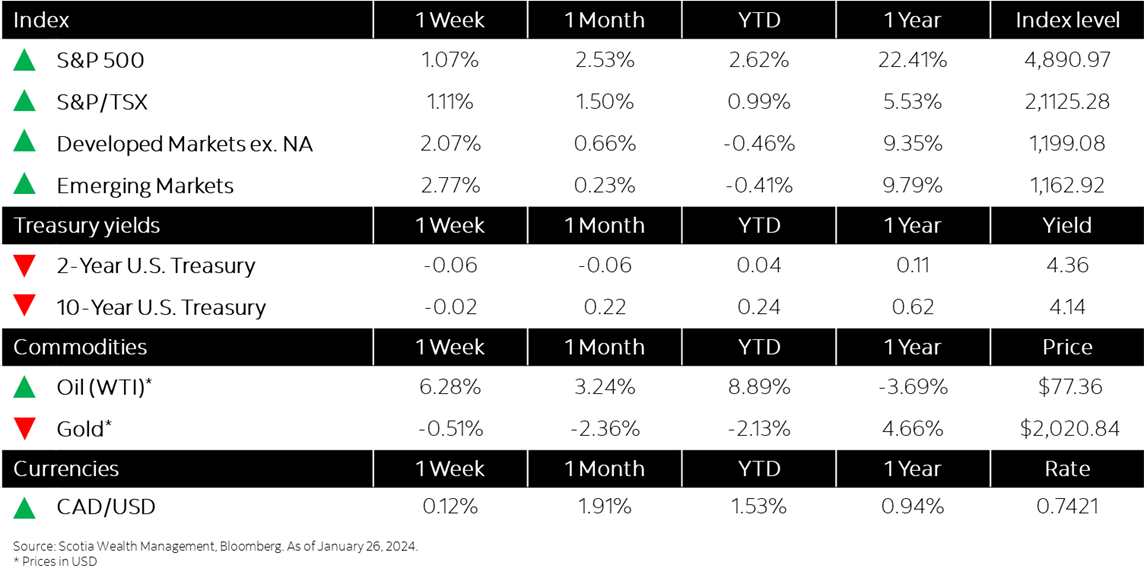
  • U.S. markets returned 1.07%1 on the back of strong GDP and PCE data but was ultimately restrained by sell-offs among some well-known stocks following lacklustre earnings reports.
  • Canadian markets rose 1.11%2 for the week with gains in technology offset by losses in utilities after a rate announcement from the Bank of Canada that left the policy rate unchanged.
  • European markets were largely positive, up 2.07%3 following a spate of strong earnings reports as investors assessed interest rate cut prospects for 2024 following the European Central Banks (ECB) decision to hold interest rates steady.
  • Emerging markets recorded their first weekly gain of the year, rising 2.77%4 after China announced new stimulus measures which will allow banks to hold smaller cash reserves. What followed was one of the largest weekly flows into Chinese equity funds since 2015.

Fixed income markets rally on inflation data and rate cut hopes

Sovereign yields moved slightly lower for the week following a better-than-expected U.S. GDP and the latest PCE reading. The ECB kept rates unchanged while holding back on rate-cut rhetoric. European bonds rallied after Lagarde’s press conference. The expectations for monetary policy across major central banks hasn’t changed materially since December, with futures markets largely anticipating rate cuts as early as March-April. Credit spreads are trading tight, driven by strong demand throughout January. Investment grade primary issuance is likely to surpass the January 2017 record, currently sitting at $168bn USD.

Highlights:

  • The 2-year U.S. Treasury yield fell 6 basis points (bps) while the 10-year yield was down 2 bps. In Canada, the 2- and 10-year yields were 5 bps and 1 bps lower, respectively.
  • Headline PCE inflation was unchanged while core ticked down year-over-year. However, both measures ticked up on a month-over-month basis.
  • The coming week’s economic calendar is busy, with the Fed and Bank of England rate decisions and the latest U.S. employment measured by ADP and Nonfarm payroll.

Weekly dashboard

Bank of Canada keeps key interest rate at 5%

The Bank of Canada held its policy interest rate steady for the fourth consecutive time and said that monetary policy discussions have shifted from whether to raise borrowing costs further to how long the bank should wait before lowering them. Tight monetary policy is having its intended impact. The economic slowdown is feeding through to inflation, which has declined significantly from a peak of 8.1% reached in mid-2022 and came in at 3.4% in December. The bank targets 2% inflation.

Highlights:

  • Economic growth in Canada has stalled, consumers have cut spending, businesses have pulled back on investment, and unemployment is rising. Taken together, the bank now thinks the Canadian economy is operating in a state of “excess supply.”
  • The bank gave no guidance about the timing of possible rate cuts. “I think it’s important that we don’t give Canadians a false sense of precision,” Bank of Canada governor Tiff Macklem said. “We’re going to have to see how inflation evolves.”
  • The bank’s latest forecast sees only 0.8% gross domestic product (GDP) growth in 2024, although it expects economic activity to pick up around the middle of the year. It expects 2.4% GDP growth in 2025.

U.S. economy grew 3.1% over the past year

The U.S. economy grew 3.1% over the past year, defying projections of a recession as a resilient labour market supported strong consumer spending. According to the U.S. Commerce Department, the year was capped by a fourth quarter in which the economy grew at a 3.3% seasonally and inflation-adjusted annualized pace, as household outlays and government spending rose. The quarterly reading was a slowdown from the summer’s torrid 4.9% pace but in line with pre-pandemic trends.

Highlights:

  • The 2023 figures stand in contrast to what economists expected a year ago when they saw a recession as very likely and expected anemic 0.2% growth for the year. Last year’s gain was a sharp pickup from a 0.7% advance in 2022.
  • The expansion is expected to continue in 2024, albeit at a significantly slower pace. According to economists, the highly anticipated pivot from the U.S. Federal Reserve toward interest rate cuts should support the economy this year.
  • However, that buoyancy could be challenged by slower hiring and increased strain on Americans who have spent down pandemic-era savings.

China moves to boost bank lending in broad effort to prop up growth

China’s central bank announced new steps to boost bank lending to households and businesses, an early move in what is expected to be a broad but restrained campaign by authorities to prop up growth after a lacklustre 2023. The cut to banks’ reserve requirements, announced unexpectedly by the People’s Bank of China, sends a new signal that officials are feeling growing pressure to curb the stock-market selloff while also stepping up support for the broader economy.

Highlights:

  • The central bank would lower the amount of reserves banks need to hold against their deposits (starting February 5), freeing up around 1 trillion Chinese yuan, equivalent to US$139 billion, that can then be funnelled into new loans.
  • The reserve reduction marked the third such move in less than a year and takes the average reserve requirement across all banks to around 7%, from 7.4% previously.
  • The central bank also announced it intends to cut some key rates linked to loans for small firms and rural enterprises.

In the news: Concerns arise over potential supply chain shock in wake of Red Sea attacks

Right at a time when inflation seemed to be tamed, global shipping prices continue to spike as the Houthi rebel group strikes vessels in and around the Red Sea. The increased attacks are causing many companies to either divert ships around the Cape of Good Hope leading to longer lead times and increased fuel costs, or to purchase costly “war risk” insurance. It is s unclear whether increased costs and shipping times will be reflected in future inflation readings as consumers pay higher prices, but with weak demand businesses will likely be pressured to absorb the higher costs in their profit margins as opposed to passing them along to already stretched consumers.

Behind the headline:

  • Since attacks on shipping through the Red Sea began in December, the average cost to ship a standard 40-foot container has risen 173% to $3,776 USD5.
  • The delays are already beginning to affect manufacturers in Europe, with both Tesla and Volvo suspending some production in Germany and Belgium citing parts shortages.
  • On the positive side, longer transit times are helping the industry absorb what would have been a substantial oversupply of vessels and containers that were acquired following 2022’s shipping tumult.

1 S&P 500 Index CAD
2 S&P/TSX Composite Index CAD
3 Bloomberg Developed Markets ex N. America Large & Mid Cap Price Return Index CAD
4 Bloomberg EM Large & Mid Cap Price Return Index CAD
5 Source: Drewry Shipping Consultants. From November 30, 2023 to January 18, 2024.

Download the rdnewsNOW mobile app on Google Play and the Apple App Store for all the latest updates on this and other stories.