
Get the free daily rdnewsNOW newsletter by subscribing here!
(Photo 148650665 © motortion | Dreamstime.com)
permanent supportive housing desperately

Mayor, City & Safe Harbour react to sharp rise in Red Deer homelessness

Mar 17, 2023 | 1:24 PM

The City of Red Deer, including Mayor Ken Johnston, is pinning a staggering increase in the number of people experiencing homelessness on a combination of issues.

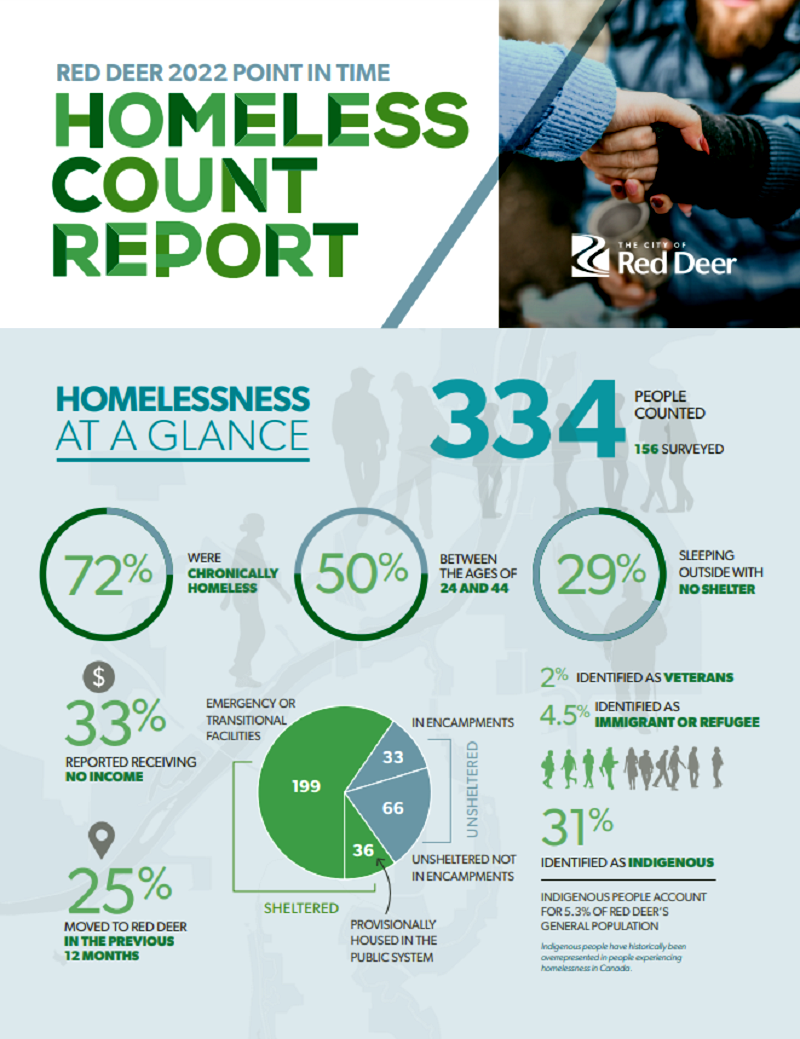
Results from the 2022 Point in Time homeless count — revealed earlier this month — show there are at least 334 people in that situation. That’s up from from 144 in 2018, or an increase of 132 per cent.

The COVID-19 pandemic, worsening substance abuse, and global inflation are all to blame, agree Johnston and City Superintendent for Wellness and Integration Supports, Ryan Veldkamp.

The two also concur there’s a severe lack of affordable housing stock, adding that the rise in homelessness isn’t unique to Red Deer.

Lethbridge, for example, rose from 223 in 2018 to 454 in 2022.

In 2020, Victoria, B.C. counted 620 unsheltered or emergency sheltered, up from 517 in 2016.

Also worth noting, however, is that Red Deer had a 10-year plan to end homelessness, beginning in 2009. Reviewed halfway through, it was succeeded by a five-year strategy in 2019.

So why is homelessness on the rise when a plan had set out to end it?

“It took a lot of courage to come up with a plan to end homelessness. It’s quite an aspiration. Again though, look across the country and you’ll see the problem isn’t shrinking,” says Mayor Johnston.

“Our survey showed 78 per cent of those asked indicated substance abuse as being the driver of a lot of their ills. Look further and we need about 100 permanent supportive housing spaces. That’s different from affordable housing.”

Out of all respondents, 62 per cent cited mental health issues.

Johnston says agencies helping people are stretched thin, particularly with an increase in more difficult cases.

Enter the Red Deer & District Chamber of Commerce which on March 14 announced it was in the process of forming a Task Force on Homelessness.

READ MORE: Red Deer Chamber to create Task Force on Homelessness

Johnston says the City has been deliberate about speaking with the Chamber and CEO Scott Robinson over the last 18 months, about their ideas. He believes the Chamber can be a powerful voice and advocate in this arena.

“I think they understand this is a very difficult landscape to navigate, but they want to jump in,” says Johnston.

“Turning to housing; I’ve been here 27 years and there are success stories. We can’t forget people are being placed in housing, and that agencies are working feverishly. The City doesn’t have a direct role, but a supportive role in housing, and we try to support those agencies.

“Looking at what the province has done around recovery-oriented housing strategies and shelter strategies, I can tell they’re acutely aware the housing stream must be beefed up.”

Indeed agencies are working frantically, says Veldkamp, who shares there are currently about 170 individuals in Red Deer-based housing programs.

Those programs are where the bulk of money from the provincial and federal governments go, he explains.

“A critical piece of how we look at this going forward is that it’s not just a housing loss issue. It’s often a health issue or a series of income issues. The solution is going to come from working with various systems and finding the appropriate supports,” Veldkamp says.

“There are projects we’re familiar with, which are currently in exploration and are largely through the non-profit sector. In terms of the private sector, we did have conversations around housing asset development last summer,” he shares. “We heard from private developers there certainly is interest, but they’re looking for various incentives the City could provide, as well as regulatory changes that would support the feasibility and sustainability of such projects.”

Kath Hoffman, long-time executive director at Safe Harbour Society, says it’s correct that homelessness has not waned across the country. Hoffman was at the table in 2008 when the City forged its aforementioned 10-year plan.

“I remember thinking it was a wonderful plan, but I questioned, ‘Where is the money?’ That’s always the problem. You can’t leave that for the non-profit sector to do on its own. We had to have that philanthropic and corporate buy-in, and that’s maybe been the biggest missing piece, which is why it excites me to see the Chamber getting involved,” says Hoffman.

“But it’s not just that money. You can build houses, but you have to also be able to get money to fund the different models of support from the provincial government. As usual, it takes everybody.”

Hoffman doesn’t downplay the affects of homelessness on businesses close to the temporary shelter in the Railyards neighbourhood.

READ MORE: Downtown business owner upset over City’s handling of social disorder

She admits too that the numbers, at least to her, aren’t surprising, and affirms the increasing rate of higher acuity cases.

“It’s impossible to get people housed sustainably without 24-hour staffing, because people are active in their addiction. It doesn’t mean they can’t be housed; it just means they need the 24/7 support, as do neighbours and landlords, to help minimize any untoward behaviour. We know once people get a roof over their heads, their use starts to decrease. As well, the shelter has to be just for emergency; we have to be able to move people out quick and into housing, but it takes a bunch of different options,” Hoffman explains.

“We’ve seen the same rise in our temporary shelter. Before COVID, our maximum overnight was 52, and one night this February, we hit 188. The Point in Time count is a good measurement, but it doesn’t capture all of it.

“The one good thing about these numbers coming out is that it draws attention to the issue, and that’s what we need.”

READ MORE: City of Red Deer releases Point in Time (PiT) homeless count numbers

(City of Red Deer)