
Get the free daily rdnewsNOW newsletter by subscribing here!
Hail spotted near Innisfail on Aug. 1, 2022. (Submitted)
Alberta Hard Hit

2022 third worst year for insured damage in Canadian history, says IBC

Jan 20, 2023 | 3:20 PM

Officials with the Insurance Bureau of Canada (IBC) say severe weather across Canada, including in central Alberta, continues to highlight the financial costs of a changing climate to insurers, governments and taxpayers.

Nationally, the organization reveals that insured damage for severe weather events reached $3.1 billion last year, according to Catastrophe Indices and Quantification Inc. (CatIQ).

Officials say 2022 now ranks as the third worst year for insured losses in Canadian history. While the $3.1 billion figure is alarming, IBC says no single catastrophic event nor any particular region accounted for the majority of losses. Unlike 2016, the highest loss year on record, where the Fort McMurray, AB, wildfire accounted for about 75 per cent of national losses, 2022 saw disasters from nearly every part of the country, the organization points out.

According to IBC, noteworthy severe weather events last year include Hurricane Fiona, the Ontario and Quebec derecho, the Eastern Canada late-winter storm, the Western Canada summer storms and the Eastern Canada bomb cyclone.

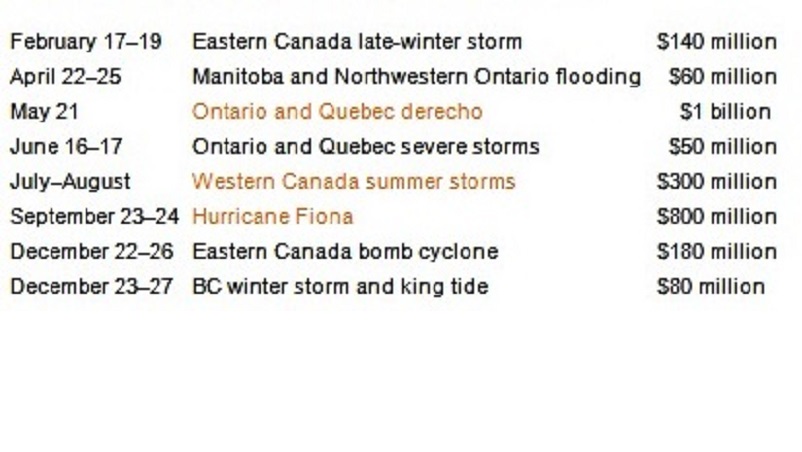
Insured Damage for Severe Weather Events in 2022

Canada’s Top 10 Highest Insured Loss Years on Record (loss and adjusted expenses in 2022 dollars)

Sources 1983–2007: IBC, PCS Canada, Swiss Re, Deloitte. 2008–2021: CatIQ.

“Canada is increasingly a riskier place to live, work and insure,” said Craig Stewart, Vice-President, Climate Change and Federal Issues, Insurance Bureau of Canada (IBC). “Governments have spent far too little attention to adaptation in the discourse over climate policy. This spring, the federal government needs to lead the way in finalizing a National Adaptation Strategy and boldly funding both community-level infrastructure and property-level retrofits that increase resilience to floods, windstorms, heat events and wildfires.

“In particular, we’re seeing early signs that property insurance may become less affordable or even unavailable as global reinsurers shift capacity away from riskier countries,” continues Stewart. “Now is the time for Canadian insurers and governments to partner on a National Flood Insurance Program to ensure Canadian homeowners remain financially resilient in the face of these growing number and severity of events.”

In today’s world of extreme weather events, says IBC, insured catastrophic losses in Canada now routinely exceed $2 billion annually, most of it due to water-related damage. In the decade before 2008, Canadian insurers averaged only $456 million a year in severe weather-related losses.

September 20, 2022 (Edmonton) – Storms that hit Western Canada this summer are expected to result in over $300 million in insured damage, according to initial estimates from Catastrophe Indices and Quantification Inc. (CatIQ). In addition, new estimates from CatIQ indicate that the July 2, 2021, hailstorm and flooding in Calgary resulted in over $600 million in insured damage, more than double the initial estimate. That makes it one of the top-10 costliest weather events in Canadian history.

The following storms have been designated as catastrophes (events where insured damage estimates total more than $30 million) by CatIQ.

July 7 to 8, 2022 – Over $30 million in insured damages:

Strong thunderstorms developed over Alberta and Saskatchewan, with hot and humid conditions facilitating the creation of large supercell-type storm cells. At least one damaging tornado was confirmed near Bergen, Alberta, and large hail damaged vehicles and homes in Ponoka and Oyen. Additional tornadoes occurred in Saskatchewan, along with local flash flooding.

July 15 to 17, 2022 – Over $70 million in insured damages:

A series of severe thunderstorms tracked across the Prairies, bringing heavy rain, very large hail and damaging winds. At least one tornado was confirmed, along with a damaging downburst in Alberta. Large hail damaged homes and shattered windows in Ponoka, Alberta, while several tornadoes were confirmed in Saskatchewan.

July 18 to 21, 2022 – Over $100 million in insured damages:

A system tracking across much of Western and Central Canada left a trail of damaging severe weather in its wake. Tornadoes were confirmed in Alberta, Ontario and Quebec, and large hail, heavy rain and flooding occurred at points in between. Reports of damage to homes, other structures, trees and power lines stretched from Southern Alberta to Quebec’s Gaspé Peninsula.

July 29 to 31, 2022 – Over $40 million in insured damages:

A disturbance tracking from the Canadian Rockies across the central Prairies sparked a cluster of severe thunderstorms over the course of several days. At least two tornadoes were reported, along with large hail and flooding.

August 1 to 2, 2022 – Over $55 million in insured damages:

Severe thunderstorms in Central Alberta damaged windows with very large hailstones. Several storm cells also produced wind gusts at speeds above 100 km/h, as well as heavy rain and flooding. The storm drifted as far east as Saskatoon, Saskatchewan, over the course of two days. Dozens of cars were severely damaged along Highway 2 in Alberta, along with properties from Central Alberta to Central Saskatchewan.

IBC reminds consumers that damage caused by wind and rain is typically covered by home, commercial property and comprehensive auto insurance policies. Insurers continue to work diligently through the entire claims process to help clients impacted by these storms.

Insurance claims from severe weather have more than quadrupled across Canada since 2008. The new normal for insured catastrophic losses in Canada has reached $2 billion annually. In the past 10 years, five of the most costly severe weather events occurred in Western Canada totaling in excess of $8 billion in insured damages. Alberta in particular has experienced more severe weather events this decade than any other region in Canada

The amount of insured damage is an estimate provided by CatIQ (www.catiq.com) under license to IBC.