Subscribe to the 100% free rdnewsNOW daily newsletter!
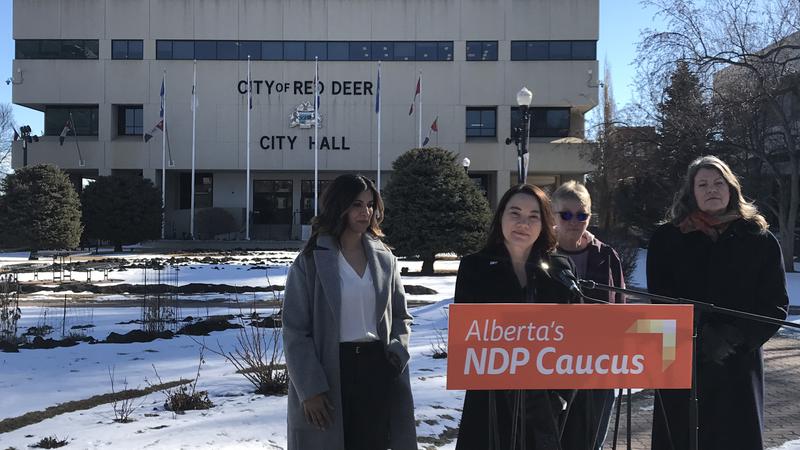
NDP Finance Critic Shannon Phillips speaks at a press conference held at Red Deer's City Hall on Monday. NDP Children's Services Critic Rakhi Pancholi, local woman Joanne Buhler, and Seniors and Housing Critic Lori Sigurdson stand behind (left to right). (Alessia Proietti/rdnewsNOW)
Red Deer's City Hall

Alberta NDP talk inflation with Red Deer woman facing the effects

Mar 22, 2022 | 12:34 PM

Members of Alberta’s NDP stopped at Red Deer City Hall on Monday to highlight the impacts of inflation, with one local woman saying she can no longer afford prescribed vitamins for her medical condition.

During the press conference, the three critics claimed that Premier Jason Kenney’s UCP policies have further taxed Albertans on the current 30-year high inflation.

One of the main topics debated was the UCP’s decision in the 2019 budget to de-index income tax and social benefits for Albertans on Assured Income for Severely Handicapped (AISH), the Alberta Seniors Benefit, Income Support and Child and Family Benefit. The NDP says it has drafted a policy indexing benefits and income tax would increase each year to match inflation.

With de-indexing, continued in the 2022 budget until 2025, an NDP report released Monday titled “Protecting Albertans from Inflation” stated a family of four with two income earners would lose $400 per year.

NDP Seniors and Housing Critic Lori Sigurdson said, “In real terms, Albertans on AISH, like Joanne, will lose nearly $3,000 a year under the UCP’s plan while low income seniors, those struggling with poverty, will lose roughly $750 a year.”

Red Deerian Joanne Buhler worked at a casino when she was diagnosed with depression and anxiety in 2009 and put on AISH. Transitioning to construction work for a more labor intensive job, she fell off a ladder in 2015, needing multiple surgeries.

After three months, Buhler was told to return to work. She went back to the casino part-time, but after a failed surgery in September 2020 on her right rotary cuff, she had to quit in November 2021 as the repetitive motion of the position became too painful.

While AISH paid for prescription medications, they did not pay for her Vitamin D or Calcium, prescribed for her depression and bone health, respectively, as they are considered over-the-counter medications.

The bills, however, started to pile, she says.

“When you’re choosing between food and medication, it’s a sad state of affairs, from a real person. It’s ugly,” said Buhler.

Living with a roommate, the 61-year-old says her electricity and energy bill increased to $229 per month compared to the $85 she paid last year, while a full vehicle gas tank costs $60 instead of her usual $35. Making roughly $1,000 less a month compared to when she worked full time at the casino, she could no longer make ends meet.

Taking a part-time hotel receptionist job in February this year, she says some days are too physically painful and still not enough financially, toying with the idea of selling her car instead.

AISH recipients make $1,685 per month and can make an additional $1,072 through employment before their AISH benefits start being deducted. Taking pension through early retirement would also reduce AISH benefits.

Justin Marshall, Press Secretary for the UCP’s Minister of Community and Social Services, responded in a statement saying, “We know how important social programs like Assured Income for the Severely Handicapped (AISH) are for people who rely on them. That is why Alberta’s AISH rates are the highest among the provinces at $1,685 per month. At over $1.4 billion, this is the largest budget AISH has ever had and we are proud of that. In budget 2022 Alberta’s government is also investing $34 million in employment supports to empower the most vulnerable and help them reach their full potential.”

NDP Children’s Service Critic Rakhi Pancholi spoke about rising utility costs and the UCP’s response.

“We have been clear that the fake natural gas rebate that is unfunded in the UCP budget and the $50 electricity rebate don’t go far enough,” she said.

The UCP announced in the 2022 Budget a natural gas rebate for customers being charged more than $6.50/GJ during October 2022 and March 2023 and a $150 electricity retroactive rebate from January to March this year. Pancholi said one factor increasing the costs was the UCP’s decision in 2019 to remove the NDP’s electricity price cap.

READ: Online petition over Alberta’s high utility rates exceeds 82,000 signatures

As customers can face utility cut-offs starting April 15, the NDP proposed last week a six month extension, rejected by the UCP. Pancholi said the NDP will vote this week on the 2022 Budget in attempts to make amendments.

NDP Finance Critic Shannon Phillips said the party’s plan is to “inflation-proof the budget”, reversing the UCP’s “tax on inflation” by promising $1 billion in tax relief.

She also cites the UCP’s removal in 2019 of the NDP’s price cap on car insurance premiums causing hikes, increase in public education costs and post-secondary tuition, property and personal income tax hikes, and corporate tax cuts.

Attributing some of the inflationary effects to the federal government’s spending, Marshall also stated, “It should be noted that Albertans continue to have substantial advantages over those living in other provinces, including lower overall taxes, almost 40 per cent of filers pay zero provincial income tax, higher wages, some of the lowest housing prices, and the lowest food and transportation costs in the country.”

“Additionally, since the changes made in Bill 41, seven insurers have filed for auto insurance premium reductions. Under the previous government’s rate cap, many Alberta drivers had to pay for the full year’s premium up-front and were denied collision and comprehensive coverage. That is not a realistic option for many Alberta households.”

Proposed in the legislature on Monday, the UCP refused the NDP’s proposal to re-index benefits. The 2022 Budget is the first balanced budget in seven years, with the UCP expecting a surplus of $500 million through forecasts of large revenues from oil and gas prices.

READ: Budget 2022: Alberta Government unveils full financial plan