Subscribe to the 100% free rdnewsNOW daily newsletter!
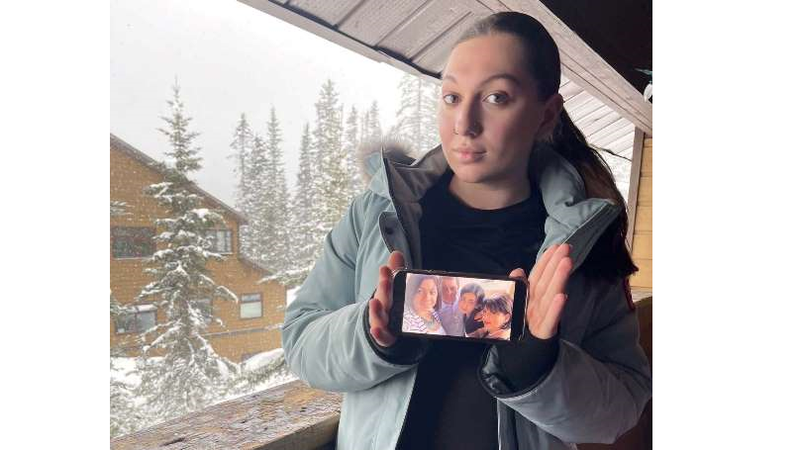
Anna Fediva lives in Lake Louise, but her family is still in Odessa, Ukraine. (Supplied)
Russian invasion of Ukraine

Wait or war: First hand accounts from Alberta to Ukraine

Mar 16, 2022 | 3:16 PM

The Great European Plain is one of the largest mountain-free landscapes on Earth. With Ukraine and Russia along this plain; their mainly flat border is acknowledged by some as a suitable topography for Vladimir Putin’s invasion.

Anna Fediva currently lives in Lake Louise, an Alberta mountain hamlet with the highest elevation in all of Canada. A stark contrast from her life in Odessa, a port city of the Black Sea in southern Ukraine. Moving on her own to Niagara Falls for hospitality studies, she then continued westward for her Canadian dream. At the young age of 22, she built a life in Alberta, with friends in Edmonton and Red Deer, and just received her permanent residency. But today, she thinks about her family and friends, mostly all in Ukraine.

“My biggest concern was how fast it was going to take Russia to take the whole Ukraine. How fast and how bad it was going to be,” she said.

While Odessa has not yet been the target of invasion, Fediva’s parents send her a text message each day letting her know they’re doing alright. Every morning, the sight brings Fediva a small sigh of relief but the feeling is short lived.

“Everyone was scared but at the same time, it was like ‘no way in the 21st century is Russia going to invade’,” said Fediva.

She explained major pieces from the long history of tensions between Russia and Ukraine, dating centuries with multiple wars over Ukraine’s current capital of Kyiv, the Russian-made famine killing millions of Ukrainians in 1932, and the country’s independence in 1991 after the fall of the Soviet Union.

The most recent tensions can be linked to 2004, when two months of daily protests by thousands of Ukrainians took place in Kyiv disputing the presidential election. The victory of Russian-backed President Viktor Yanukovych was deemed to be fraudulent from corruption, resulting in a revote order after the non-violent protests. President Viktor Yushchenko, seen as free and fair, then won instead. Known as the Orange Revolution, the color was scattered by civilians around the country in support of the new president. Yanukovych later became President in 2010.

In 2013, the Euromaiden protests began when President Yanukovych decided not to sign a free trade agreement with the European Union in order to seek better economic relations with Russia. Three months of protests transitioned into the 2014 Revolution of Dignity when protestors fought against Ukrainian police and overthrew the government in five violent days.

Immediately after, President Vladimir Putin invaded and annexed the Crimean Peninsula in Ukraine, claiming they must “return” the land to Russia. Many pro-Russian demonstrations took place in Crimea, an ethnically Russian population. The Ukrainian-Russian war had officially begun.

“They literally invaded Ukraine when Ukraine was at their weakest point because they were solving their own problems,” said Fediva.

When current President Volodymyr Zelensky came into power in 2019, one priority was to join the North Atlantic Treaty Organization (NATO), an international military alliance. Fediva described the rumors she heard being spread at the time by Russia that NATO was utilizing Ukraine’s rich nuclear resources to one day attack the Kremlin.

President Putin declared war on Feb. 24.

For Fediva, not only was this moment filled with shock, but the Rocky Mountains she looked out to each day gave her a sinking feeling.

“I was going outside and I was feeling guilty because I can see the sun, I can breathe, I don’t have to be scared and people in that country do,” she said. “You literally feel guilty if you are not there.”

This sentiment was not unique, however, as described by Anna’s friend Valeriia, who wished to keep her last name anonymous.

“I also feel…..guilty? That I’m here in safety. I was driving in my car today and thought that I’m not afraid that a missile will fall on the road in front of me and explode, but people in Ukraine are. My family lives in constant fear and I am here perfectly safe; it isn’t fair”, she told rdnewsNOW in early March.

Living in Niagara Falls, Valeriia had a plane ticket to fly back on Feb. 24 to celebrate her birthday with her family, all living in Okhtyrka, a small city in the Eastern region of Sumy along the Russian border.

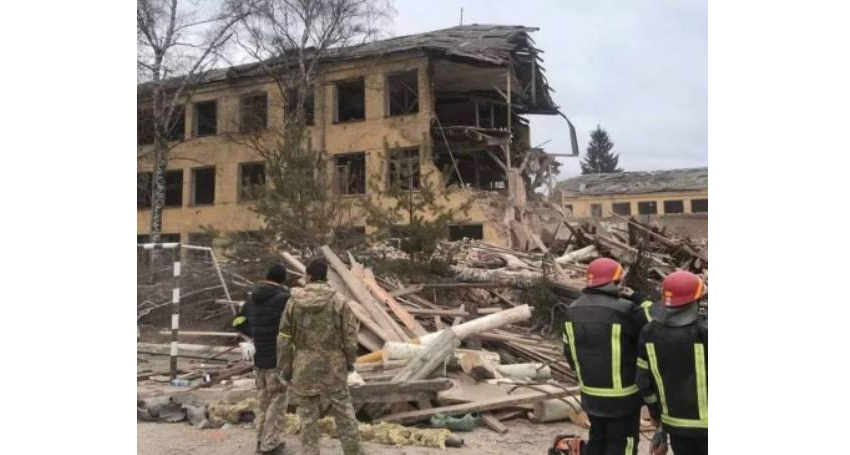
Photos sent to Valeriia by friends in her home town of Okhtyrka, Ukraine. (Supplied)

The city was bombed heavily that day with one missile hitting a building killing 70 people, she claims.

Her mother, sister and grandmother sought refuge westward in the small village of Poltava, where they sleep fully clothed, ready to leave at any time, Valeriia said. Her father, however, stayed behind as territorial defense. Unlike the army, this defense was made up of civilians and any available weapons.

“He said how he was carrying dead bodies of young Russian boys, 18-22 years old, who came to our land with terrible intentions. He said there was a dead little girl in the backseat of a car left by her dad because he didn’t have time to save himself from another attack,” her father shared the few times he could call.

She references another factor, the Donbas war, as a key player in the present conflict. After the Crimean annexation, pro-Russian protests took place in the Donetsk and Luhansk regions, just about 500 km south of Valeriia’s home town. Armed separatists in support of Russia took over Ukrainian government buildings, declaring themselves as the Donetsk and Luhansk People’s Republics, DPR and LPR, respectively.

On the opposite end, 22-year-old Volodymyr Savchuk waits for a war in the western city of Ivano-Frankivsk. While a martial law bans him and all men from 18-60 years old from leaving the country in case called upon to join the army of nearly 200,000, Savchuk says he’s ready.

“It feels nice because you know that you’re not by yourself just staying at home and watching it from your TV what’s happening in Kyiv and all the cities that have been attacked by Russians. So you feel nice to help the army as much as you can,” he said.

Attending the same school as Fediva in Niagara Falls, he later moved to Poland to continue his business studies, and back to Ukraine at the start of the pandemic. Today, he spends his days volunteering with friends at schools and government buildings converted into relief spots. And, he makes hand-made Molotov Cocktails for territorial defense soldiers.

Volodymyr Savchuk at a school converted into a relief spot in Ivano-Frankivsk. (Supplied)

His city was also attacked. Hearing the sirens, he described quickly grabbing a backpack, filling it with money, documents and some clothes, and waited for the signal to leave. As things calmed in the west for a while, the family is instead living in a state of limbo.

“We have a curfew from 10 p.m. to 8 a.m.; you’re not allowed to leave your house. You’re not allowed to turn the lights on,” said Savchuk. “The whole city is in the dark.”

“It’s kind of scary when you hear the sirens and you don’t really see anything at 2 a.m. but you get used to it.”

Back in Canada, Fediva is in a different state of limbo, undecided on whether to return for her family, or continue waiting.

But with President Putin in power, she doesn’t see an end in the near future.

“That’s why presidents can be selected twice. They can’t be selected three, four, five, six times because then you have the feeling of power. You have this feeling that you are not touchable, you have this feeling that you can do anything and everything you want in the world and nobody will tell you anything,” she said.

In the meantime, she waits for her mother to text her in the night. A message of relief and a tiny ray of hope each morning.

UPDATE: This weekend, Valeriia notified rdnewsnNOW that her city of Okhtyrka is “basically nonexistent”, as residents have no gas, water, or electricity. She says many have died of dehydration and humanitarian efforts being blocked by Russian forces.

While the situation is still fairly calm for Savchuk’s city of Ivano-Frankivsk, their airport was airstriked on March 11 for the third time. Russia’s invasion in the western part of Ukraine began last week, also hitting the city of Lviv, just a two hour drive from his city.