Subscribe to the 100% free rdnewsNOW daily newsletter!
"This is home for people"

Agencies, downtown business owner respond to Red Deer MLA’s op-ed on homelessness and addictions

Dec 20, 2021 | 12:24 PM

In his latest op-ed, Red Deer-South MLA Jason Stephan focuses on “fairness for all.”

The subject at hand, as he describes it: “supporting our neighbors suffering under addictions, while respecting businesses and individuals working and families raising children in our city.”

The op-ed – submitted to media Dec. 7 — can be seen in its entirety below.

Stephan shares that upon visiting Lloydminster’s Thorpe Recovery Centre, a facility not dissimilar to what will open on Red Deer’s north end next summer, one thing stood out: no drugs.

“If someone you loved was suffering under a drug addiction would you take them to a drug consumption site?,” he asks. “No! You would love and support them, not in living in their addictions, but becoming free of them. This will become easier with our recovery community.”

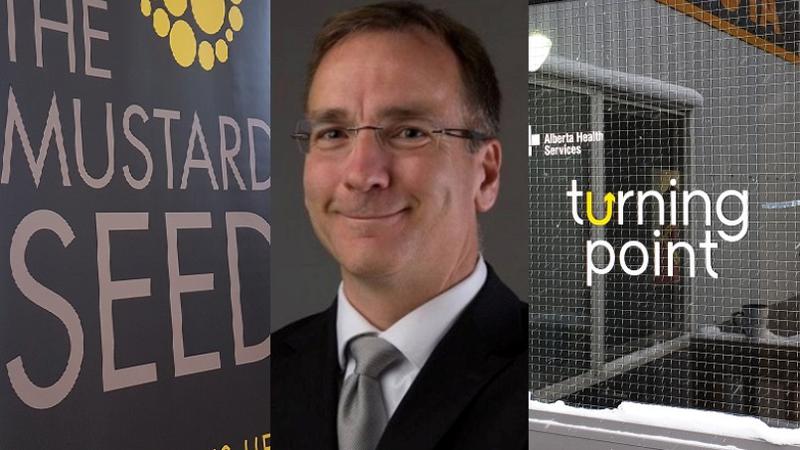
The MLA claims Red Deer didn’t ask for an overdose prevention site (OPS), which opened in Oct. 2018 and is operated by Turning Point Society.

Stephan says at packed OPS consultations he attended, the “vast majority” of participants voiced opposition. He says the then-governing NDP forced the OPS upon Red Deer, adding that its impacts to date are evident.

“The OPS has become an attraction for individuals who are not from Red Deer, to come to our city, to live in drug addictions. Because of this drug consumption site, there are more, not less, suffering under addictions in Red Deer,” he writes.

rdnewsNOW asked Stephan where he came up with the claim about outsiders, but no clarity was given.

Stacey Carmichael, executive director at Turning Point, calls Stephan’s claim false. In three years, she adds, there’s never been a death at the OPS.

According to the Alberta Substance Use Surveillance System, 92 per cent of all unintentional opioid deaths in Red Deer in Q1 of 2021 occurred in a person’s private residence.

“The OPS saw 238 unique clients 3302 times in November. Staff responded to 102 adverse events (overdoses) and called EMS one time,” she says. “Is the recovery community prepared to take on these numbers? This doesn’t include the hundreds or thousands of other people who use drugs who don’t use the OPS.”

“The OPS doesn’t give out drugs. The OPS does not enable drug use, it acknowledges it happens and tries to make it as safe as possible,” Carmichael adds.

Stephan continues: “A prioritization on ‘harm reduction’, such as the OPS, has caused great collateral ‘harm expansion’ to businesses and individuals in our community seeking to live their lives, working, and raising their families.”

“The merits of Harm Reduction have been proven over and over again. Harm reduction is an important part of a continuum of care and of our own community drug and alcohol strategy, we cannot just change that fact,” retorts Carmichael, who along with Safe Harbour have previously expressed empathy with area businesses.

“The OPS serves as more than a site that reverses potentially fatal overdoses, it acts as an entry to service for other recovery-oriented services including detox, treatment, opioid agonist therapy (OAT), mental health support and other health and social supports.”

Carmichael agrees the recovery community will be a fantastic resource, but also remembers the consultations differently.

The need for an OPS was determined through, “robust consultation, research and evaluation,” she says, noting that an OPS or full-fledged SCS need to be where people will utilize it — in other words, in the city’s core, as things stand.

“There was also a lot of support,” she recalls.

“Together we have an opportunity to support a fundamental course correction; focusing on healing and recovering, while providing opportunities for those who want to continue to use OPS services to transition to other communities,” says Stephan, who declined to provide further clarity on the meaning of ‘transition to other communities.’

READ MORE: City councillor suggests busing rule breakers to other communities, Safe Harbour scoffs

“If we can face struggles and challenges in our community, we can also find the answers and solutions. This is home for people,” says Byron Bradley, managing director for Central Alberta at The Mustard Seed.

“As a community, we need to come together and do our very best to provide care across the whole continuum, whether a person is choosing or not choosing substances. It’s very important to have options.”

Stephan names The Mustard Seed in his op-ed, saying it, nor other agencies like Turning Point and Safe Harbour Society – which runs the local homeless shelter – should be anywhere near residential areas.

Stephan acknowledges the agency’s merits, and suggests some of its services, namely those shelter-related, could be migrated to the site of a permanent shelter, presumably away from homes.

Bradley agrees that’s doable, saying they could keep community resource-type services at its current location. He has spoken with Stephan about this.

Otherwise, Bradley says, there’s no plan whatsoever, to entirely leave their current location in Riverside Meadows.

Tracy Chabot, a property owner in Railyards where the OPS and shelter are located, describes what’s been created in the area as a “dysfunctional community.”

“I don’t believe Red Deer has the capacity. Not with the way we’re handling it, because mitigation is not in place. The way they’ve done this band-aid solution downtown, I believe in what Stephan is saying in terms of this needing to be handled in a different way,” she says. “The north-end centre is the way to go and then try to transition those folks into a more normal life. What’s happening now is not normal and it hurts my heart to see it really.”

Chabot predicts city council will allow continued operation of the shelter in Railyards when it comes to public hearing next month.

She says a group of property owners is going to be seeking compensation of some kind from the municipality or province for repeated damages suffered.

A provincial review of supervised consumption services is no longer ongoing, a spokesperson for the Associate Minister of Mental Health and Addiction confirms.

“The province continues to take a balanced city by city approach to supervised consumption services in Alberta,” a statement reads. “The Turning Point Society overdose prevention site receives funding from Alberta’s government on a bi-annual basis. That funding remains unchanged and the service continues to be provided without interruption.”

Stephan says he stands by his op-ed.

READ MORE

Public Hearing set for temporary shelter, undisclosed location chosen for permanent

Two-year extension for Red Deer’s temporary shelter back on the table

Red Deer extends State of Local Emergency, homeless shelter to stay open

Turning Point marks third anniversary of overdose prevention site opening