Get the free daily rdnewsNOW newsletter by subscribing here!
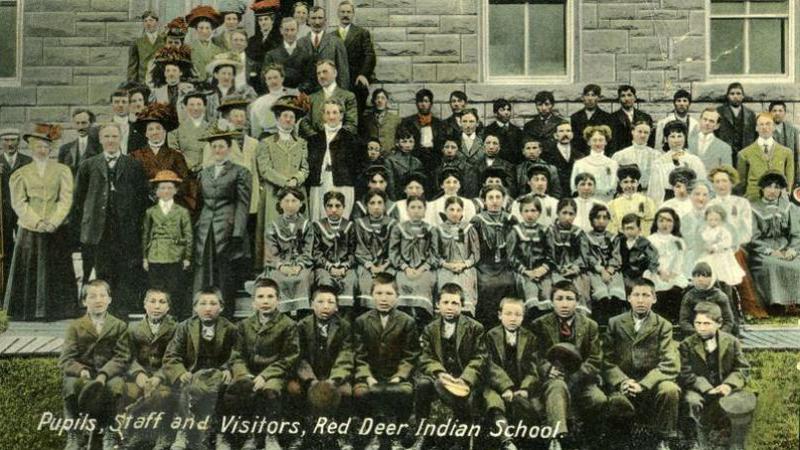
This postcard from 1911, shows the students, staff, and important visitors in front of the main building at the Red Deer Indian Industrial School, and was created as propaganda for the residential school. Ground-penetrating radar work at this site began in fall 2021. (Red Deer & District Archives DA971)
take a look back

Local coverage of CP Newsmaker of the Year: Children who didn’t return from residential schools

Dec 15, 2021 | 2:58 PM

On Wednesday, the Canadian Press announced its newsmaker of the year: the children who didn’t come home from residential schools.

The newsmaker of the year is selected by a survey of editors across the country.

This subject grabbed international headlines following the recovery of 215 bodies — believed to be children — at the site of the former Kamloops Indian Residential School in late May.

This year, rdnewsNOW covered this subject several times directly and indirectly. On many opportunities, we had the privilege of speaking with Indigenous leaders and community members, and others who felt it important to say something.

Reflecting on this story, and how it’s impacted our collective thoughts in 2021, we feel, is important.

Before you revisit our list of stories below, it’s important to share that their are supports available for those affected by the ongoing impacts of residential schools, and those triggered by media reports in 2021 and going forward.

A national Indian Residential School Crisis Line has been set up to provide support for former students and those affected. People can access emotional and crisis referral services by calling the 24-hour national crisis line: 1-866-925-4419

Below is a collection of our stories on this and related subjects:

May 6: Red Dress Day recognized in Red Deer

May 31: City of Red Deer lowers flags in remembrance of 215 children found in Kamloops

June 3: Red Deer Indigenous voices: Kamloops discovery only the first domino

June 18: National Indigenous Peoples Day takes on more meaning this year

June 21: Mayor Veer issues statement for National Indigenous Peoples Day

June 22: Rocky takes huge step towards reconciliation

June 25: July 1 a ‘day of hurt’ for local Indigenous leader

June 26: Shining Mountains Living & UAVS hosting BBQ and housing survey on Sunday

June 29: A Day to Listen: Radio stations dedicate programming in name of reconciliation

June 29: Red Deer-South MLA staffer who downplayed residential schools in email no longer with office

June 30: Student artwork represents Orange Shirt Day

July 28: Mural series livening up downtown Red Deer ahead of Meet the Street festival

Sept. 28: Central Alberta school divisions mark National Day for Truth and Reconciliation

Sept. 30: Sept. 30 a day for learning, acknowledging and restoration

Sept. 30: Local author launches poetry book, “The Little Bones”

Oct. 10: Indigenous murals unveiled at St. Gregory the Great School

Oct. 15: Red Deer International Powwow a chance to learn through cultural experience

Oct. 23: Powwow organizer recalls inspiration for love of dance

Oct. 25: Ground-penetrating radar work begins at former Red Deer industrial school site

Nov. 8: No matter how seemingly small, all war contributions important to remember

Nov 29: How a tipi in the middle of Red Deer is furthering truth and reconciliation

Dec. 9: Lacombe holds ceremony to recognize Treaty 6

This year, Pattison Media’s Amplify Canada podcast dedicated an episode to Indigenous ingenuity.

LISTEN HERE

Land acknowledgement: We respectfully acknowledge Treaty 6 territory – the traditional and ancestral land of the Cree, Dene, Blackfoot, Saulteaux and Nakota Sioux. We also acknowledge Treaty 7 territory – the traditional and ancestral land to the Blackfoot Confederacy, including the Kainai, Piikani and Siksika, as well as the Tsuu T’ina Nation and Stoney Nakoda First Nation. We acknowledge this territory is home to the Métis Settlements and Métis Nation of Alberta, and we acknowledge the many First Nations, Métis and Inuit who have lived in and cared for these lands for generations. We are grateful for the traditional Knowledge Keepers and Elders who remain with us today and those who’ve gone before us. We make this acknowledgement as an act of reconciliation and gratitude to those whose territory we reside and work on.

READ MORE: Canadian Press newsmakers of the year since 1946