Subscribe to the 100% free rdnewsNOW daily newsletter!
(file photo)
Harvest Going Strong

Nearly half of crops now in the bin, regionally

Sep 10, 2021 | 2:21 PM

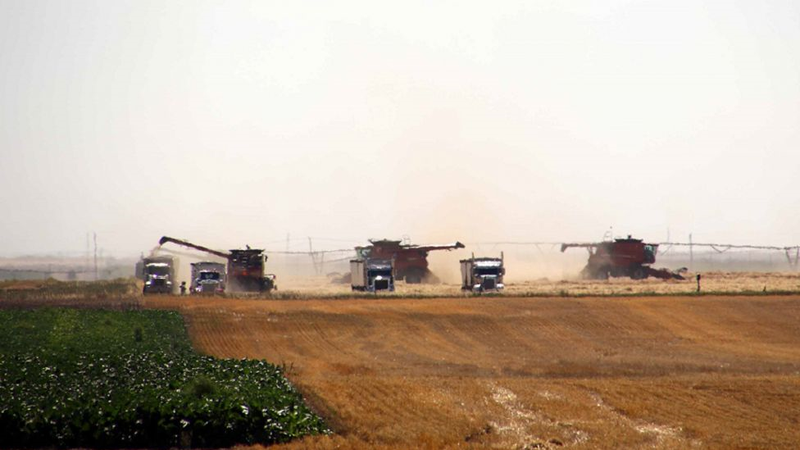
Over the past week, harvest was in full swing throughout the central Alberta region, despite some rain showers.

According to the latest Crop Report from Alberta Agriculture and Forestry in partnership with Agriculture Financial Services Corporation (AFSC), an additional 17 per cent of major crops have been combined.

Regionally, about 45 per cent of crops are now in the bin (compared to the 5-year average of 16 per cent), with another 22 per cent swathed and 33 per cent of crops still standing.

To date, the quality for the harvested spring and durum wheat, barley and canola are better than their 5-year averages, while oats and dry peas are below. Second cut haying on dryland is 80 per cent complete (compared to the 5-year average of 48 per cent), with yield estimated at 1.2 tons per acre and below the 5-year average of 1.5 tons per acre.

For irrigated haying, it is 35 per cent complete (compared to the 5-year average of 19 per cent), with yield estimated at 1.2 tons per acre, slightly above the 5-year average of 1.1 tons per acre. Quality for dryland hay (irrigated hay shown in brackets) is rated as 17 (20) per cent poor, 40 (60) per cent fair and 43 (20) per cent good.

Pasture conditions are rated as 32 per cent poor, 36 per cent fair, and 32 per cent good.

Since the beginning of August, officials say precipitation has shifted from a ‘drier than normal’ trend to an ‘above normal’ trend through most of the province, with some exceptions in the North East, North West and Peace Regions. Over this period, precipitation was extremely variable in different regions, but improved soil moisture reserves provincially, with the South Region improving the most.

Surface soil moisture is now rated at 32 per cent poor, 32 per cent fair, 35 per cent good and one per cent excellent. Hail was reported in some areas, impacting yields negatively. Due to favourable weather over the past week, harvest advanced 17 per cent for major crops from a week ago.

As of September 7, about 45 per cent of all crops have been combined, more than doubled from last year`s progress of 22 per cent, and was ahead of both the 5-year (2016-2020) and 10-year (2011-2020) averages of 21 per cent. Another 20 per cent of crops are currently in swath, while 35 per cent is still standing. Regionally, harvest has advanced for all regions.

Preliminary dryland yield indices remained similar to two weeks ago. The provincial estimated dryland yield index is estimated at 39 per cent below the 5-year averages and 37 per cent below the 10-year averages.

The best yields are in the North West Region (but still 24 per cent below the 5-year averages), while the South Region has the lowest (53 per cent below the 5-year averages). The average yields for potatoes on dryland and irrigated fields are estimated at 11 and 15 tons per acre, respectively. For sugar beets, the average yield is estimated at 28.9 tonnes per acre, while for dry beans it is 26.2 cwt per acre.

The quality for crops harvested so far varies across the province. Provincially, quality for malt barley, the top two grades of spring and durum wheat, oats and dry peas are below the 5-year averages, while feed barley and the top two grades of canola are above average. There are reports of some greens in canola, while some are being graded as sample, due to sprouts in pods.

Across the province, second cut dryland hay is 48 per cent complete (ahead of the 5-year average of 37 per cent), while it has been limited in the South and Peace Regions, given the dry conditions and extreme heat. The provincial average yield for second cut dryland hay is estimated at one ton per acre, below the 5-year average of 1.3 tons per acre. Quality is rated as 42 per cent poor to fair, 54 per cent good and 4 per cent excellent.

Second cut hay on irrigated fields is 85 per cent complete, with yield estimated at 1.7 tons per acre, and below the 5-year average of 1.9 tons per acre. Quality for baled irrigated hay is rated as 40 per cent poor to fair, 53 per cent good and 7 per cent excellent.

Pasture growth is minimal in most areas at this point, and heavily grazed pastures are still struggling to recover, even with the recent moisture. Pasture conditions (tame hay numbers shown in the brackets) across the province are now reported as 55 (50) per cent poor, 28 (31) per cent fair and 17 (19) per cent good.