Subscribe to the 100% free rdnewsNOW daily newsletter!
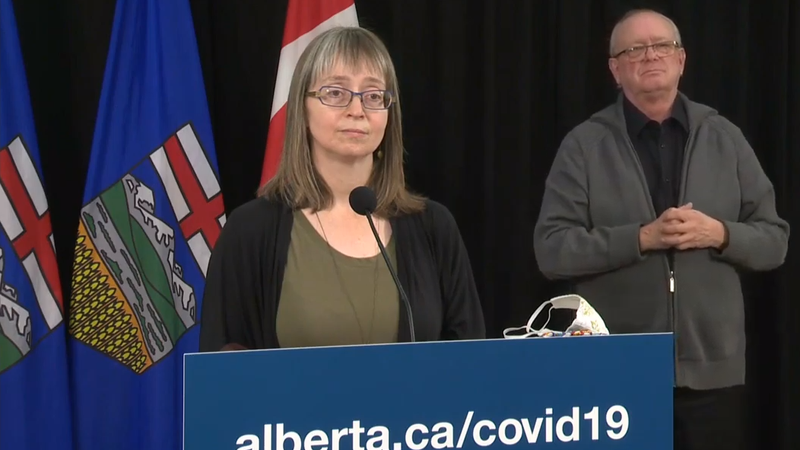
Dr. Deena Hinshaw, Alberta's chief medical officer of health, will be meeting with cabinet officials Monday to recommend additional COVID-19 measures for the province (Photo: CPAC livestream)
“This is like a snowball rolling down a hill"

Red Deer with 141 active COVID-19 cases as Alberta prepares for additional measures

Nov 23, 2020 | 2:19 PM

Alberta reported another 1,549 cases of COVID19 cases on Monday, just shy of the previous day’s record total of 1,584.

That’s out of 19,472 tests completed over the past 24 hours for a positivity rate of about eight per cent.

There are now 13,166 active cases of COVID-19 in the province, an increase of 971.

Alberta has had 34,779 recovered cases, up 573.

There are 328 Albertans in hospital because of the virus, an increase of nine, which includes 62 in intensive care, an increase of two.

Five new deaths were reported Monday to bring Alberta’s total to 476.

“It’s clear that we have reached a precarious point in Alberta. The virus is spreading faster and more widely than at any other point in the pandemic,” said Dr. Deena Hinshaw, Alberta’s chief medical officer of health. “The number of fatalities from this virus is growing and the number of hospitalizations and ICU admissions continues to rise.”

Red Deer now has 141 active cases of COVID-19, an increase of 15 over the past day. There has been 272 recovered cases, two more than Sunday, as the total number of cases attributed to the city rose by 17 to 413.

Red Deer County has 44 active cases as of Monday, an increase of seven, while Sylvan Lake is up from 18 to 24.

Lacombe County has 28 active cases, up two, and the city of Lacombe has 17, an increase of three.

Rocky Mountain House has added two more active cases for a total of 11.

Ponoka County saw yet another increase on Monday, going from 195 active cases to 212.

Mountain View County is up from 11 active cases to 13, Olds added one for a total of 11, and Kneehill County added one more for a total of 14.

Starland County and the County of Stettler each sit with three active cases.

The Central zone as a whole now has 812 active cases, an increase of 98 over the past day, and 18 hospitalizations (unchanged), including two in intensive care (increase of one).

Rocky Mountain House (Clearwater County) is now listed under ‘enhanced’ on the province’s status map, meaning additional measures are now in place to limit COVID-19 spread. Red Deer, Red Deer County, Sylvan Lake, Lacombe, Lacombe County, Ponoka County, Olds, Mountain View County and Kneehill County also remain on the ‘enhanced’ status list.

There are currently seven COVID-19 outbreaks in the Central zone, including five in the Red Deer area: Avenue Living Communities office in Red Deer, Drumheller Institution, Olymel in Red Deer, a private gathering in Ponoka, and at Pure Fitness in Red Deer.

Dr. Hinshaw gave her update earlier than usual on Monday before heading into a cabinet committee meeting to recommend additional COVID-19 measures for the province.

Hinshaw said she will be doing media availabilities every day this week to keep Albertans as up to date as possible on the province’s evolving COVID-19 situation.

“I need your help, and we all need to work together,” she urged.

“This is like a snowball rolling down a hill, growing bigger and faster and it will continue unless we implement strong measures to stop. We must take action. Waiting any longer will impact our ability to care for Albertans in the months and weeks ahead.”

Premier Jason Kenney has suggested more restrictions are coming but a “holistic” approach to the pandemic will continue.

In a Zoom call on Saturday with the Canada India Foundation, Kenney said new measures are likely coming but he continued to reject a sweeping shutdown of businesses and community activity as intrusive and ineffective.

“We will likely have to take some more restrictive measures, given the current direction of things here. Because ultimately our goal is to protect the health-care system from being overwhelmed while minimizing damage to the broader social, economic, mental, emotional and physical health of society,” said Kenney.

“(But) our point is we are not exclusively focused on COVID-19. We understand that for every policy in response to it, there are unintended consequences.

“So we’ve taken a holistic approach, and we believe that that has been effective.”

Kenney’s government shut down many retail businesses, restaurants, recreation centres and schools during the first wave of COVID-19 in the spring. Most were able to reopen in May and June with health restrictions. Schools reopened in the fall.

In recent weeks, Kenney’s United Conservative government and Alberta Health Services have taken targeted steps by limiting public gatherings in areas including Edmonton and Calgary and forcing bars and restaurants to stop serving booze by 10 p.m. and close by 11.

Alberta’s Opposition NDP said Monday it is calling for an emergency legislature debate about the crisis, and accused Kenney of failing to address the core health issues of COVID-19, such as instituting a province-wide mandate on wearing masks in public indoor spaces.

Many municipalities have such mask mandates in place, but the NDP says seniors are particularly vulnerable in areas that don’t have them.

Alberta is the only province in Canada without such a mandate.

“This is the greatest public health threat we have faced in our lives,” said NDP Leader Rachel Notley in a news release.

“When faced with great challenges, Albertans are always willing to roll up their sleeves and work together, but to do so they need leadership and a road map. So far, the premier has provided neither.”

There has been a slowly growing backlog of cases over the past several weeks who have not yet had a call from AHS to do a case investigation. Hinshaw made clear on Monday that notifications have continued to be made for all positive cases.

“In order to maximize the effectiveness of the team, I have asked AHS to start with the most recently diagnosed cases and work backwards, trying to reach as many cases as possible, but prioritizing the cases that will have the greatest benefit in reducing further transmission,” she said.

“As a temporary measure, effective tomorrow, if 10 days have passed since an Albertan received their positive COVID-19 test results, AHS will no longer call these individuals to conduct case investigation and contact tracing.”

(With file from The Canadian Press and CHAT News Today)
