Subscribe to the 100% free rdnewsNOW daily newsletter!
Red Deer RCMP Supt. Gerald Grobmeier says a ‘bad start’ to 2019 led to an overall rise in crime rates for the year.  (File photo, rdnewsNOW/Josh Hall)
"Really bad start we couldn’t recover from"

Red Deer crime rates rose noticeably in 2019

Nov 9, 2020 | 1:41 PM

Red Deer’s crime statistics for 2019 don’t tell the whole story, says the officer in charge for the city’s RCMP detachment.

The numbers released Oct. 29 by Statistics Canada show Red Deer’s Crime Severity Index (CSI) for last year was nearly 16 per cent higher than 2018, while the CSI for violent crimes surged by over 36 per cent.

The Crime Severity Index measures the volume and severity of police-reported crime in Canada, and has a base index value of 100 for 2006, Statistics Canada explains.

It is highlighted annually with the November release of Maclean’s Magazine’s ‘Canada’s Most Dangerous Places’ list, which Red Deer has been included in for the last several years.
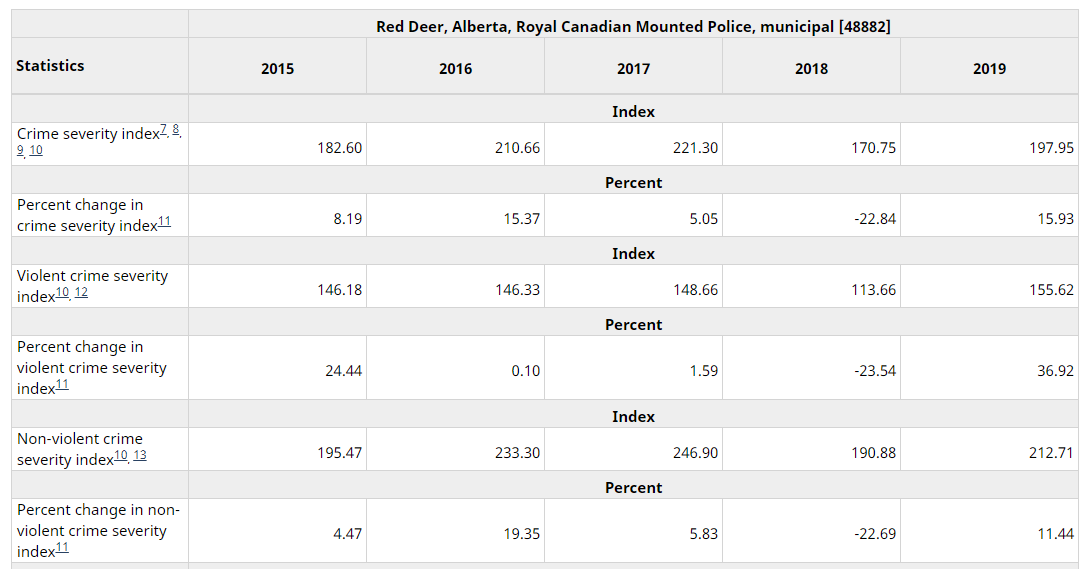
(Source: Statistics Canada – Table 35-10-0190-01 Crime severity index and weighted clearance rates, police services in Alberta)

Red Deer RCMP Superintendent Gerald Grobmeier says the large increases our city saw in 2019, before the COVID-19 pandemic, were caused by bloated first quarter crime rates which subsequently tailed off as the year went on.

“We had significant increases those first three months. Our stats – by the last half of the year – were at or even better than the rates of 2018,” Grobmeier says. “We had a really bad start we couldn’t recover from, but by end of year, for example, our break and enters were actually down four per cent, even though we had that first quarter increase.”

Break and enters were up 38 per cent from January to March, year over year, he shares.

Meantime, theft of motor vehicles were up 100 per cent, but settled at a 19 per cent increase by year’s end. Theft from motor vehicles was up 104 per cent to start 2019, but finished at an increase of 28 per cent.

Grobmeier says it’s difficult to pinpoint why these trends occurred, but suggests the exceptionally cold winter didn’t help matters.

Theft of motor vehicle, break and enter, and domestic assaults all tend to go up when that happens, he says.

“We always look to refine our policing methods. Since the increase, we’ve launched a dedicated property crimes unit,” Grobmeier points out. “The biggest contributor to our CSI is property crime, not so much persons (violent) crimes. We’ve also implemented other crime reduction strategies.”

In 2020, there have been no such increases.

Property crime overall is down 23 per cent, break and enters are down 16 per cent, theft of motor vehicles has slumped 37 per cent, theft over $5,000 has dipped 36 per cent, theft under $5,000 is 21 per cent less, fraud is 26 per cent down, and mischief to property is down 20 per cent.

“Some cities are seeing significant spikes in violent crime. We’re not seeing that here in Red Deer. Our persons crime are down two per cent, and total criminal code offences are down 19 per cent.”

Violent or persons crimes include incidents like shootings, aggravated assault and robberies, to name a few. Grobmeier says numbers for this year are even below 2016 levels.

He adds that because so many communities across Canada saw crime increase, Red Deer may drop a spot or two when Maclean’s unveils their next ‘Dangerous Places’ list despite the 2019 CSI going up. Our city ranked 10th overall on the list last year.

But as far as Red Deer deserving to be on that list, Grobmeier says the numbers don’t lie.

“Stranger-to-stranger crime is still very low in this city. Year over year or quarter over quarter, there can be some wild swings, but over five years, we’re seeing CSI in this city go down,” he says. “That is despite unemployment being at some of the highest levels it’s been in years, our court system is still overloaded, and the justice system hasn’t changed. Even with all those things, crime rates have been going down and continue to do so.”

Elsewhere locally, Sylvan Lake’s CSI rose by over 22 per cent last year to 124.28. Lacombe’s CSI rose to over 18 per cent to 79.94. Blackfalds saw its CSI rise more than 33 per cent to 91.11.