Get the free daily rdnewsNOW newsletter by subscribing here!
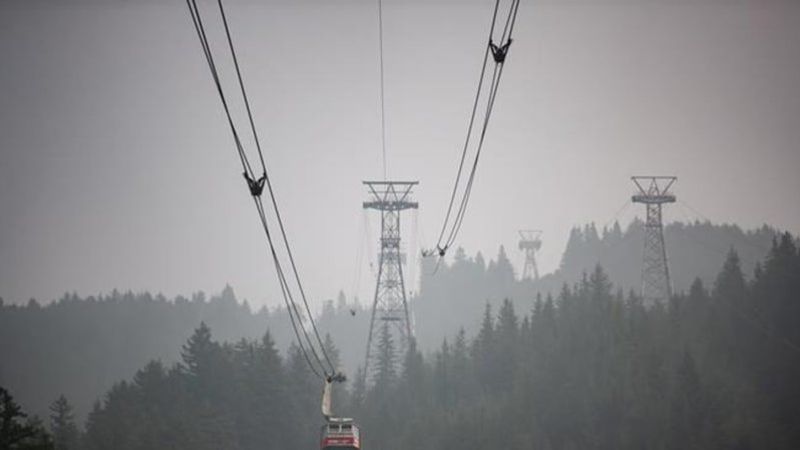
Wildfire smoke from the U.S. west coast has drifted into southern B.C. (pictured above) and into parts of Alberta, including the Red Deer region. (Canadian Press)
Smoke Gets In Your Eyes

Wildfire smoke expected to linger throughout central Alberta for next several days

Sep 17, 2020 | 1:58 PM

Wildfire smoke from the U.S. west coast is expected to continue lingering throughout central Alberta over the next few days.

Environment and Climate Change Canada Warning Preparedness Meteorologist Blaine Lowry says the smoky haze will still hang around through Friday and Saturday for sure.

“Potentially increasing in thickness, especially on Saturday,” says Lowry. “Then there’s the potential later in the day on Sunday when our winds switch to the northwest behind a low pressure system moving across the northern prairies that we may see a reprieve at that point in time.”

Lowry says the Air Quality Health Index (AQHI) hasn’t moved into the ‘moderate’ range as of yet, meaning health risks have remained low so far (staying in the 1-3 range).

“We saw the smoke move into the region through the late part of last weekend and it’s kind of been with us, especially through southern Alberta, more or less since then,” he explains. “So what people are going to want to be aware of is what that Air Quality Health Index is at.”

Red Deer’s AQHI forecast for Thursday afternoon is 3, rising to 4 by Thursday evening and 5 on Friday.

Lowry says if the AQHI starts to creep up into the moderate range of 4-6, then people who have pre-existing conditions or are susceptible to particulate matter in the air, may want to consider postponing or holding off on strenuous activities outdoors.

He notes that a Special Air Quality Statement would be issued if the index reached levels between 7-10+.

“Then, even people who are healthy may want to consider postponing those outdoor, strenuous activities,” adds Lowry.

Although the majority of wildfire smoke is coming from California, Oregon, and Washington State, Lowry says some of it is also coming from the Kootenay region of southeastern B.C.

“So generally as we get into next week, at the moment, it’s looking like our mid-atmosphere flow goes to more westerly, as opposed to southwesterly,” he points out. “The southwesterly is what we’re going to be experiencing through the next few days and will help to bring that smoke back into the region more prominently. So we may be dealing with the smoke on and off for the next week.”

However, Lowry suggests it’s been a largely quiet wildfire season in Alberta so far.

“The only real fire of note that we have had this year in Alberta was the one in Big Horn County – just north of Lake Minnewanka through the early part of this month,” he remarks. “Heavier than normal precipitation across southern B.C. and most of Alberta through the early part of summer really helped with the fire weather concerns through that part of the season and there has been an uptick in southern B.C. in the last few weeks, although nowhere near what we’ve seen in years like 2017 or 2018.”