Get the free daily rdnewsNOW newsletter by subscribing here!
Crop Conditions Update

Central region harvest progressing well following dry month of August

Sep 11, 2020 | 12:33 PM

Generally dry conditions throughout most of Alberta over the month of August has been especially helpful in the western and northern parts of the province where there was a need for less precipitation.

Since the end of August, officials with Agriculture Financial Services Corporation (AFSC) and Alberta Agriculture and Forestry say parts of Alberta have received moisture, with the southern half receiving 20 to 30 mm.

The second frost of the season happened on September 8, after a brief one on August 31, with many areas (particularly in the southern half of the province) experiencing freezing temperatures as low as -4°C. However, officials say it is still too early to determine if there was any crop damage as a result.

Precipitation over the past week has slowed down harvest progress in most areas across the province, particularly in the North East, North West and Peace Regions. As of September 8, about 18 per cent of major crops are now in the bin (up eight per cent from a week ago).

For all crops, 22 per cent have been combined, compared to 15 per cent in 2016, 32 per cent in 2017, 17 per cent in 2018, 16 per cent in 2019 and the 5-year (2015-2019) average of 22 per cent. Regionally, when compared to the 5-year averages, harvest progress is ahead in the Southern, Central and North West Regions and behind in the North East and Peace.

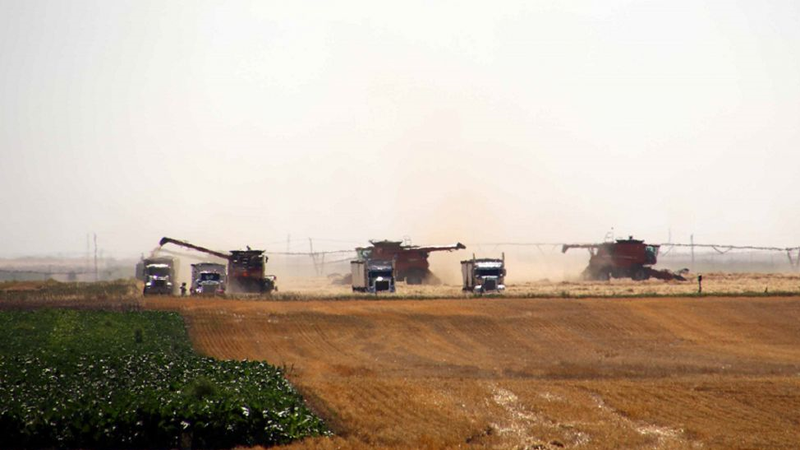
In the Central Region (Rimbey, Airdrie, Coronation, Oyen), harvest has been progressing with fall seeded crops, barley and dry peas, while swathing the other crops is also under way. Cutting, balling and silaging greenfeed crops is also progressing.

Rain showers halted harvest operations in most areas over the weekend, but harvest has progressed seven per cent over the past week.

Overall, about 17 per cent of major crops are combined, with 15 per cent swathed and 68 per cent still standing. About 90 per cent of fall seeded crops and more than three quarters of dry peas are now in the bin.

Quality for harvested crops so far in the region is above the provincial 5-year averages. About 52 per cent of harvested dry peas is graded as No. 1, 43 per cent as No. 2, four per cent as No. 3 and about one per cent as feed.

Second cut haying operation progress is at 39 and 15 per cent for dryland and irrigated fields, respectively. Average yield is estimated at 1.7 tons per acre for dryland and 1.3 tons per acre for irrigated (both above the 5-year averages).

Quality is rated as 80 per cent good to excellent for dryland hay and 90 per cent for irrigated hay.

Pastures need moisture to get restored from dry conditions over the month of August. Pasture growing conditions are reported as 13 per cent poor, 10 per cent fair, 69 per cent good and 8 per cent excellent.

Elsewhere, second cut dryland hay across the province is 39 per cent completed (on par with the 5-year average), while it has been limited in the Southern Region given dry conditions over the month of August. The provincial average yield for first cut dryland hay is estimated at 1.5 tons per acre, above the 5-year average of 1.1 tons per acre.

Also, the quality of the baled dryland hay is rated as 30 per cent poor to fair, 57 per cent good and 13 per cent excellent. Second cut haying in irrigated fields is 71 per cent complete, with yield estimated at 1.6 tons per acre (below the 5-year average of 1.9 tons per acre) and quality is rated as 17 per cent poor to fair, 66 per cent good and 17 per cent excellent.

Dryland yield estimates improved slightly from the previous estimates reported on August 25, with yields 16 per cent higher than the short-term averages and 14 per cent above the long-term averages.

Yields for the Southern, Central and North East Regions are 49 per cent, 19 per cent and nine per cent, respectively above the 5-year averages. For the North West and Peace Regions, yields are 14 per cent and five per cent below.

The provincial average yields for potatoes on dryland and irrigated fields are estimated at 10.9 and 16.1 tons per acre, respectively. Yields for irrigated dry beans are estimated at 28.4 hundredweight per acre and 28 tonnes per acre for sugar beets.