Subscribe to the 100% free rdnewsNOW daily newsletter!
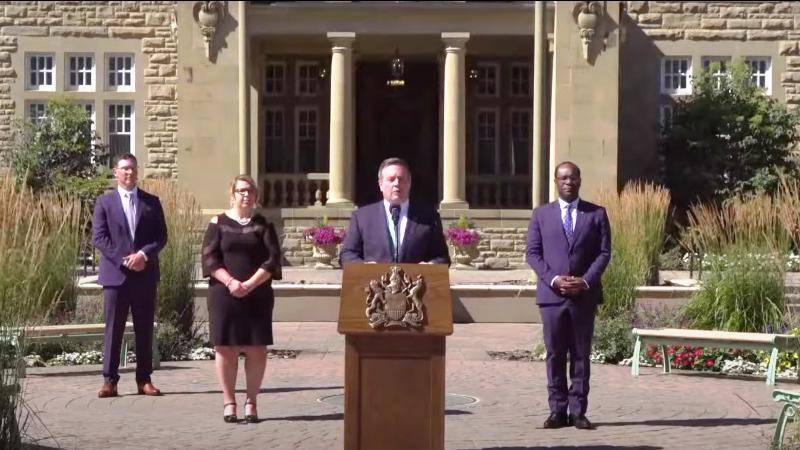
Premier Jason Kenney announced a cabinet shuffle from Edmonton on Aug. 25 and warned of an eventual 'fiscal reckoning' for Alberta in advance of the government's First Quarter Report announced on Aug. 27. (Government of Alberta)
Mounting Debt

COVID-19, oil price crash have devastating impact on Alberta’s finances

Aug 27, 2020 | 10:51 AM

COVID-19 and the recent collapse in oil prices are being blamed for what is described as a historic deficit in Alberta.

On Thursday, the government released its first quarter report for 2020-21, and it forecasts Alberta’s deficit at $24.2 billion.

The 2019-20 Annual Report and 2020-21 First Quarter Fiscal Update and Economic Statement show the toll both challenges have taken on the province.

Officials say the province now sits on a debt burden of $99.6 billion, or $22,400 per Albertan. All the while Albertans have experienced losses of more than 170,000 jobs and a 13 per cent unemployment rate.

The first-quarter projections show a significant increase to the deficit reaching $24.2 billion – $16.8 billion higher than estimated in Budget 2020.

Almost 70 per cent of this increase is said to be due to a sharp decline in revenue with non-renewable resource revenue down $3.9 billion. Total revenue is estimated to be $38.4 billion, down $11.5 billion, or 23 per cent from Budget 2020.

“These numbers are incredibly sobering to all of us. If left unchecked, they predict a grim reality for Albertans,” says Travis Toews, President of Treasury Board and Minister of Finance, in a press release. “We are facing the most significant economic challenge of our generation. To deal with this challenge, our government is developing a path forward – a path of economic recovery that will see job creation, diversification and stability restored to Alberta’s finances.”

Officials say total expense is forecast at $62.6 billion, adding that government responded to the COVID-19 pandemic with extensive public health supports and relief measures for Albertans, Alberta businesses and municipalities.

These one-time spending measures, along with investments in Alberta’s Recovery Plan to position the province for economic growth, were described as necessary to see the province through unprecedented times.

Officials point out that an updated economic forecast shows the pandemic has negatively affected business investment, oil production and consumer spending.

Although 2020 began with a strong investment market, the fallout of COVID-19 has sidelined that expected growth. Alberta’s economy is expected to contract by 8.8 per cent in 2020, the largest decline in modern-day history and a decrease of 11.3 percentage points from the budget forecast.

Alberta’s Recovery Plan is said to build on the initial actions taken to rebuild the economy before the pandemic hit. This included bringing in the Job Creation Tax Cut, eliminating the carbon tax and cutting red tape.

Alberta’s government is now expected to continue moving forward by investing in infrastructure projects that put Albertans back to work, supporting growth in key sectors and positioning the province for future economic prosperity.