Subscribe to the 100% free rdnewsNOW daily newsletter!
SPONSORED

MARKET WATCH: Jan. 31, 2020

Jan 31, 2020 | 12:20 PM

Big Picture

Coronavirus Fears Weigh on Markets

It was a rough start to the week for markets Monday as concerns began to mount over China’s ability to contain the growing coronavirus outbreak. Canada’s main stock index had its worst day in nearly four months, while the Dow and S&P had their biggest one-day percentage drops since early October. Travel-related stocks, including airlines, casinos and hotels, were among the hardest hit in the U.S. By the closing bell, the Dow had plunged 454 points, the Nasdaq surrendered 176, and the TSX was off by more than 120 points. Additionally, crude prices tumbled below $60 a barrel for the first time in nearly three months, while gold prices surged 1% to nearly a three-week high.

Global equity markets on Tuesday rebounded in a broad rally as the coronavirus panic subsided somewhat and investors turned their attention to earnings season. U.S. indexes then continued their recovery on Wednesday as strong earnings from Apple and McDonald’s helped boost market sentiment. The upbeat earnings also helped offset news that pending U.S. home sales had fallen nearly 5% from November to December, well below the 1% increase that analysts had been expecting. Meanwhile, Hong Kong-listed stocks dropped sharply on Wednesday–the first trading day after the Lunar New Year break–as investors assessed the spreading coronavirus and its potential impact on Hong Kong. As expected, the Federal Reserve on Wednesday held interest rates steady, citing a strong economy.

U.S. stocks were in the red much of Thursday but managed to register small gains after the World Health Organization said they weren’t recommending restrictions on international trade and travel in light of the viral outbreak. Finally, the U.S. economy looks to have entered 2020 on solid footing as Q4 GDP rose at an annual rate of 2.1%.

N.A. Markets Surrender Ground

For the four days covered in this report, the Dow lost 131 points to close at 28,859, the S&P 500 declined 11 points to settle at 3,284, while the tech-heavy Nasdaq dropped 16 points to close at 9,299. In Canada, the TSX surrendered 74 points to end at 17,491.

Strategy

Viral outbreaks tend to have a short-term effect on market sentiment though existing economic trends typically prevail

Financial market sentiment has been affected by the coronavirus outbreak with a spike in global equity market volatility.

Chipmakers, cruise lines, and casino operators were among the stocks hardest hit in the beginning of the week and safe haven assets are firmer. China’s markets will resume trading this coming Monday (February 3rd). Chinese monetary authorities on Tuesday pledged to provide abundant liquidity for money markets and urged investors to evaluate the impact of the coronavirus objectively.

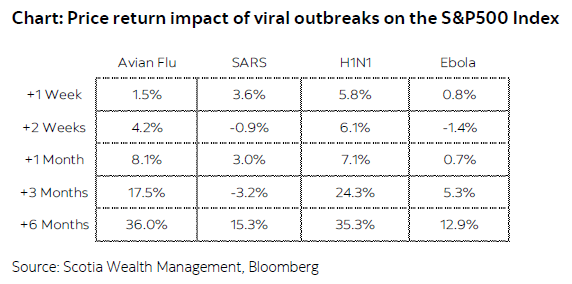
The chart below shows the price return of the S&P 500 Index in the months and weeks following the first case of different viral outbreaks.

The outlier of the group is the SARS outbreak wherein the outbreak was preceded by a sell-off of 43% in early 2002 owing to other economic factors. In the other three scenarios, market impact was generally short-lived before prevailing trends carried the index higher.

The first U.S. case of Ebola in 2014 brought about a decline of 8% before being fully retraced in the ensuing 12 trading days.

We continue to hold a generally favourable outlook for the global economy and would underscore that in periods of heightened volatility and uncertainty, a principled and disciplined investment philosophy will benefit investors in the long-run.

Disclaimer: This report is provided to you for informational purposes only and is not intended to provide personal investment advice. This report does not include or constitute an investment recommendation and does not take into account the particular investment objectives, financial conditions, or specific needs of individual clients. Any statements regarding future prospects may not be realized. Before acting on this material, you should consider whether it is suitable for your particular circumstances and talk to your investment advisor.