Get the free daily rdnewsNOW newsletter by subscribing here!
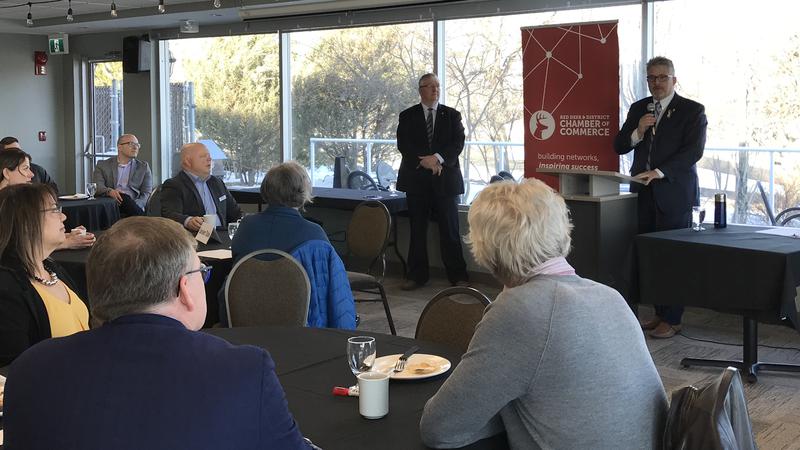
Conservative MP Earl Dreeshen (left) and Blaine Calkins (right) speak at a Red Deer & District Chamber of Commerce breakfast Thursday at the River Bend Golf & Recreation Area. (Alessia Proietti/rdnewsNOW)
"We are our own worst enemies in this country"

Conservative MPs Dreeshen and Calkins speak in Red Deer about nation’s divide

Apr 21, 2022 | 3:19 PM

Conservative Members of Parliament Earl Dreeshen and Blaine Calkins discussed current Canadian issues in Red Deer on Thursday and say one of the main causes is relentless division rather than discussion.

“We are our own worst enemies in this country because we fight with each other regionally and we fight with each other along different sectors,” said Calkins, MP for Red Deer-Lacombe.

At a Red Deer & District Chamber of Commerce breakfast held at the River Bend Golf & Recreation Area, a strong question period was delivered by a full room of participants, including Red Deer city councillors Bruce Buruma, Kraymer Barnstable, and Lawrence Lee.

The MPs stated that the current war in Ukraine has exposed and accelerated issues already in Canada, one of them being the energy crisis driving up gasoline prices alongside an additional federal carbon tax.


Calkins said the nation is stopping each other from being successful, federally and provincially. He referenced the 14 liquefied natural gas (LNG) pipeline project propositions from Western Canada connecting nationally and beyond, but only has one under construction: the Coastal GasLink.

“It seems as though it is always a fight: west against east, one resource type versus another resource type,” said Dreeshen, MP for Red Deer- Mountain View.

Some of the reasons against the projects have been for environmental concerns, but Calkins says the lack of foresight by governments has not led to ecological benefits. He mentions European countries that now, due to the ban on Russian oil, must burn coal for energy.

Dreeshen, the new vice-chair of the Standing Committee on Environment and Sustainable Development, also says Canada should not be trying to create a “utopian” picture by cutting out natural resources in replacement of others. He used the example from Dow Canada’s presentation at the last Chamber event, who spoke about the necessity of plastics for the creation of renewable wind energy turbines.

READ: Dow Canada gives update on Prentiss plant and engagement in Red Deer

“If you’re going to talk about these new innovations, make sure you’re talking about them from the first molecule until the end,” he said.

Calkins also expressed his views on the importance of a free market. Regarding energy, he says all resources available should be discussed, such as natural gas, hydrocarbon, wind, solar, and more, to create a diversified and self-sufficient Canadian market.

Impacted by the economy, Calkins touched upon national defense.

He says it was another divide that caused the “cupboards to be bare” in national security equipment. In 1997, the Liberals under Prime Minister Jean Chretien began their involvement with the F-35 fighter jet program to replace their increasingly insufficient aircrafts. Continued under Conservative Prime Minister Stephen Harper, the program came under scrutiny for inaccurate costs and mechanical issues. It was cancelled by Prime Minister Justin Trudeau to instead hold an open competition for a potentially less expensive alternative. However, in early April 2022, Trudeau announced it was moving forward with a deal on the jets.

Calkins claims the federal government cannot adequately support Ukraine, only able to provide them with 50-year-old equipment. With an increasing deficit and inflation, he said the budget should focus on balancing, with a fund allocation towards “restocking the shelves” with proper equipment for soldiers.

“We share a border with Russia as well, so that’s something that we should keep in mind,” he said.

Finally, the MPs both argued vaccination mandates as a form of division that haven’t proven fruitful.

“The government keeps saying ‘we’re keeping Canadians safe’. The truth is, we haven’t kept anything out; all we’re keeping out is economic prosperity,” said Calkins.

To date, 17.8 per cent of the population is unvaccinated, meaning approximately 6.5 million people still cannot fly domestically due to mandates. Calkins said while everyone’s views should be respected, mandates solely become a mental health issue.

While the Conservatives brought two motions two remove the mandates, he claims the federal governments pushing of incomplete and divisive narratives, like that of the trucking convoy, have kept the mandates alive.

Other topics discussed at the meeting were federal bureaucracy, affordable housing, and Canadian relations with Russia and China.