Get the free daily rdnewsNOW newsletter by subscribing here!
(rdnewsNOW file photo)
2026 Budget

Red Deer city council begins budget process

Dec 8, 2025 | 8:08 PM

Day one of the budget discussion at Red Deer City Hall began with presentations from City Manager Tara Lodewyk, CFO Jean-Guy Wiart, and Executive Director of Corporate Performance and supports, Tricia Hercina.

This was intended to provide Red Deer city council and the public with information and an overview of the process for the 2026 budget debate throughout the week as well as the financial state of the city.

Lodewyk explained there are four key points this year that the public and council should take away from the budget.

The first is that the city’s financial situation has improved, and the results are seen in strengthened reserves.

Secondly, the proposed budget is grounded in the May 2025 council direction and objectives set for the city manager.

Thirdly, the proposed budget advances the July 2025 road map to financial sustainability, and lastly, municipalities are struggling across Alberta to provide services with adjustments to funding from other levels of government and inflation.

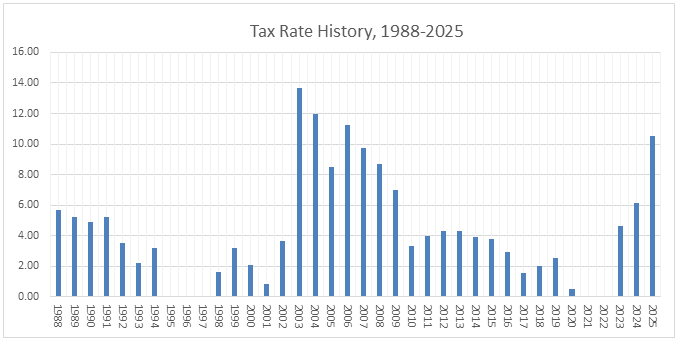
She also talked about the context of the landscape heading into the budget. As part of the presentation, she showed what property tax increases have looked like for the city dating back to 1988.

“There are a few trends where years where we have zero per cent or very low tax increases are always followed by high tax increases for several years,” she said. “We are seeing in this that history does repeat itself… I think there’s one thing we can agree on is that the rollercoaster is not fun, and these high ups and downs make it very hard to do planning, to be predictable, and they’re very hard on our community.”

(City of Red Deer)

Lodewyk said in 2026, the city is still recovering from three years from 2020 to 2023 of one per cent and zero per cent tax increases.

As a result, she said they’re looking at strategies such as multi-year budgeting to help build stability. She said next time they do the budget, she hopes they’re doing at least a two-year budget, adding that some communities, such as Edmonton and Lethbridge that do four-year budgets.

In comparison to Red Deer, Calgary landed on a 1.6 per cent tax increase, Edmonton at 6.9 per cent and Medicine Hat at 5.6 per cent.

“Based on what we’ve proposed and where I think we’ll land, we’re still at that comparable range to our other colleague municipalities,” she added.

According to Alberta Municipalities, property taxes are increasing in Alberta for five main reasons, including inflation, which makes things more expensive for municipalities. Another reason is that Albertans pay an additional amount in their property tax bill that municipalities collect for the province for education. Provincial funding has also been cut in half over the last 15 years. In addition, new laws and decisions are making property taxes go up. Finally, people are asking councils to spend money on services that are typically handled by the Alberta government.

The city manager said when it comes to federal grants, one of the biggest ones they receive comes from the Canadian Community Building Fund. This replaced the gas tax in 2021 and provides approximately $6 million in capital funding each year. It typically funds tax-supported capital projects. She explained the city usually has to upfront the cost because they have to submit an application for reimbursement once the projects are done.

Meantime, when it comes to provincial grants, she said the local government fiscal framework grant is the largest they receive. It’s now based on a formula and fluctuates based on how the province is doing. In 2017, the city received $40 million, and in 2025, it received $15 million. This year, Red Deer expect to receive the same amount as last year.

Lodewyk also talked about construction growth. In 2025, there was an increase of $1.5 million in construction growth compared to a decrease seen in 2024. The construction of the Red Justice Centre caused a massive spike of $2.5 million in 2022-23. They do expect another spike with the Red Deer hospital expansion.

In closing, Lodewyk said this week their intent is not to debate with council.

“We have proposed a budget for 2026, and we want to hear what your changes are… I hope you’ll have respectful dialogue with your colleagues and you land on a decision I know is best for our community,” she added.

Current state of the city financial update

CFO Jean-Guy Wiart said knowing the financial state of the city sets the stage for budget 2026.

He explained that reserve levels are projected to improve in 2025 but remain below optimal levels.

According to the city’s statement of financial position, he explained that the city’s financial assets as of Sept. 30, 2025, are at $337 million, the liabilities are at $491 million, and the net debt is at $153 million.

The tax-supported operating reserve, he said, is meant as an emergency one-time option. In December 2024, the reserve was in a deficit position of $5.4 million and by Dec. 31, 2025, Wiart anticipates the reserve will have a projected balance of $19.6 million.

The next reserve is the capital project reserve, which has a projected balance of $20 million by the end of December this year, compared to the $18.5 million at the end of 2024. When it comes to the budget 2026, CPR funding is being requested for capital projects for $19.5 million.

Total city reserves have been steadily depleting over the last five years, he reported.

After reserves, the CFO touched on long-term debt when it comes to tax-supported and self-supported. The projected total balance by the end of December 2025 will be $343.9 million compared to the $286.3 million in 2024. The unused debt room is also projected to be by the end of the year is $316 million. He said that Red Deer maintains well below the debt limit.

The key fiscal challenges the city is facing are that the structural deficit limits flexibility because of reserves.

They will also face inflationary pressures and contractual obligations, as well as changes in provincial and federal grants. The inflationary pressures, including collective bargaining in 2026 and the contract with the RCMP.

Since 2020, there’s been a sharp decrease every year in the city’s operating reserve from $40,000 to below $0 in 2024. However, in 2025, they project to be above $0.

The main strategic takeaways Wiart said is that the operational financial management in 2025 is stronger. The city is also forecasting to make contributions to reserves in 2025 but the reserves are still well under desired targets. He said the focus must remain on longterm planning.

2026 budget approach and process

Tricia Hercina, executive director of corporate performance and supports, said over 76 per cent of the proposed capital budget is for infrastructure preservation. In addition, 12 per cent is for current growth, and the other 12 per cent is for infrastructure enhancements.

Some of the proposed highlights for the capital budget include $6.9 million for stormwater infrastructure annual requirements and $7.2 million for paved roadway network requirements, among other items.

Meanwhile, 68 per cent of the proposed operating budget is for sustaining services, followed by 27 per cent for strategic investments, three per cent to accommodate growth, and two per cent for alignment of service levels

Some of the highlights for the proposed operating budget include an increase to $2.5 million for the RCMP contract, $6.2 million for personnel provision, and restoring 2024 service levels for spray parks, mowing, and outdoor rinks.

With changes to the budget, Hercina unveiled a new starting point when it comes to the budget, which includes a property tax increase of 6.89 per cent. This was brought down 0.47 per cent because of an $800,000 construction growth estimate.

To watch budget deliberations click here and to view the full draft budget, click here.